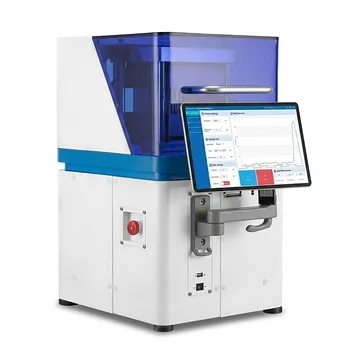
The laboratory hydraulic press is the critical instrument used to transform raw polymer composites into standardized, high-integrity test specimens. By applying simultaneous high heat and precise uniaxial pressure, the press converts composite granules or layers into dense, uniform plates. This process is fundamental to eliminating internal defects and ensuring that subsequent mechanical, thermal, and electrical tests reflect the material’s true properties rather than manufacturing flaws.
A laboratory hydraulic press provides the controlled thermal and mechanical environment necessary to produce defect-free polymer specimens. Its primary role is to ensure structural homogeneity and dimensional stability, which are the prerequisites for any reliable material characterization.
Ensuring Structural Integrity and Homogeneity
The Elimination of Internal Voids and Porosity
The application of high pressure, often reaching up to 300 kN, is essential for forcing air and volatiles out of the polymer matrix. By eliminating internal voids and air bubbles, the press ensures the specimen achieves its maximum theoretical density. This removal of porosity is vital for researchers studying viscoplasticity, as it prevents pore-related weaknesses from skewing mechanical response data.
Achieving Uniform Density Gradients
A precision hydraulic press ensures that pressure is distributed evenly across the entire surface of the mold. This uniformity prevents density gradients, where some parts of a specimen are more compressed than others. Consistent internal structures are necessary to ensure that test results, such as tensile or flexural strength, are repeatable and accurate across different samples.
Standardizing Dimensional Stability
Standardized test plates require exact geometric dimensions to meet international testing protocols. The hydraulic press uses stainless steel molds and constant pressure to ensure that every specimen has a uniform thickness and smooth surface finish. This dimensional precision is critical for applications requiring high optical transparency or specific mechanical tolerances.
Facilitating Material Transformation and Integration
Promoting Viscous Flow and Filler Infiltration
During the hot-pressing process, temperatures—often exceeding 220°C—bring the polymer matrix to a viscous flow state. This allows the polymer to fully encapsulate and infiltrate primary and secondary fillers, such as inorganic powders or fibers. Proper infiltration is necessary to enhance the ionic conductivity and mechanical flexibility of advanced materials like composite electrolytes.
Managing Molecular Cross-Linking
For thermosetting polymers like EVA or PVB, the press provides the heat and pressure required to trigger molecular cross-linking. This chemical transformation is what gives the polymer its final strength and thermal stability. Precise control over the press environment ensures that the cross-linking is uniform throughout the entire thickness of the interlayer.
Eliminating Internal Residual Stresses
The molding process is not just about heating and pressing; it also involves a controlled cooling phase. By accurately managing the preheating, pressure holding, and cooling cycles, the hydraulic press minimizes the internal stresses that naturally occur during polymer solidification. This prevents the specimens from warping or cracking, ensuring they accurately reflect the material's true thermal deformation characteristics.
Understanding the Trade-offs and Limitations
Thermal Gradients and Edge Effects
While a heated press provides a controlled environment, larger molds can suffer from thermal gradients where the center is hotter than the edges. This can lead to uneven curing or varying crystallinity levels across a single test plate. Users must ensure their press has high-quality heating elements and sufficient insulation to maintain a truly isothermal environment.
Pressure Overshoot and Material Flash
Applying excessive pressure or failing to control the ramp-up speed can cause "flash," where the molten polymer is squeezed out of the mold cavity. This not only wastes material but can also lead to thinning of the specimen below the required specifications. Precise, automated pressure control is required to balance the need for density with the preservation of the mold’s geometry.
Cooling Rate Sensitivities
The rate at which a specimen is cooled under pressure significantly impacts the morphology of semi-crystalline polymers. Rapid cooling might "freeze" a disordered state, while slow cooling allows for higher crystallinity. Research professionals must standardize their cooling protocols to ensure that the physical samples are representative of the intended manufacturing process.
How to Optimize the Pressing Process for Your Goal
Making the Right Choice for Your Goal
To achieve the best results with a laboratory hydraulic press, you must align the machine's capabilities with your specific material requirements.
- If your primary focus is mechanical characterization: Prioritize high-pressure maintenance and precise cooling cycles to eliminate internal stresses and voids that could lead to premature failure.
- If your primary focus is filler integration (e.g., electrolytes): Focus on the heating precision and the "viscous flow" window to ensure the polymer matrix fully encapsulates inorganic additives.
- If your primary focus is optical or interlayer consistency: Ensure the press offers high thickness uniformity and fine-tuned pressure control to remove all traces of internal air bubbles.
The laboratory hydraulic press remains the definitive tool for bridging the gap between raw composite materials and high-quality, data-ready test specimens.
Summary Table:
| Key Function | Core Benefit to Specimen | Target Parameter |
|---|---|---|
| Void Elimination | Removes internal air/volatiles to reach max density | High Uniaxial Pressure (up to 300kN) |
| Homogeneity | Prevents density gradients for repeatable results | Even Pressure Distribution |
| Material Integration | Promotes viscous flow for filler encapsulation | Precise Temperature Control (> 220°C) |
| Stress Management | Prevents warping and cracking via controlled cycles | Optimized Cooling Phase |
| Dimensional Stability | Ensures uniform thickness and smooth surfaces | High-Quality Stainless Steel Molds |
Elevate Your Material Research with KINTEK Solutions
To bridge the gap between raw composites and reliable data, your laboratory needs a press that offers uncompromising precision. KINTEK specializes in comprehensive laboratory pressing solutions designed for the most demanding research environments. Whether you are conducting fundamental battery research, developing advanced electrolytes, or testing mechanical tolerances, we have the right tool for your application:
- Manual & Automatic Models: For varied production scales and repeatable cycles.
- Heated & Multifunctional Presses: Perfect for managing viscous flow and cross-linking.
- Glovebox-Compatible Solutions: Ideal for sensitive material handling in inert environments.
- Cold & Warm Isostatic Presses: Ensuring multidirectional density for complex parts.
Ready to achieve superior structural homogeneity and defect-free specimens? Contact our technical team today to discuss your specific pressing needs and find your ideal lab solution!
References
- Mihai Georgescu, Dana Gurău. Thermally resistant polymer composites reinforced with fibreglass. DOI: 10.24264/lfj.17.4.7
This article is also based on technical information from Kintek Solution Knowledge Base .
Related Products
- Laboratory Hydraulic Press Lab Pellet Press Button Battery Press
- Laboratory Hydraulic Press 2T Lab Pellet Press for KBR FTIR
- Laboratory Hydraulic Press Lab Pellet Press Machine for Glove Box
- 24T 30T 60T Heated Hydraulic Lab Press Machine with Hot Plates for Laboratory
- Automatic Laboratory Hydraulic Press Lab Pellet Press Machine
People Also Ask
- How is a laboratory hydraulic press used for HAP composite gels? Master Mineral Substrate Standardization
- What role does a laboratory hydraulic press play in reaction pellets? Optimizing Lunar Soil and Metal Fuel Density
- What role does a laboratory hydraulic press play in the preparation of piezoelectric ceramic discs for DC-PG? | KINTEK
- Why is a laboratory hydraulic press required for PBAT and PLA sample preparation? Achieve Flawless Characterization
- What role does a laboratory hydraulic press play in the assembly of all-solid-state battery test cells? Expert Guide