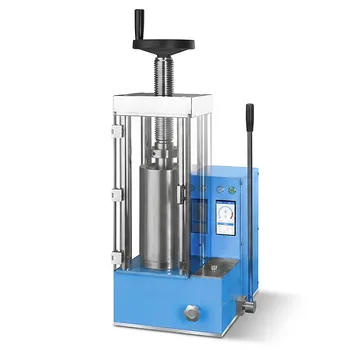
A laboratory press is the essential tool for transforming loose Li3/8Sr7/16Ta3/4Hf1/4O3 (LSTH) powder into a high-density geometric green body. By applying precise mechanical force, it expels trapped air and maximizes inter-particle contact area, which is a vital prerequisite for material migration. This structural foundation is what ultimately allows the ceramic to reach a remarkable 98 percent relative density during the subsequent sintering process.
The laboratory press serves as the bridge between raw chemical powder and a functional ceramic, using controlled pressure to establish the initial density and particle arrangement required for successful high-temperature densification.
The Mechanics of Powder Compaction
Eliminating Internal Voids and Air
Loose LSTH powder contains significant volumes of air between individual particles that would prevent densification if left unaddressed. The laboratory press applies vertical or uniaxial pressure to force these particles together, physically expelling air and reducing the porosity of the material.
This compaction creates a tightly arranged internal structure where the distance between atoms is minimized. This close proximity is essential because it sets the stage for the atomic diffusion that occurs later in the furnace.
Establishing Physical Interlocking
Beyond mere proximity, the press creates physical interlocking between the LSTH particles and the added binders. This interlocking provides the "green body" with its mechanical strength (green strength), allowing it to be handled and moved without crumbling.
The use of specialized molds during this process ensures the material takes a regular geometric shape, such as a disc or pellet. This uniformity is critical for consistent heat distribution and predictable shrinkage during the final stages of production.
The Foundation for High-Temperature Sintering
Facilitating Material Migration
High-density green bodies are necessary because they maximize the contact area between LSTH particles. In the sintering furnace, material must migrate across these contact points to fuse the particles together into a solid ceramic.
By starting with a high-density state, the laboratory press ensures there are more pathways for this material migration to occur. This leads to a more uniform microstructure and helps the final product achieve its target 98 percent relative density.
Reducing Sintering Stress and Temperature
A well-pressed green body can often be sintered at lower temperatures because the particles are already in such close contact. This efficiency helps prevent common manufacturing defects such as excessive shrinkage or macroscopic cracking.
Precise pressure control during the pressing stage also helps eliminate internal density gradients. This ensures that the ceramic shrinks at a uniform rate, preventing the warping that often ruins functional material samples.
Understanding the Trade-offs and Limitations
Pressure Gradients and "Die Friction"
One of the primary challenges in uniaxial pressing is friction between the powder and the walls of the mold. This can lead to uneven pressure distribution, where the center of the pellet is less dense than the edges.
If these density gradients are too severe, the green body may crack during or after decompression. Researchers often mitigate this by using lubricants or employing isostatic pressing as a secondary step to apply pressure equally from all directions.
The Risk of Over-Compaction
Applying excessive pressure can lead to a phenomenon known as capping or delamination, where the green body splits into horizontal layers upon release from the mold. This occurs when the stored elastic energy in the particles exceeds the strength of the binder.
Finding the optimal pressure—often involving a specific holding time (such as 90 seconds)—is a balancing act. It must be high enough to achieve density but low enough to avoid structural failure.
How to Apply This to Your Process
Making the Right Choice for Your Goal
- If your primary focus is maximum final density: Use the laboratory press to achieve the highest possible green density, as this directly correlates to reaching a 98% relative density after sintering.
- If your primary focus is structural integrity: Ensure the use of appropriate binders and a controlled pressure release to prevent cracking or delamination of the LSTH green body.
- If your primary focus is uniform microstructure: Consider a two-stage approach, using a uniaxial lab press for initial shaping followed by a cold isostatic press to eliminate internal density gradients.
By mastering the precise application of pressure, you ensure that the LSTH ceramic possesses the structural and physical properties required for advanced technical applications.
Summary Table:
| Process Stage | Function of Laboratory Press | Impact on LSTH Ceramic |
|---|---|---|
| Compaction | Expels trapped air & reduces porosity | Creates a tightly arranged internal structure |
| Interlocking | Facilitates physical particle-binder bonds | Enhances green strength for handling and shaping |
| Material Migration | Maximizes inter-particle contact area | Enables atomic diffusion to reach 98% relative density |
| Uniformity | Applies controlled uniaxial or isostatic pressure | Prevents warping, cracking, and density gradients |
Elevate Your Advanced Material Research with KINTEK
Precision is the difference between a failed sample and a 98% dense LSTH ceramic. KINTEK specializes in comprehensive laboratory pressing solutions designed for the rigorous demands of battery research and material science.
Whether you require manual, automatic, or heated presses, or need glovebox-compatible and multifunctional models, our equipment ensures optimal density and structural integrity. For those seeking to eliminate internal gradients, we also offer high-performance cold and warm isostatic presses.
Ready to optimize your ceramic green body preparation? Contact KINTEK today for expert guidance and tailored solutions!
References
- Danyi Sun, Kuan-Chun Huang. Understanding ionic transport in perovskite lithium-ion conductor Li<sub>3/8</sub>Sr<sub>7/16</sub>Ta<sub>3/4</sub>Hf<sub>1/4</sub>O<sub>3</sub>: a neutron diffraction and molecular dynamics simulation study. DOI: 10.1039/d5ta01157d
This article is also based on technical information from Kintek Solution Knowledge Base .
Related Products
- Lab Round Bidirectional Press Mold
- Special Shape Lab Press Mold for Laboratory Applications
- Lab Infrared Press Mold for Laboratory Applications
- 24T 30T 60T Heated Hydraulic Lab Press Machine with Hot Plates for Laboratory
- Automatic Heated Hydraulic Press Machine with Hot Plates for Laboratory
People Also Ask
- What is the purpose of incorporating cartridge heaters into a lab press mold for MLCC block compression? Optimize Results
- What is the function of a pressing tool in thermoplastic panels? Master Precision Shaping & Fusion Bonding
- Why is precise cooling management of the lab press mold necessary? Protect Core Integrity in Thermoforming
- Why is a high-performance laboratory molding press critical for in-situ electrolyte formation? Unlock Battery Success
- How do the design and geometric precision of pressing molds and mandrels affect the quality of PTFE composite samples?