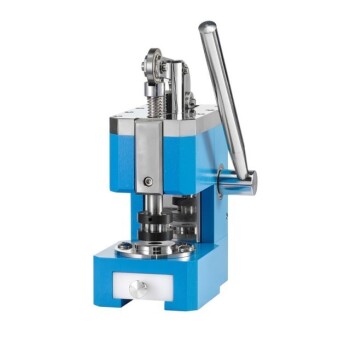
A precision manual sample tamper serves as the primary instrument for density control during the delicate process of loading coral sand. Used in conjunction with layered loading techniques, this tool allows technicians to gently compress sand within a rubber membrane to a specific height and density. Its crucial function is to apply uniform pressure without exerting the excessive mechanical force that would typically damage this fragile material.
The tamper acts as a safeguard during preparation, allowing you to achieve a precise target density while preventing the premature crushing of particles that would invalidate test results.
The Mechanics of Sample Preparation
Integration with Layered Loading
The manual tamper is not used in isolation; it is integral to the layered loading technique.
Technicians place the coral sand into a rubber membrane in distinct layers. The tamper is then used to compact each individual layer before the next is added.
Achieving Uniform Compaction
The goal of the tamper is to create a sample that is consistent from bottom to top.
By manually applying pressure, the operator ensures uniform compaction throughout the sample. This prevents weak spots or density gradients that could skew the structural analysis of the sand.
Why Precision Matters for Coral Sand
Meeting Target Parameters
Experimental accuracy relies on hitting exact physical metrics before testing begins.
The tamper is used to guide the sample to reach a preset relative density and height. These parameters are calculated beforehand to simulate specific environmental conditions.
Preventing Premature Crushing
Coral sand is structurally different from standard silica sand; it is highly susceptible to breakage.
The "manual" aspect of the tamper is critical here. It allows for a gentle application of force, avoiding the high-impact mechanical shock that would pulverize the coral particles.
Ensuring Data Integrity
If the particles are crushed during the loading phase, the sample no longer represents the natural material.
By preserving the particle structure, the tamper ensures that the final test results reflect the material's natural mechanical properties, rather than artifacts of a destructive preparation process.
Risks of Improper Compaction
The Danger of Mechanical Impact
Using standard mechanical compaction tools on coral sand is often a critical error.
Mechanical impact delivers force that exceeds the crush strength of coral particles. This leads to premature crushing, effectively changing the grain size distribution of the sample before the test even starts.
Inconsistency in Density
Without the precision of a manual tamper, achieving specific relative density becomes guesswork.
If the sample does not meet the preset height and density requirements, the resulting data cannot be reliably compared to other studies or field conditions.
Making the Right Choice for Your Goal
To ensure your coral sand testing yields valid engineering data, consider the following regarding your sample preparation workflow:
- If your primary focus is material integrity: Prioritize manual tamping over automated methods to eliminate the risk of altering the sand's grain structure through crushing.
- If your primary focus is experimental repeatability: Adhere strictly to preset height and density benchmarks for every layer to ensure consistent relative density across all samples.
Using a precision manual tamper is the only reliable method to balance the requirement for density control with the need to protect the fragile structure of coral sand.
Summary Table:
| Feature | Manual Tamper Benefit | Impact on Sample |
|---|---|---|
| Compaction Method | Layered, gentle manual pressure | Prevents premature particle crushing |
| Density Control | Precise height & density adjustment | Ensures target relative density is met |
| Force Application | Non-impact, controlled force | Maintains natural grain size distribution |
| Data Accuracy | Eliminates preparation artifacts | Guarantees results reflect true material properties |
Achieve Unmatched Precision in Material Research
Preserve the integrity of your most fragile samples with specialized laboratory solutions from KINTEK. Whether you are conducting battery research or geotechnical analysis, our expertise in high-precision preparation ensures your data remains valid and repeatable.
KINTEK specializes in comprehensive laboratory pressing solutions, offering:
- Manual & Automatic Pressing Models
- Heated and Multifunctional Systems
- Glovebox-Compatible Designs
- Cold and Warm Isostatic Presses (CIP/WIP)
Don't let preparation errors compromise your experimental outcomes. Contact KINTEK today to discover the ideal pressing solution for your laboratory's unique requirements.
References
- Md Mahmudul Hasan, Md Nasrullah Sami. The Physical and Mechanical Properties of Coral Sand. DOI: 10.59324/ejtas.2024.2(1).27
This article is also based on technical information from Kintek Solution Knowledge Base .
Related Products
People Also Ask
- Why is a precision disc cutter used to process samples? Ensure Accuracy in Gel Content and Swelling Ratio Testing
- Why is it necessary to use a high-precision disc cutter for coin cells? Ensure Data Accuracy and Prevent Shorts
- How does a precision disc puncher ensure experimental accuracy? Standardize Your Battery Research Samples
- How do chemical etchants assist in Micro EDM microstructure analysis? Reveal Heat-Affected Zones and Recast Layers
- Why is a blade grinder necessary for PLA composites? Master Pretreatment for Perfect Hot-Press Molding