
Cold Isostatic Pressing (CIP) is capable of processing a diverse array of powdered materials, primarily spanning metals, ceramics, plastics, and composites. This method is particularly effective for consolidating "difficult" materials—such as cemented carbides, refractory metals, and graphite—into high-density parts that are ready for sintering.
The core value of CIP does not lie in a single specific material, but in its ability to apply uniform pressure to almost any powdered substance. If a material can be reduced to a flowable powder, CIP can likely consolidate it into a pre-form with high green strength, regardless of the complexity of the final shape.
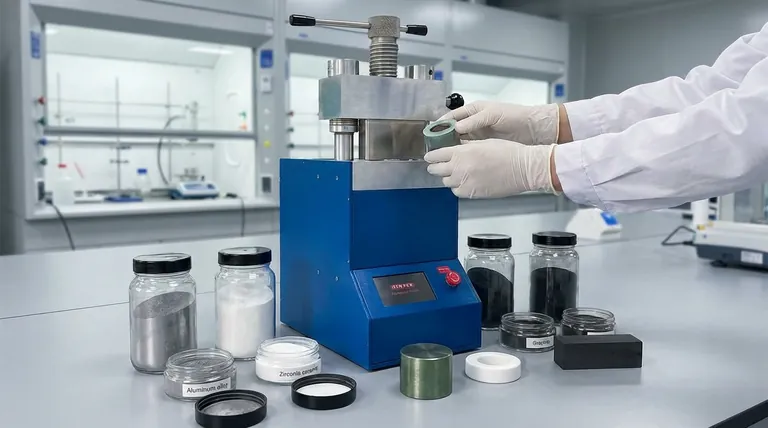
Material Categories by Application
Powdered Metallurgy and Metals
CIP is extensively used in the consolidation of metal powders to create robust pre-forms. Common applications include aluminum, magnesium, and copper alloys.
It is also the standard for processing cemented carbides (hard metals) and refractory materials, which require high density and uniformity often unattainable by uniaxial pressing.
Advanced Ceramics and Carbon
The process is ideal for ceramic industries, handling everything from traditional technical ceramics to sputtering targets.
Carbon and graphite are frequently processed via CIP to ensure isotropic properties in the final component. This category extends to diamond and diamond-like materials used in industrial cutting and drilling applications.
Polymers and Composites
While often associated with metals, CIP effectively processes plastics, particularly for creating specialized tubes or seals.
It is also highly effective for composite powders, allowing for the consolidation of mixed materials without the segregation that can occur in other molding processes.
Specialty and Hazardous Materials
Due to the nature of the hydrostatic pressure application, CIP is uniquely suited for processing sensitive materials.
This includes electronic and electrical materials, as well as explosives and pyrotechnics, where uniform density and safe consolidation are paramount.
Critical Prerequisites for Processing
Requirement for Powder Flowability
To be processed successfully, the raw material must possess excellent flowability to fill the mold evenly.
If the raw powder flows poorly, it often requires pre-processing steps like spray drying or the use of vibration during mold filling to ensure a defect-free compact.
Mold Compatibility
The material must be compatible with elastomeric tooling.
The powder is sealed inside a flexible mold made of urethane, rubber, or polyvinyl chloride (PVC) during the pressing cycle; therefore, the powder must not chemically react with or degrade these elastomers.
Understanding the Trade-offs
The "Green" Density Limit
It is vital to understand that CIP is rarely the final step in manufacturing.
The process typically yields parts with 60% to 80% of their theoretical density. These parts, known as "green bodies," usually require subsequent sintering or hot isostatic pressing to achieve full density and final mechanical properties.
Pre-Processing Costs
While CIP handles complex shapes well, the requirement for flowable powders can add cost.
The need to spray-dry powders or engineer specific particle size distributions to ensure proper mold filling adds a layer of complexity compared to standard pressing methods.
Making the Right Choice for Your Goal
To determine if CIP is the correct consolidation method for your material, consider your primary manufacturing objective:
- If your primary focus is Hard Metals or Ceramics: CIP is ideal for cemented carbides and refractory materials where uniform density is critical to preventing cracking during sintering.
- If your primary focus is Complex Geometries: CIP allows for the consolidation of intricate shapes and long aspect ratios (like rods or tubes) that uniaxial pressing cannot handle.
- If your primary focus is Material Purity/Safety: The process is excellent for sensitive applications like explosives or high-purity sputtering targets due to the sealed, contaminant-free mold environment.
CIP is the definitive choice when internal structural uniformity and high green density are required for powdered materials that defy conventional pressing limits.
Summary Table:
| Material Category | Common Examples | Key Benefit of CIP |
|---|---|---|
| Metals & Alloys | Aluminum, Copper, Cemented Carbides, Refractory Metals | Uniform density, complex shapes, high green strength |
| Ceramics & Carbon | Technical Ceramics, Sputtering Targets, Graphite, Diamond | Isotropic properties, prevents sintering defects |
| Polymers & Composites | Plastics, Composite Powders | Consolidates mixed materials without segregation |
| Specialty Materials | Explosives, Pyrotechnics, High-Purity Electronic Materials | Safe consolidation, contaminant-free environment |
Ready to Achieve Uniform Density in Your Complex Powdered Parts?
KINTEK specializes in providing high-performance lab press solutions, including Cold Isostatic Presses (CIP), designed to meet the demanding needs of your laboratory.
Whether you are working with advanced ceramics, refractory metals, or sensitive composite powders, our expertise ensures you get the high green strength and uniform density critical for successful sintering.
Let's discuss your specific material and application goals. Our team is ready to help you determine if CIP is the ideal consolidation method for your project.
Contact KINTEK today for a personalized consultation and discover the right press for your lab's needs.
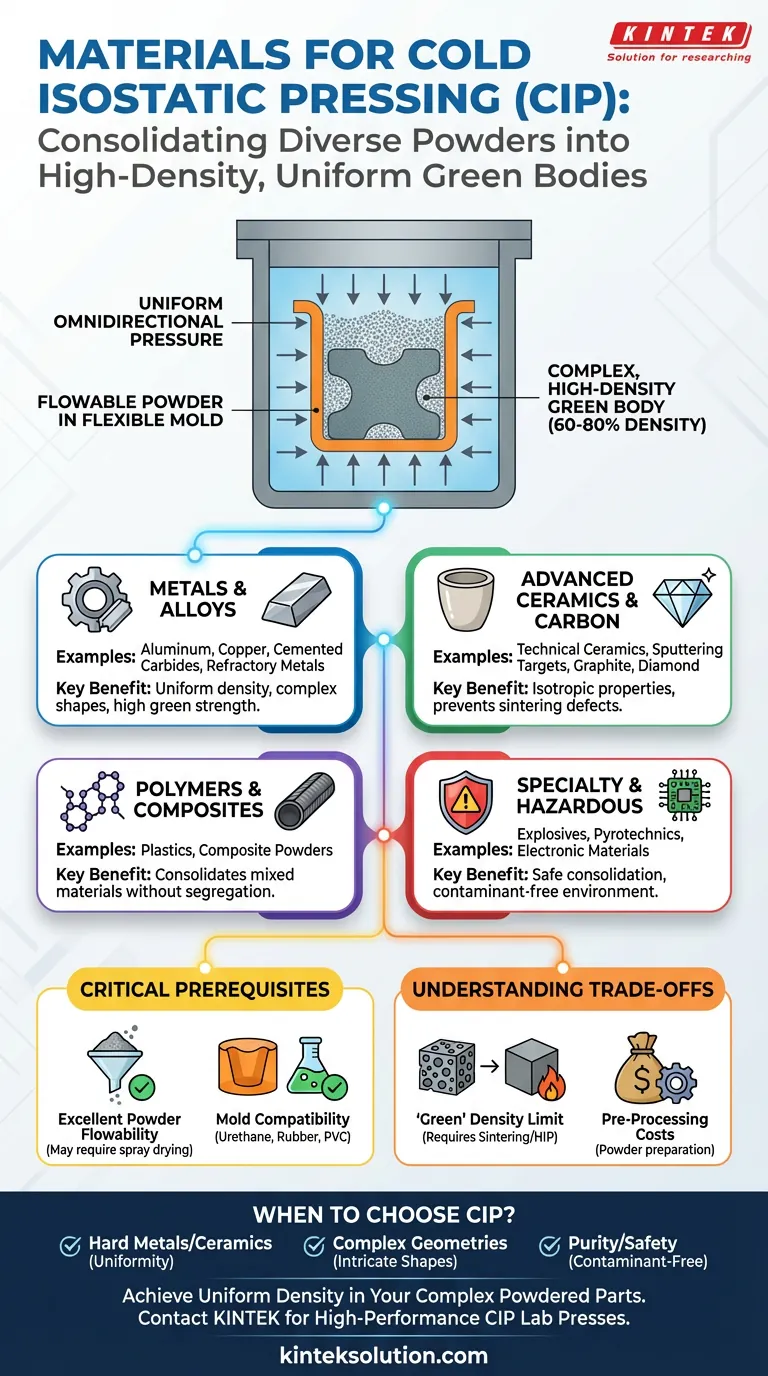
Visual Guide
Related Products
- Automatic Lab Cold Isostatic Pressing CIP Machine
- Electric Split Lab Cold Isostatic Pressing CIP Machine
- Electric Lab Cold Isostatic Press CIP Machine
- Manual Cold Isostatic Pressing CIP Machine Pellet Press
- Lab Isostatic Pressing Molds for Isostatic Molding
People Also Ask
- What are the key features of automated laboratory Cold Isostatic Press (CIP) systems? Achieve Precise, High-Pressure Powder Consolidation
- Why is an Isostatic Press (CIP) Necessary After Uniaxial Pressing? Achieve Transparency in Nd:Y2O3 Ceramics
- How does a Cold Isostatic Press (CIP) increase Bi-2223/Ag current density? Boost Superconductivity with Uniform Pressure
- How does a Cold Isostatic Press (CIP) facilitate the preparation of CaO-doped silicon carbide (SiC) green bodies?
- What is the primary function of a Cold Isostatic Press (CIP) in NASICON preparation? Achieve 96% Theoretical Density










