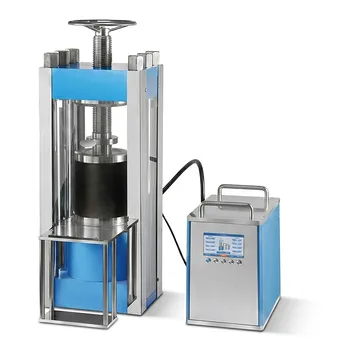
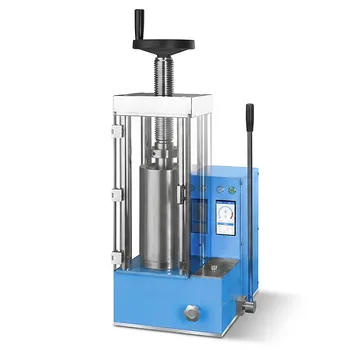
Ensuring the quality of polylactic acid (PLA) sheets requires the precise synchronization of three primary parameters: temperature, pressure, and cooling rate. These factors must be controlled across the preheating, pressing, and cooling stages to achieve uniform thickness, high density, and the desired crystalline structure.
The success of PLA sheet fabrication depends on transitioning the polymer into a sufficiently fluid state to eliminate internal voids while maintaining constant pressure during solidification to prevent warping. Mastering the interplay between thermal energy and mechanical force is the only way to ensure standardized, defect-free specimens.
The Critical Role of Thermal Management
Achieving Optimal Melt Fluidity
The laboratory press must heat PLA granules—typically to a range of 200°C to 210°C—to reach a fluid state suitable for molding. This precise temperature control ensures that polymer chains flow sufficiently to fill every corner of the mold.
Uniformity Through Preheating
During the preheating stage, the press ensures the polymer melts uniformly before high pressure is applied. Uniform melting is essential to prevent "cold spots" that result in inconsistent sheet density or surface defects.
Thermal Stability and Bonding
In functional composites, controlled heating softens the matrix resin to allow for the rearrangement of reinforcement fillers. This facilitates strong interfacial bonding, which is the foundation of the material's final physical properties.
Pressure Control and Material Integrity
Eliminating Internal Voids
The application of several tons of constant pressure is necessary to expel trapped air bubbles and pores from the molten PLA. This process increases the density of the film, ensuring the internal structure is dense and free of structural weaknesses.
Ensuring Dimensional Precision
High pressure forces the molten material to fill the mold completely, resulting in uniform thickness (often as precise as 0.2 mm) and a flat surface. This standardization is critical for accurate downstream mechanical testing, such as tensile modulus evaluation.
Maintaining Structural Integrity
Pressure must be maintained even as the temperature begins to drop. Constant pressure during the transition from liquid to solid prevents the material from warping or deforming, preserving the geometric accuracy of the sheet.
The Impact of Cooling on Material Properties
Controlling Crystallization Behavior
The cooling stage is a decisive factor in determining whether the PLA sheet is amorphous or crystalline. By controlling the rate at which the temperature drops, the press dictates the material's final transparency and mechanical stiffness.
Rapid Quenching for Amorphous States
To produce standardized amorphous specimens, the press can be used to facilitate rapid quenching. This process inhibits static crystallization, resulting in a clear, flexible sheet suitable for specific optical or mechanical applications.
Preventing Thermal Stress
A controlled, gradual cooling process under pressure minimizes internal thermal stresses. This ensures that the final PLA substrate remains flat and does not develop micro-cracks during the cooling-induced contraction.
Understanding the Trade-offs
Temperature vs. Degradation
While higher temperatures improve flow and bubble elimination, exceeding the thermal stability limit of PLA can lead to polymer degradation. This reduces molecular weight and compromises the mechanical strength of the final sheet.
Pressure vs. Mold Wear
Excessive pressure ensures high density but can lead to material flash (leaking out of the mold) or premature wear of the laboratory press platens. Finding the "minimum effective pressure" is key to equipment longevity.
Cooling Speed vs. Brittleness
Rapid cooling creates amorphous sheets that are often tougher, while slow cooling promotes crystallization, which increases stiffness but also brittleness. The choice of cooling rate must be strictly aligned with the intended end-use of the substrate.
How to Apply This to Your Project
Recommendations Based on Your Objectives
- If your primary focus is mechanical testing accuracy: Prioritize pressure compensation to ensure a perfectly uniform 0.2 mm thickness and a bubble-free internal structure.
- If your primary focus is optical clarity: Focus on the cooling stage by implementing rapid quenching to inhibit crystallization and maintain an amorphous state.
- If your primary focus is composite reinforcement: Maximize the preheating time at 210°C to ensure the matrix resin is fluid enough to fully encapsulate fillers and additives.
The quality of a PLA sheet is ultimately a reflection of how effectively the laboratory press manages the transition from a granular solid to a pressurized melt and back to a stabilized geometric form.
Summary Table:
| Parameter | Critical Stage | Key Function | Target Metric |
|---|---|---|---|
| Temperature | Preheating & Pressing | Ensures melt fluidity and strong interfacial bonding | 200°C - 210°C |
| Pressure | Pressing & Solidifying | Eliminates voids and ensures uniform thickness | Constant (0.2mm precision) |
| Cooling Rate | Solidification | Dictates crystallization behavior and prevents warping | Rapid Quench vs. Slow Cool |
Optimize Your Material Research with KINTEK Precision
Achieving consistent PLA sheet substrates requires a laboratory press that offers uncompromising control over thermal and mechanical variables. KINTEK specializes in comprehensive laboratory pressing solutions tailored for demanding applications like battery research and polymer science.
Our advanced equipment range includes:
- Manual & Automatic Presses: For high-repeatability molding.
- Heated & Multifunctional Models: Delivering precise temperature control up to 210°C and beyond.
- Glovebox-Compatible & Isostatic Presses (Cold/Warm): Specifically designed for sensitive research environments and advanced materials.
Whether you are prioritizing optical clarity through rapid quenching or mechanical strength through pressure compensation, KINTEK has the technology to elevate your results. Contact us today to find the perfect laboratory press for your research!
References
- Denis Mihaela Panaitescu, Mona Mihăilescu. Proposal of a Biobased and Biodegradable Polymer as a Hot Embossing Substrate for Holographic Security Marks Fabrication. DOI: 10.1002/pat.6626
This article is also based on technical information from Kintek Solution Knowledge Base .
Related Products
- Cylindrical Lab Electric Heating Press Mold for Laboratory Use
- Automatic Heated Hydraulic Lab Press with Programmable Touch Screen Controls and Precision Temperature Regulation
- Automatic Heated Hydraulic Lab Press Machine 200x200 Plate Size for Battery Research and Materials Science
- Automatic Heated Hydraulic Press Machine with Hot Plates for Laboratory
- Automatic Heated Hydraulic Lab Press 120x120mm Plate Fully Automated Material Research Press
People Also Ask
- How does a laboratory electric heated press ensure sample quality? Optimize SiR-EPDM vulcanization and molding.
- What role does a laboratory electric heated press play in polymer composite fabrication? Key for Standardized Specimens
- What role does a laboratory electric heating press play in NBR molding? Master Vulcanization & Material Density
- Why is a laboratory electric heating press required for PP/EPDM molding? Achieve Superior Specimen Integrity
- What is the purpose of incorporating cartridge heaters into a lab press mold for MLCC block compression? Optimize Results