
Cold Isostatic Pressing (CIP) is a standard manufacturing method for processing specific refractory metals, most notably tungsten, molybdenum, and tantalum. Because these metals possess exceptionally high melting points, they are often unsuitable for traditional casting; instead, CIP is used to compact their powders into dense, solid forms at room temperature.
Core Insight: Refractory metals are defined by their resistance to heat and wear, which ironically makes them difficult to process using thermal methods. CIP solves this by applying uniform hydrostatic pressure to metal powders, creating a high-density "green" compact that is strong enough to be handled before the final sintering stage.
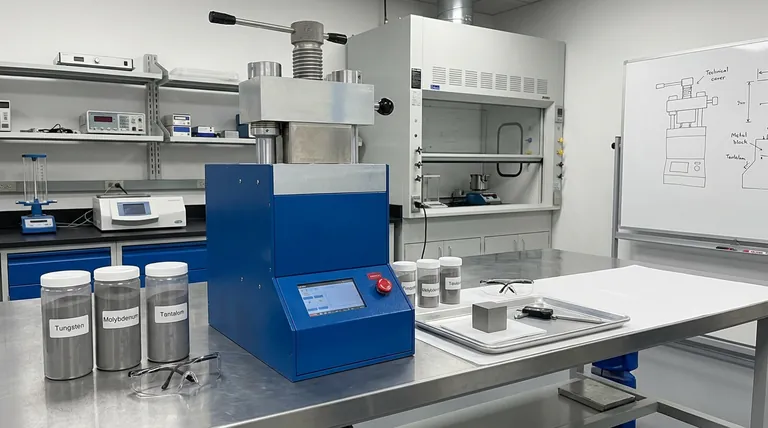
The Role of CIP in Refractory Metal Production
Overcoming High Melting Points
Refractory metals like tungsten and molybdenum have melting points so high that melting and casting them is practically difficult or economically inefficient.
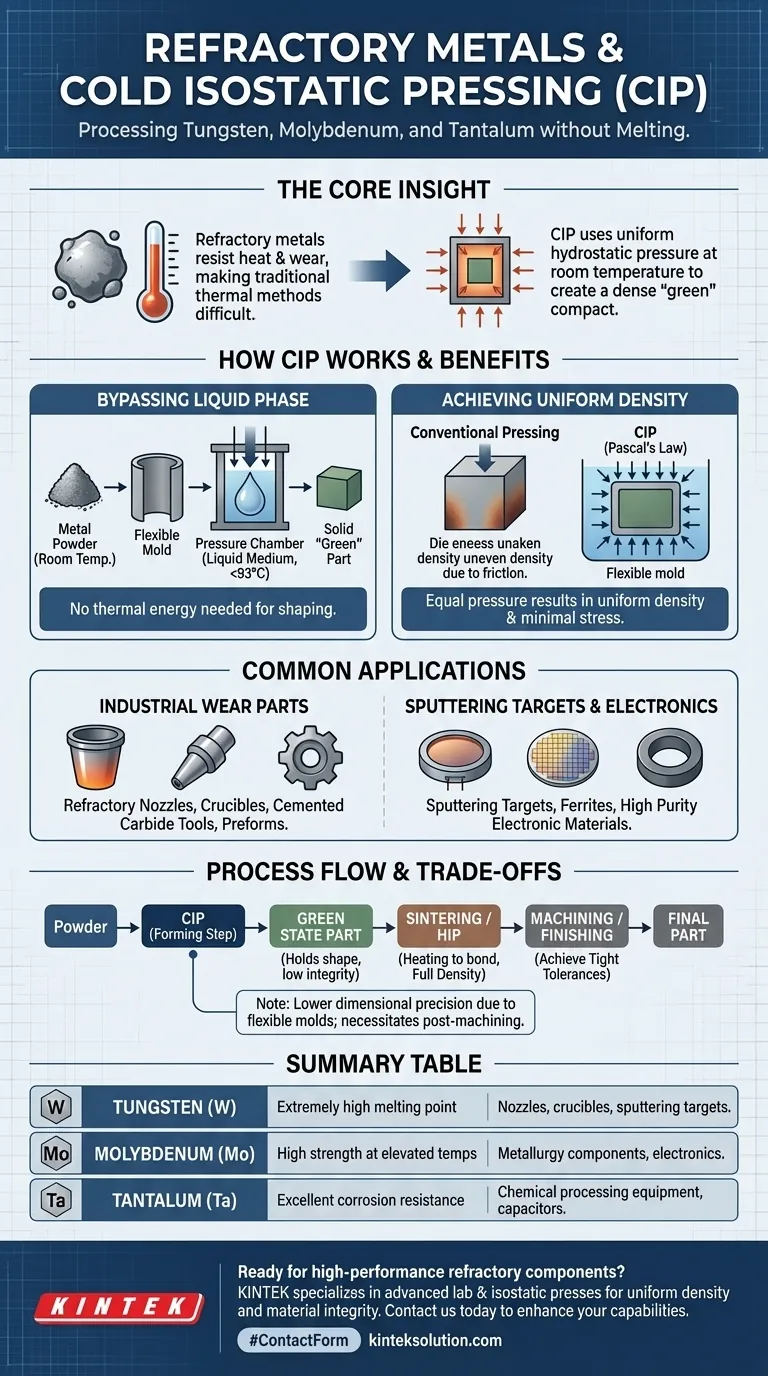
CIP allows manufacturers to bypass the liquid phase entirely. By compressing the metal powder at room temperature (or slightly above, up to 93°C), a solid part is formed without requiring thermal energy during the shaping phase.
Achieving Uniform Density
Conventional mechanical pressing often results in uneven density due to friction between the powder and the die walls.
CIP utilizes a liquid medium (such as water, oil, or glycol) to apply pressure to a flexible mold. Following Pascal’s Law, this pressure is exerted equally in all directions, resulting in a refractory metal part with uniform density and minimal internal stress.
Common Applications and Components
Industrial Wear Parts
The resulting compacted metals are frequently used to manufacture robust components capable of withstanding extreme environments.
Common examples include refractory nozzles and crucibles used in high-temperature metallurgy. The process also produces preforms for metal filters and various cemented carbide tools known for their wear resistance.
Sputtering Targets and Electronics
Beyond heavy industrial machinery, CIP is used to produce specialized components for the electronics sector.
This includes sputtering targets, which are thin coatings used in semiconductor manufacturing. The process is also capable of producing ferrites and other electronic materials that require high material purity and density.
Understanding the Trade-offs
The "Green State" Limitation
It is critical to understand that CIP does not produce a finished, fully dense metal part.
The process creates a "green" or "raw" part that holds its shape but lacks final structural integrity. These parts must undergo sintering (heating without melting) or Hot Isostatic Pressing (HIP) to bond the particles permanently and achieve full theoretical density.
Dimensional Tolerances
Because CIP uses flexible molds made of rubber or elastomers, the dimensional precision is lower than that of rigid die pressing.
While CIP is excellent for complex shapes and large aspect ratios, the flexible mold deforms under pressure. This necessitates additional finishing or machining processes after the part has been sintered to achieve tight tolerances.
Making the Right Choice for Your Project
If you are evaluating fabrication methods for refractory applications, consider the following regarding CIP:
- If your primary focus is material composition: CIP is the ideal choice for tungsten, molybdenum, and tantalum where traditional casting is impossible due to melting points.
- If your primary focus is part geometry: Choose CIP if you need to produce complex shapes or large components (like long tubes or crucibles) that would suffer from density gradients in rigid dies.
- If your primary focus is process flow: Remember that CIP is a forming step, not a finishing step; you must plan for significant post-processing, including sintering and machining.
CIP remains the definitive solution for converting high-performance refractory powders into viable industrial components where uniformity and material integrity are paramount.
Summary Table:
| Refractory Metal | Key Characteristic | Common CIP Applications |
|---|---|---|
| Tungsten | Extremely high melting point | Nozzles, crucibles, sputtering targets |
| Molybdenum | High strength at elevated temperatures | Metallurgy components, electronics |
| Tantalum | Excellent corrosion resistance | Chemical processing equipment, capacitors |
Ready to produce high-performance refractory metal components?
KINTEK specializes in advanced lab press machines, including isostatic presses and automatic lab presses, designed to meet the precise needs of laboratories and R&D facilities. Our equipment ensures uniform density and material integrity for your tungsten, molybdenum, and tantalum projects.
Contact us today using the form below to discuss how our solutions can enhance your refractory metal processing capabilities. Let's achieve superior results together!
Visual Guide
Related Products
- Electric Lab Cold Isostatic Press CIP Machine
- Automatic Lab Cold Isostatic Pressing CIP Machine
- Electric Split Lab Cold Isostatic Pressing CIP Machine
- Manual Cold Isostatic Pressing CIP Machine Pellet Press
- Lab Isostatic Pressing Molds for Isostatic Molding
People Also Ask
- What are the applications of electric lab cold isostatic presses in research settings? Advance Material R&D with High-Pressure CIPs
- What role do electric lab cold isostatic presses play in industrial contexts? Bridge R&D and Manufacturing with Precision
- How does electrical Cold Isostatic Pressing (CIP) contribute to cost savings? Unlock Efficiency and Reduce Expenses
- What are some research applications of electric lab CIPs? Unlock Uniform Powder Densification for Advanced Materials
- What are the characteristics of standard off-the-shelf electric lab CIP solutions? Achieve Immediate, Cost-Effective Processing








