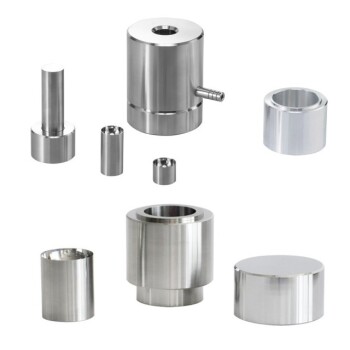
The inherent hardness and abrasiveness of Silicon (Si) and Germanium (Ge) powders make high-performance mold materials mandatory. Standard metal molds cannot withstand the extreme pressures required for forming these materials without suffering from rapid abrasive wear and plastic deformation. Utilizing high-hardness mold steel or cemented carbide is the only way to maintain structural integrity and ensure the final components meet strict dimensional specifications.
Core Takeaway Processing Si-Ge powders requires molds that possess exceptional wear resistance and compressive strength to counter the material's abrasive nature. High-performance alloys and carbides prevent mold deformation under pressure, ensuring consistent surface quality and long-term dimensional accuracy.
The Physical Challenge of Si-Ge Powders
Combating High Abrasiveness
Silicon and germanium particles act as abrasive agents during the pressing process. When standard metals are used for tooling, these hard particles effectively grind away the mold surface.
High-performance mold steels and cemented carbides possess a hardness level that exceeds that of the powder particles. This hardness barrier prevents the Si-Ge powder from cutting into the mold surface, significantly reducing wear over time.
Preventing Plastic Deformation
The pressing and forming process involves subjecting powders to immense pressure to create a solid body. Under these loads, softer mold materials may yield, leading to plastic deformation.
Once a mold deforms—even microscopically—it loses its precise geometry. Hardened materials like cemented carbide maintain their rigidity under these extreme loads, ensuring the mold cavity retains its exact shape cycle after cycle.
Critical Role of Surface Integrity
Reducing Demolding Resistance
Friction is a major enemy during the ejection (demolding) phase of the process. High-performance molds are capable of achieving and maintaining a superior internal surface finish.
A highly polished, hard surface minimizes the friction between the compacted Si-Ge body and the mold walls. This reduction in resistance is critical to preventing cracks or surface defects when the part is ejected.
Ensuring Dimensional Accuracy
The ultimate goal of using specialized tooling is repeatability. If a mold wears down or warps, the dimensions of the final product will drift outside of tolerance.
By resisting both abrasive wear and pressure-induced deformation, these high-grade materials guarantee long-term dimensional accuracy. This stability is essential for maintaining yield rates and product quality in production environments.
Operational Considerations and Trade-offs
Balancing Hardness with Cost
While cemented carbide and high-performance steels offer superior longevity, they represent a significantly higher initial investment than standard tooling.
You are effectively trading upfront capital for extended service life and reduced downtime. For low-volume prototyping, the cost may be difficult to justify, but for production, the cost-per-part decreases significantly due to reduced tool replacement needs.
Machinability Challenges
The very properties that make these materials excellent for molds—extreme hardness and wear resistance—make them difficult to manufacture.
Creating complex geometries in cemented carbide often requires specialized machining processes, such as EDM (Electrical Discharge Machining) or diamond grinding. This can increase the lead time for producing the molds compared to softer, standard tool steels.
Making the Right Choice for Your Goal
- If your primary focus is long-term production consistency: Prioritize cemented carbide to maximize wear resistance and minimize dimensional drift over thousands of cycles.
- If your primary focus is part surface quality: Ensure your mold material is capable of achieving a high-polish finish to reduce demolding friction and surface defects.
In the processing of abrasive Si-Ge powders, the quality of your mold material directly dictates the quality of your final product.
Summary Table:
| Feature | Standard Metal Molds | High-Performance Steel/Carbide |
|---|---|---|
| Wear Resistance | Low (Rapid abrasive wear) | High (Resists abrasive Si-Ge particles) |
| Structural Integrity | Prone to plastic deformation | Maintains rigidity under high pressure |
| Surface Quality | Rougher finish, higher friction | High-polish finish, low friction |
| Dimensional Stability | Poor repeatability over time | Superior long-term accuracy |
| Best Use Case | Low-cost, soft powder testing | High-volume Si-Ge production |
Optimize Your Si-Ge Material Research with KINTEK
Precision in silicon-germanium processing starts with the right equipment. KINTEK specializes in comprehensive laboratory pressing solutions designed to handle the most demanding materials. Whether you are conducting initial battery research or scaling production, we offer:
- Versatile Pressing Options: Manual, automatic, heated, and multifunctional models.
- Advanced Technology: Cold and warm isostatic presses for uniform density.
- Specialized Tooling: Compatibility with high-performance carbide molds to ensure your samples meet strict dimensional tolerances.
Don't let mold wear compromise your results. Contact our technical experts today to find the perfect pressing system for your laboratory needs.
References
- Yaru Li, Ning Lin. Silicon‐Germanium Solid Solutions with Balanced Ionic/Electronic Conductivity for High‐Rate All‐Solid‐State Batteries (Adv. Energy Mater. 40/2025). DOI: 10.1002/aenm.70268
This article is also based on technical information from Kintek Solution Knowledge Base .
Related Products
- Lab Round Bidirectional Press Mold
- Lab Polygon Press Mold
- XRF KBR Plastic Ring Lab Powder Pellet Pressing Mold for FTIR
- XRF KBR Steel Ring Lab Powder Pellet Pressing Mold for FTIR
- Lab XRF Boric Acid Powder Pellet Pressing Mold for Laboratory Use
People Also Ask
- What is the purpose of incorporating cartridge heaters into a lab press mold for MLCC block compression? Optimize Results
- What is the function of a pressing tool in thermoplastic panels? Master Precision Shaping & Fusion Bonding
- Why is precise cooling management of the lab press mold necessary? Protect Core Integrity in Thermoforming
- Why is a high-performance laboratory molding press critical for in-situ electrolyte formation? Unlock Battery Success
- How do the design and geometric precision of pressing molds and mandrels affect the quality of PTFE composite samples?