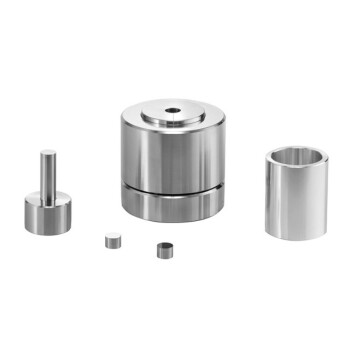
Fabricating ultra-thin solid-state electrolyte layers is a process defined by a narrow margin for error, requiring high-precision molds and uniform pressure to prevent catastrophic structural failure. When working with low mass loadings, such as 20 mg/cm², insufficient mold precision or uneven pressure distribution causes the electrolyte layer to crack or suffer from "bleed-through," where cathode powder penetrates the separator and causes internal short circuits. Uniform pressure is the absolute technical prerequisite for achieving a structurally complete, dense layer with consistent properties.
The integrity of a solid-state battery depends on the electrolyte acting as a flawless physical barrier; without precise pressure application, ultra-thin layers develop density gradients that compromise this barrier and lead to immediate device failure.
The Mechanics of Structural Integrity
Preventing Internal Short Circuits
When fabricating layers with minimal powder mass, any deviation in mold alignment leads to uneven powder distribution. If the powder is not perfectly level, the subsequent compression forces cathode particles to penetrate the electrolyte layer. This "bleed-through" creates a direct path for electrons, resulting in an internal short circuit that renders the cell useless.
Eliminating Physical Defects
Low mass loadings make the resulting pellet extremely fragile during the pressing phase. Uneven pressure distribution creates stress concentrations within the powder bed. These concentrations manifest as macroscopic cracks or microscopic fissures, destroying the continuity of the separator layer.
Achieving Consistent Density
Uniform pressure control is the only way to ensure the electrolyte achieves a specific, homogeneous density. A layer with consistent density provides a uniform pathway for ions, whereas density variations lead to localized resistance hotspots and erratic electrochemical performance.
The Role of Pressure Dynamics
Particle Rearrangement and Air Exclusion
High-precision hydraulic presses apply stable vertical pressure to force the rearrangement of loose powder particles. This mechanical force is critical for expelling air trapped between particles, which is necessary to minimize internal voids.
Deformation and Bonding
To form a cohesive "green body," the powder particles must undergo plastic or elastic deformation. Uniform pressure ensures that this deformation happens evenly across the entire surface area. This results in a structurally sound pellet that maintains the intended thickness without warping.
Understanding Material Trade-offs
The Necessity of Mold Rigidity
The mold itself must resist deformation under immense loads to maintain precision. High-strength zirconia molds are often utilized because they can withstand compressive stresses up to 1000 MPa without permanent deformation. Their chemical inertness also prevents contamination of sulfide electrolytes, preserving the accuracy of mechanical testing.
Balancing Strength with Demolding
While hardness is vital, the interaction between the powder and the mold wall is also critical. High-strength PEEK molds are an alternative that offers distinct advantages in demolding. Their low friction coefficient and smooth inner walls allow the ultra-thin sample to be ejected without sticking or breaking, ensuring high dimensional consistency even if they handle slightly lower absolute stress limits than ceramics.
Making the Right Choice for Your Goal
Achieving a viable ultra-thin electrolyte layer requires matching your tooling to your specific fabrication constraints.
- If your primary focus is maximizing compression limits (up to 1000 MPa): Prioritize high-strength zirconia molds to prevent tool deformation and ensure chemical inertness.
- If your primary focus is sample recovery and dimensional consistency: Prioritize PEEK molds to leverage their low friction coefficient for safer demolding of fragile, thin layers.
- If your primary focus is preventing short circuits: Ensure your hydraulic press offers active pressure control to guarantee uniform vertical force distribution during the compaction phase.
Precision in the molding process is not a luxury; it is the fundamental enabler of thin-film solid-state battery performance.
Summary Table:
| Factor | Impact on Ultra-Thin Layers | Mitigation Strategy |
|---|---|---|
| Pressure Distribution | Prevents density gradients and structural cracks | Use active vertical pressure control hydraulic presses |
| Mold Precision | Prevents cathode "bleed-through" and internal shorts | High-tolerance mold alignment and rigid materials |
| Material Selection | Affects demolding success and chemical purity | Zirconia for high strength; PEEK for low-friction recovery |
| Air Exclusion | Reduces internal voids and improves ion conductivity | Stable mechanical force to drive particle rearrangement |
Elevate Your Battery Research with KINTEK Precision Solutions
Fabricating flawless ultra-thin solid-state electrolyte layers leaves no room for error. KINTEK specializes in comprehensive laboratory pressing solutions, providing the high-precision tools necessary to eliminate density gradients and prevent catastrophic internal shorts.
Whether you need manual, automatic, heated, or glovebox-compatible models, or require the advanced capabilities of cold and warm isostatic presses, our equipment is engineered for the rigorous demands of battery research. From high-strength zirconia molds that withstand 1000 MPa to low-friction PEEK options for fragile sample recovery, we provide the technical edge your lab needs.
Ready to achieve superior pellet density and structural integrity?
Contact KINTEK today to find the perfect pressing solution for your application.
References
- Yi Lin, John W. Connell. Toward 500 Wh Kg<sup>−1</sup> in Specific Energy with Ultrahigh Areal Capacity All‐Solid‐State Lithium–Sulfur Batteries. DOI: 10.1002/smll.202409536
This article is also based on technical information from Kintek Solution Knowledge Base .
Related Products
- Square Bidirectional Pressure Mold for Lab
- XRF KBR Steel Ring Lab Powder Pellet Pressing Mold for FTIR
- XRF KBR Plastic Ring Lab Powder Pellet Pressing Mold for FTIR
- Lab Polygon Press Mold
- Lab Round Bidirectional Press Mold
People Also Ask
- What is the purpose of incorporating cartridge heaters into a lab press mold for MLCC block compression? Optimize Results
- How do industrial-grade pressure molds affect zinc metal pouch cells? Maximize Energy Density & Performance
- What role do precision positioning and pressure molds play in single-lap joints? Ensure 100% Data Integrity
- How does the geometry of laboratory molds influence mycelium-based composites? Optimize Density and Strength
- Why are precision laboratory molds essential for forming basalt-reinforced lightweight concrete specimens?