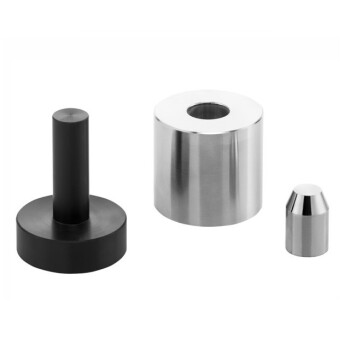
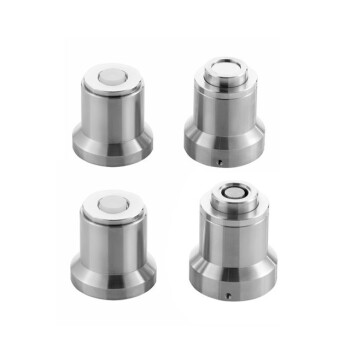
PEEK molds function as the critical interface between extreme mechanical force and delicate electrical chemistry. They serve as insulating sleeves that withstand the massive crushing force of a laboratory hydraulic press without deforming, while simultaneously isolating the electrodes to prevent electrical short circuits.
Core Takeaway To create high-performance solid-state batteries, electrolyte powders must be compressed into dense pellets, requiring a material that is both mechanically robust and electrically non-conductive. PEEK is the industry standard because it maintains structural stability under high pressure while preventing the electrical shorts that would occur with metal molds.
The Engineering Challenge: Densification vs. Isolation
The Necessity of Extreme Pressure
Constructing an all-solid-state battery is not a passive assembly process; it is a high-force manufacturing challenge.
To function correctly, solid electrolyte powders must be compressed into a dense, pellet-like structure.
This requires applying controllable pressures ranging from 100 MPa to 500 MPa.
Why Porosity is the Enemy
The primary goal of this high-pressure application is to minimize porosity between solid particles.
By eliminating voids, you significantly increase the ionic conductivity of the battery.
Furthermore, this pressure ensures optimal solid-solid interface contact between the electrolyte and the electrode active materials, which is essential for efficient energy transfer.
The Mold Material Dilemma
This requirement creates a contradiction in material selection.
To withstand 500 MPa, the mold usually needs the strength of hardened steel.
However, using a conductive metal mold directly against the active materials would create an immediate electrical short circuit between the electrodes, ruining the cell.
Why PEEK is the Definitive Solution
Exceptional Mechanical Strength
Polyether ether ketone (PEEK) is chosen primarily for its high structural stability.
Unlike standard plastics which would shatter or deform under the load of a hydraulic press, PEEK maintains its shape and integrity.
It acts as a robust sleeve that contains the lateral forces of the expanding powder as it is compressed vertically.
Critical Electrical Insulation
While acting mechanically like a "metal substitute" in this context, PEEK retains the electrical properties of a polymer.
It serves as a highly effective insulating barrier during the pressing process.
This allows researchers to apply the necessary force to densify the electrolyte without creating an electrical path between the positive and negative terminals.
Understanding the Trade-offs
Pressure Limits vs. Steel
While PEEK is exceptionally strong for a polymer, it is not indestructible.
At the upper limits of pressure (approaching or exceeding 500 MPa), PEEK may exhibit creep or deformation over time compared to a fully steel-encased setup.
Thermal Considerations
PEEK generally handles heat well, but in specific high-temperature sintering processes, its thermal limits must be respected compared to ceramic or metal alternatives.
Making the Right Choice for Your Goal
- If your primary focus is maximizing ionic conductivity: Ensure your PEEK tooling is rated to withstand the upper range of pressure (up to 500 MPa) to achieve the lowest possible porosity.
- If your primary focus is preventing assembly failures: Inspect PEEK sleeves regularly for micro-cracks, as compromised insulation under high pressure will lead to immediate short circuits.
PEEK transforms the raw potential of loose electrolyte powders into functional, high-performance energy storage units.
Summary Table:
| Feature | Requirement for Solid-State Battery Molding | Why PEEK is Selected |
|---|---|---|
| Pressure Resistance | Must withstand 100 MPa to 500 MPa | High structural stability; resists deformation under extreme force. |
| Electrical Property | Must be non-conductive to prevent shorts | Excellent insulator; prevents electrical paths between electrodes. |
| Porosity Control | Needs to minimize voids for ionic conductivity | Acts as a rigid sleeve to ensure high-density powder compaction. |
| Durability | Must maintain integrity over repeated cycles | High mechanical toughness and resistance to chemical corrosion. |
Maximize Your Battery Research Performance with KINTEK
Precise compression is the foundation of high-performance solid-state batteries. KINTEK specializes in comprehensive laboratory pressing solutions, offering manual, automatic, heated, multifunctional, and glovebox-compatible models, as well as cold and warm isostatic presses.
Our advanced PEEK-compatible pressing systems ensure your materials achieve maximum ionic conductivity without the risk of electrical short circuits. Whether you are focusing on electrolyte densification or optimizing solid-solid interface contact, KINTEK provides the robust, high-precision tools your battery research demands.
Ready to elevate your lab's efficiency? Contact us today to find the perfect pressing solution for your application.
References
- Haeseok Park, Hansu Kim. Lithium Deposition Site Controllable Sn-C Functional Layer for Lithium-Free All-Solid-State Battery. DOI: 10.2139/ssrn.5958164
This article is also based on technical information from Kintek Solution Knowledge Base .
Related Products
- Lab Button Battery Tablet Press Sealing Mold
- Carbide Lab Press Mold for Laboratory Sample Preparation
- Lab Infrared Press Mold for Laboratory Applications
- Lab Cylindrical Press Mold for Laboratory Use
- Special Shape Lab Press Mold for Laboratory Applications
People Also Ask
- How does a sealed battery mold facilitate the assembly and testing of asymmetric supercapacitors using VO2?
- Why use standardized CR2032 components & high-precision presses? Ensure reliability in lithium metal battery research.
- Why is a laboratory battery sealing press essential for desolvation energy testing? Ensure Reliable Kinetic Data
- What is the function of specialized battery molds and sealing consumables? Optimize Your In-situ XRD Testing Today
- What role does a laboratory sealing press play in thermal analysis of solid dispersion films? Ensure Data Integrity