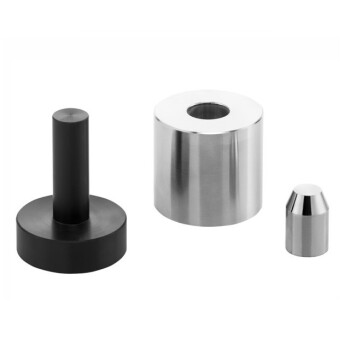
PEEK molds and stainless steel plungers are paired to balance structural integrity with precise electrochemical isolation. PEEK provides the high electrical insulation necessary to prevent current leakage during sensitive in-situ measurements, while simultaneously offering the mechanical strength to withstand hundreds of megapascals of pressure. The stainless steel plungers serve a dual purpose: they act as robust components for force transmission and function as blocking electrodes to create a symmetrical cell for accurate analysis.
By combining the insulating properties of PEEK with the conductivity and strength of stainless steel, researchers create a "symmetrical cell system." This ensures that when you evaluate ionic migration or electronic resistance, you are measuring the electrolyte's intrinsic properties, not artifacts caused by the mold itself.
The Critical Role of PEEK (Polyether Ether Ketone)
Ensuring Electrical Isolation
The primary advantage of PEEK in this application is its excellent electrical insulation.
During the cold pressing process, particularly when performing in-situ electrochemical impedance spectroscopy (EIS), it is vital that current flows only through the sample.
PEEK prevents short circuits and ensures current does not leak through the mold walls, which would otherwise skew impedance data and lead to inaccurate resistance calculations.
Withstanding High Pressure
Despite being a polymer, PEEK possesses sufficient mechanical strength to handle the immense forces required for pellet formation.
It can withstand pressures reaching hundreds of megapascals (up to 450 MPa) without significant deformation or structural failure.
This rigidity allows the mold to effectively contain the battery powder and rigidly define the final diameter of the pressed pellet.
Chemical Stability
PEEK provides a chemically inert environment for the electrolyte.
It prevents unwanted electrochemical reactions between the sample and the mold walls during compaction.
This ensures the purity of the sample is maintained and that the pellet's chemical composition remains unaltered for subsequent testing.
The Function of Stainless Steel Plungers
Precision Force Transmission
Stainless steel plungers act as the force-transmitting components within the assembly.
They are durable enough to transfer the uniform, immense pressure from a hydraulic press directly onto the powder without bending or yielding.
This uniformity is essential for eliminating internal pores and creating a pellet with high green density.
Acting as Blocking Electrodes
In this specific configuration, the plungers serve as blocking electrodes.
Because they are conductive but do not participate in the electrochemical reaction with the electrolyte, they allow for the creation of a precise symmetrical cell system.
This setup enables the accurate evaluation of ionic migration characteristics and electronic resistance without the interference of electrode reaction kinetics.
Understanding the Trade-offs
Pressure Limitations vs. Steel
While PEEK is exceptionally strong for a polymer, it has lower ultimate yield strength compared to hardened steel molds.
If the pressing requirement exceeds the material's specific limit (typically around 450 MPa), the PEEK mold may deform or crack, whereas a steel mold would remain intact.
Thermal Constraints
PEEK is a thermoplastic; while stable at room temperature, its mechanical properties degrade at extremely high temperatures.
While appropriate for cold pressing, this specific mold setup is generally not suitable for high-temperature sintering processes (like the 1600°C mentioned for sintering BCZY622), which require different containment methods after the green body is formed.
Making the Right Choice for Your Goal
To ensure your experimental setup yields valid data, align your equipment choice with your specific analytical needs:
- If your primary focus is in-situ electrochemical analysis: Use the PEEK/Stainless Steel combination to guarantee electrical isolation and accurate impedance spectroscopy data.
- If your primary focus is achieving maximum green density: Verify that your target pressure does not exceed the PEEK mold's rating (e.g., 450 MPa); otherwise, a stronger alloy mold may be required for the initial pressing.
Ultimately, this hybrid setup is the industry standard for isolating the variable of interest—the electrolyte's performance—from the mechanical variables of the test equipment.
Summary Table:
| Component | Material | Primary Function | Key Advantage |
|---|---|---|---|
| Mold Body | PEEK | Electrical Isolation & Containment | Prevents current leakage; high chemical inertness |
| Plunger | Stainless Steel | Force Transmission & Electrode | Acts as a blocking electrode; withstands high pressure |
| Assembly | Hybrid | Symmetrical Cell Creation | Enables accurate in-situ EIS measurements up to 450 MPa |
Elevate Your Battery Research with KINTEK
Precision matters when measuring ionic migration. KINTEK specializes in comprehensive laboratory pressing solutions, offering manual, automatic, heated, multifunctional, and glovebox-compatible models, as well as cold and warm isostatic presses.
Whether you need the electrical isolation of PEEK or the extreme durability of isostatic systems, our equipment ensures your results are driven by science, not artifacts. Contact us today to find the perfect press for your laboratory's needs!
References
- Denys S. Butenko, Jinlong Zhu. Rapid Mechanochemical Synthesis of Oxyhalide Superionic Conductor: Time‐Resolved Structural Evolution. DOI: 10.1002/smtd.202500947
This article is also based on technical information from Kintek Solution Knowledge Base .
Related Products
- Lab XRF Boric Acid Powder Pellet Pressing Mold for Laboratory Use
- XRF KBR Plastic Ring Lab Powder Pellet Pressing Mold for FTIR
- XRF KBR Steel Ring Lab Powder Pellet Pressing Mold for FTIR
- Lab Ring Press Mold for Sample Preparation
- Manual Cold Isostatic Pressing CIP Machine Pellet Press
People Also Ask
- Why are pellets used in XRF analysis, and what is their limitation? Boost Accuracy and Speed in Your Lab
- What are the primary factors to consider when deciding between a manual and an automatic XRF pellet press? Optimize Your Lab's Efficiency
- What should be included in a checklist for making XRF pellets? Ensure Accurate and Repeatable XRF Analysis
- What are the different pellet pressing options for XRF sample preparation? Choose the Best Method for Accurate Analysis
- What checklist of factors should be considered when choosing an XRF pellet press? Ensure Accurate Sample Preparation