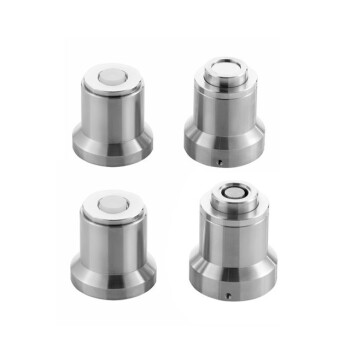
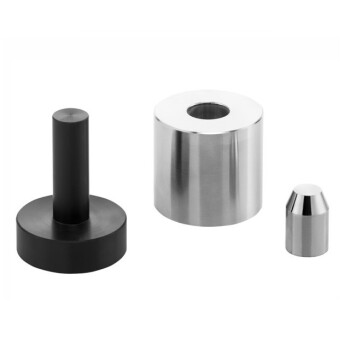
The combination of PEEK molds and titanium alloy plungers creates the ideal testing environment for all-solid-state batteries by balancing structural integrity with electrical isolation. PEEK provides the necessary electrical insulation and mechanical strength to withstand high-pressure cycling without deformation, while titanium plungers act as precise current collectors that maintain stable stack pressure on the active materials.
Core Takeaway Testing all-solid-state batteries requires maintaining immense physical pressure to prevent failure, while simultaneously isolating electrical signals. This specific material pairing solves this dual challenge: PEEK confines the cell mechanically without shorting it, and titanium transmits precise electrical signals while delivering the continuous pressure required to stabilize the battery interface.
The Role of PEEK: Insulation Meets Strength
High Mechanical Strength
All-solid-state batteries require significant external pressure to function correctly. PEEK (polyetheretherketone) is utilized because it possesses the mechanical robustness to withstand these repeated high-pressure cycles.
Unlike weaker polymers, a PEEK mold resists deformation under stress. This ensures the geometric integrity of the battery cell is maintained throughout the testing process.
Critical Electrical Insulation
The mold body must define the volume of the cell without participating in the circuit. PEEK offers excellent electrical insulation, which effectively prevents short circuits between the positive and negative terminals.
This isolation is vital for ensuring that the electrical data collected reflects the performance of the battery materials, not artifacts from the test fixture.
The Role of Titanium Plungers: Conduction and Pressure
Function as Current Collectors
The titanium alloy plungers serve a dual purpose, primarily acting as current collectors. They facilitate the transmission of electrical signals to and from the battery cell with high precision.
Titanium is chosen for its conductivity and resistance to electrochemical corrosion, ensuring clear signal transmission during charging and discharging.
Maintaining Stable Stack Pressure
Beyond electricity, these plungers act as the mechanical interface for applying force. They transfer external load to the battery stack, providing stable stack pressure directly to the active materials.
This creates a consistent physical environment, ensuring that the pressure applied by external frames is evenly distributed across the electrode surface.
Why Pressure Management is the "Deep Need"
Compensating for Volume Changes
During cycling, battery materials (especially lithium metal) undergo significant volume expansion and contraction. Without constraint, this "breathing" can destroy the battery's internal structure.
The PEEK mold and titanium plunger system creates a confined space that manages these fluctuations. This mechanical constraint compensates for volume changes during stripping and deposition processes.
Ensuring Interface Stability
The primary failure mode in solid-state batteries is often the loss of contact between layers. The continuous pressure provided by this fixture suppresses the formation of voids or contact loss at the interface.
By maintaining physical contact between the electrolyte and electrodes, the system prevents interface delamination. This results in lower interfacial resistance and inhibits the growth of lithium dendrites, which are a common cause of short circuits.
Understanding the Trade-offs
Material Limitations
While PEEK is exceptionally strong for a polymer, it still has lower moduli compared to steel or ceramic. In extreme high-pressure scenarios (exceeding standard laboratory limits), PEEK may experience slight creep over very long durations, potentially affecting pressure consistency.
Manufacturing and Cost
Titanium alloy is more difficult and expensive to machine than stainless steel or aluminum. However, this cost is a necessary trade-off to achieve the required combination of high strength, low weight, and electrochemical inertness required for precise analytical data.
Making the Right Choice for Your Goal
When selecting test fixtures for solid-state battery research, align your equipment with your specific data requirements:
- If your primary focus is Cycle Life Reliability: Prioritize the mechanical fit of the PEEK mold to ensure it can sustain constant pressures (e.g., 15 MPa) to suppress void formation over long-term cycling.
- If your primary focus is Electrochemical Precision: Ensure the titanium plungers are high-precision machined to maximize surface contact, acting as efficient current collectors to minimize contact resistance.
Ultimately, the PEEK-Titanium combination is the industry standard because it reliably converts mechanical constraint into electrochemical stability.
Summary Table:
| Feature | PEEK Mold Body | Titanium Alloy Plunger |
|---|---|---|
| Primary Function | Electrical Insulation & Housing | Current Collection & Pressure Application |
| Mechanical Property | High Strength & Creep Resistance | High Modulus & Low Deformation |
| Chemical Property | Electrochemical Inertness | Corrosion Resistance |
| Key Benefit | Prevents Short Circuits | Maintains Stable Stack Pressure |
Elevate Your Battery Research with KINTEK
Precision matters when managing the delicate interfaces of all-solid-state batteries. KINTEK specializes in comprehensive laboratory pressing solutions, offering a versatile range of equipment including manual, automatic, heated, multifunctional, and glovebox-compatible models, as well as cold and warm isostatic presses specifically designed for advanced battery research.
Don't let interface delamination or electrical interference compromise your data. Our PEEK and titanium-integrated systems provide the mechanical constraint and electrochemical precision your research demands.
Ready to optimize your testing setup? Contact KINTEK Today to find the perfect press for your lab!
References
- Gordon Jarrold, Arumugam Manthiram. Delineating the Intricate Impact of Carbon in All‐solid‐state Lithium‐Sulfur Batteries. DOI: 10.1002/aenm.202502557
This article is also based on technical information from Kintek Solution Knowledge Base .
Related Products
- Lab Cylindrical Press Mold for Laboratory Use
- Carbide Lab Press Mold for Laboratory Sample Preparation
- Lab Infrared Press Mold for Laboratory Applications
- Lab Button Battery Disassembly and Sealing Mold
- Lab Button Battery Tablet Press Sealing Mold
People Also Ask
- What is the purpose of incorporating cartridge heaters into a lab press mold for MLCC block compression? Optimize Results
- What is the function of a pressing tool in thermoplastic panels? Master Precision Shaping & Fusion Bonding
- Why is precise cooling management of the lab press mold necessary? Protect Core Integrity in Thermoforming
- Why is a high-performance laboratory molding press critical for in-situ electrolyte formation? Unlock Battery Success
- How does the geometry of laboratory molds influence mycelium-based composites? Optimize Density and Strength