
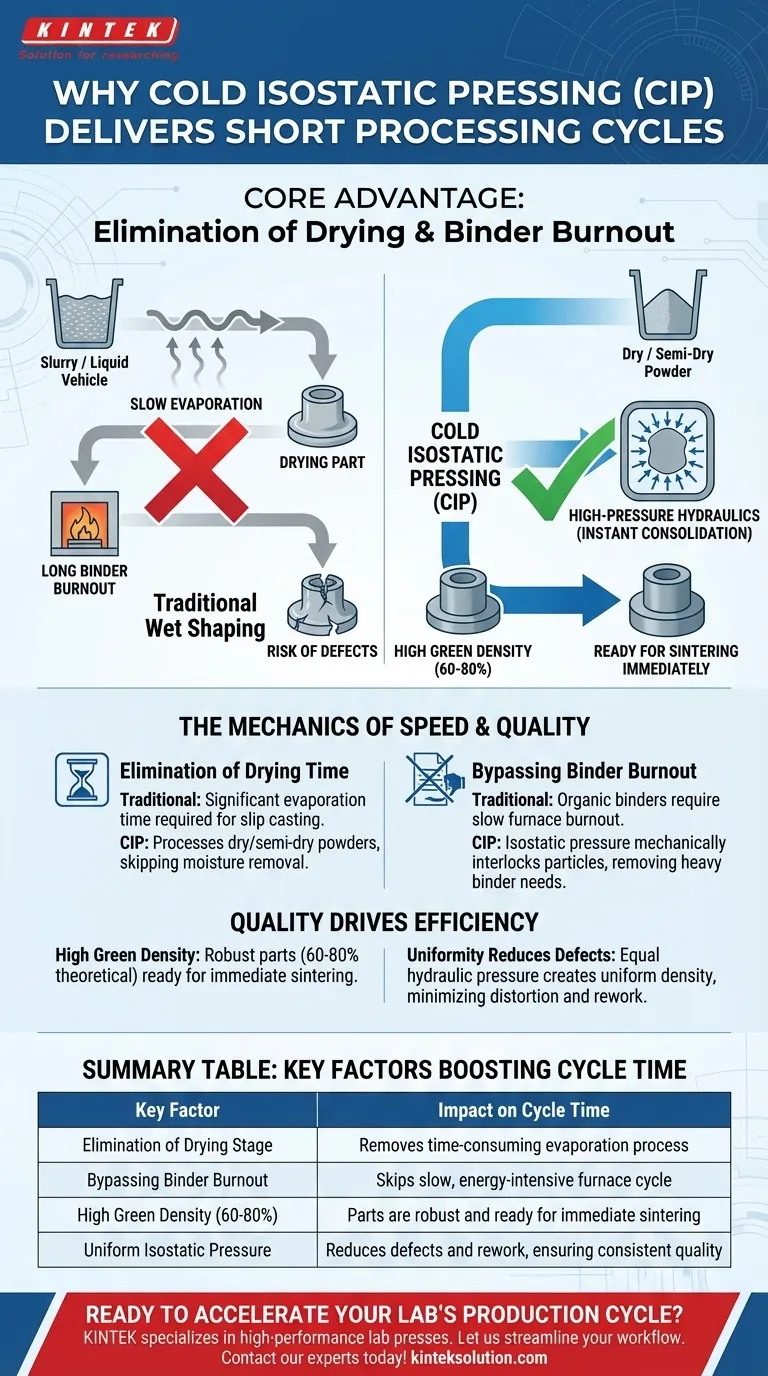
The primary reason for the short processing cycle times in Cold Isostatic Pressing (CIP) is the complete elimination of the drying and binder burnout stages.
Unlike wet shaping methods that rely on liquid evaporation, CIP utilizes high-pressure hydraulics to consolidate powder instantly. This allows manufacturers to bypass the time-consuming thermal cycles usually required to remove moisture or organic binders, enabling parts to move much faster through the production line.
Core Takeaway: CIP achieves efficiency by substituting time with pressure. By achieving high structural integrity mechanically rather than chemically, it removes the two most significant bottlenecks in powder processing: drying time and binder removal.
The Mechanics of Speed
The efficiency of CIP is not just about the pressing speed itself, but the removal of subsequent processing steps.
Elimination of Drying Time
In traditional methods like slip casting, a slurry is used. This requires a significant amount of time for the liquid vehicle (usually water) to evaporate before the part is stable enough to handle.
CIP processes dry or semi-dry powders. Because the material is immersed in a fluid medium protected by a mold, the hydraulic pressure consolidates the powder without introducing excess moisture that must later be removed.
Bypassing Binder Burnout
Many compaction processes use organic binders to glue particles together. These binders must be slowly burned out in a furnace to prevent parts from exploding or cracking.
CIP relies on isostatic pressure to interlock particles. This mechanical bonding eliminates the need for heavy binder systems, allowing you to skip the slow, energy-intensive burnout phase.
Quality as a Driver of Efficiency
Speed is often lost in manufacturing when parts must be rejected or reworked. CIP maintains high throughput by ensuring consistent quality from the start.
High Green Density
CIP yields parts with 60% to 80% of their theoretical density immediately after pressing.
This high "green density" means the parts are robust and ready for sintering immediately. There is no need for intermediate consolidation steps, further shortening the cycle.
Uniformity Reduces Defects
The process applies hydraulic pressure uniformly from all sides. This creates equal compression and eliminates the pressure gradients common in uniaxial pressing.
Because the powder density is uniform, there is minimal distortion or cracking during firing. This predictability reduces the time spent on quality control and reworking defective parts.
Understanding the Trade-offs
While CIP offers speed and density advantages, it is essential to recognize the operational requirements to maintain that efficiency.
Equipment Maintenance Dependencies
To sustain short cycle times, the high-pressure vessels and hydraulic systems require rigorous upkeep.
As noted in standard operating procedures, regular inspections of pressure vessels are crucial. If the hydraulic system fails due to poor maintenance, the theoretical speed advantage is lost to downtime.
Material Selection Constraints
Not all materials respond equally to isostatic pressing.
You must select materials capable of withstanding high pressures without degrading. Incorrect material selection can lead to poor consolidation, negating the efficiency gains of the process.
Making the Right Choice for Your Goal
CIP is a powerful tool, but its value depends on your specific production targets.
- If your primary focus is Speed and Throughput: Choose CIP to eliminate the bottlenecks of drying and binder burnout, allowing for rapid transition to sintering.
- If your primary focus is Part Complexity and Integrity: Leverage CIP’s uniform pressure application to produce intricate shapes with high density and minimal distortion.
By replacing chemical binding and drying processes with hydraulic force, CIP offers a streamlined path to high-performance components.
Summary Table:
| Key Factor | Impact on Cycle Time |
|---|---|
| Elimination of Drying Stage | Removes time-consuming evaporation process |
| Bypassing Binder Burnout | Skips slow, energy-intensive furnace cycle |
| High Green Density (60-80%) | Parts are robust and ready for immediate sintering |
| Uniform Isostatic Pressure | Reduces defects and rework, ensuring consistent quality |
Ready to Accelerate Your Lab's Production Cycle?
At KINTEK, we specialize in high-performance lab press machines, including automatic and isostatic presses designed to deliver the speed and uniformity of Cold Isostatic Pressing. Our equipment helps you eliminate bottlenecks, reduce processing times, and achieve superior part density and integrity.
Let us help you streamline your workflow and boost your throughput. Contact our experts today to find the perfect press solution for your laboratory needs!
Visual Guide
Related Products
- Electric Lab Cold Isostatic Press CIP Machine
- Electric Split Lab Cold Isostatic Pressing CIP Machine
- Automatic Lab Cold Isostatic Pressing CIP Machine
- Manual Cold Isostatic Pressing CIP Machine Pellet Press
- Lab Isostatic Pressing Molds for Isostatic Molding
People Also Ask
- What are the applications of electric lab cold isostatic presses in research settings? Advance Material R&D with High-Pressure CIPs
- What role do electric lab cold isostatic presses play in industrial contexts? Bridge R&D and Manufacturing with Precision
- How does electrical Cold Isostatic Pressing (CIP) contribute to cost savings? Unlock Efficiency and Reduce Expenses
- What are some research applications of electric lab CIPs? Unlock Uniform Powder Densification for Advanced Materials
- What are the characteristics of standard off-the-shelf electric lab CIP solutions? Achieve Immediate, Cost-Effective Processing
















