
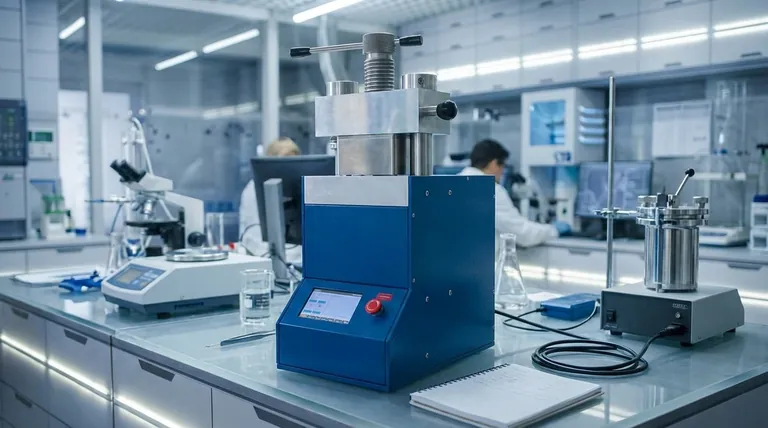
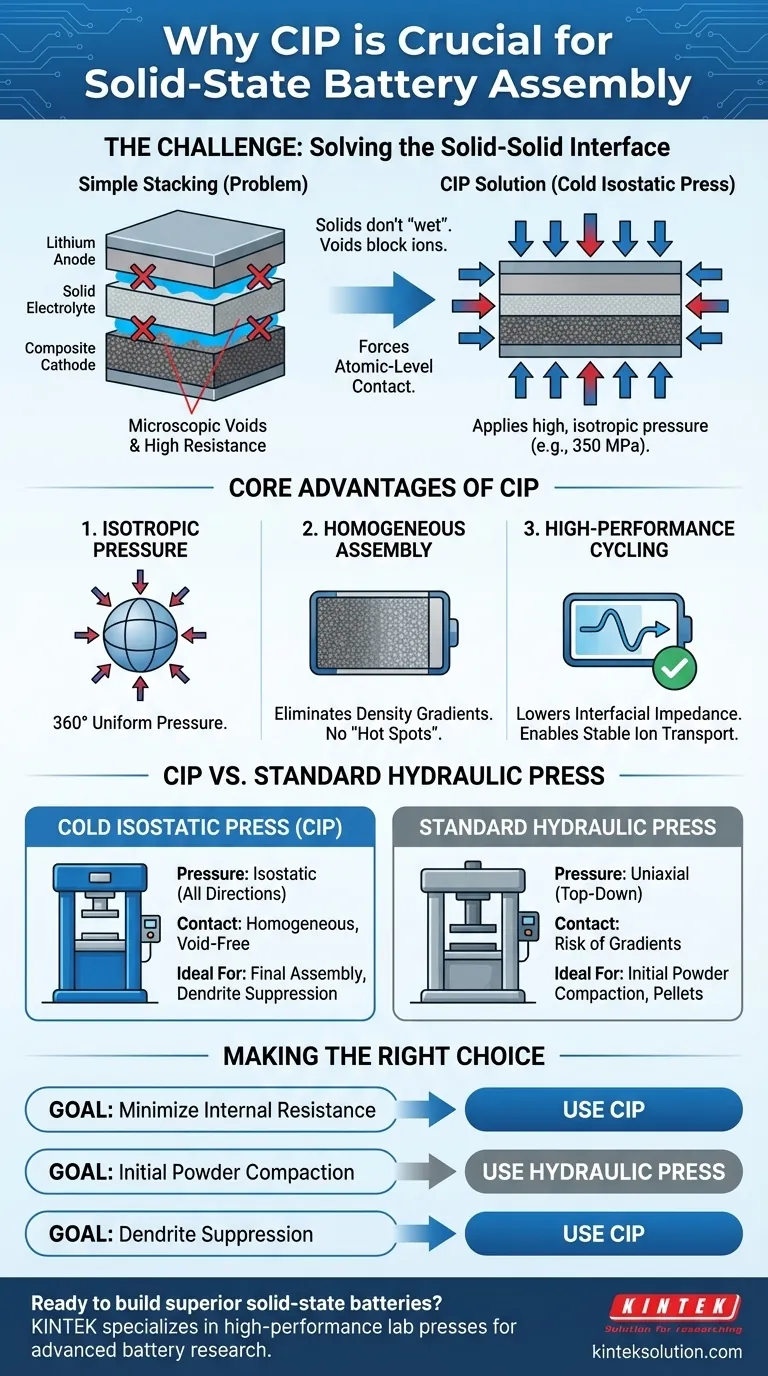
The primary function of a cold isostatic press (CIP) in solid-state battery assembly is to facilitate atomic-level contact between rigid layers. By applying high, isotropic pressure—often reaching 350 megapascals—the CIP eliminates microscopic voids between the lithium metal anode, the electrolyte pellet (such as LLZO), and the composite cathode. This mechanical force effectively substitutes for the "wetting" action found in liquid batteries, ensuring the device functions as a cohesive electrochemical unit.
Core Insight: In solid-state systems, ions cannot traverse air gaps or poor physical connections. A CIP is used to force distinct, rigid components to physically merge, drastically lowering interfacial resistance to a level that permits stable lithium-ion transport.
Solving the Solid-Solid Interface Challenge
The Limits of Simple Stacking
Unlike traditional lithium-ion batteries, solid-state batteries rely on solid electrolytes. Solids do not flow or "wet" the surface of the electrodes.
Simply stacking these components creates an assembly full of microscopic voids. These voids act as insulators, blocking ion movement and creating high internal resistance.
Eliminating Interfacial Impedance
The CIP is introduced to overcome this physical limitation. By compressing the assembly, it minimizes interfacial impedance.
This ensures that the lithium ions can move freely between the anode, electrolyte, and cathode. Without this compression, the battery would likely exhibit poor conductivity and unstable cycling performance.
The Isotropic Advantage
Uniform Pressure Distribution
A standard hydraulic press typically applies uniaxial pressure (pressure from the top and bottom). While useful for creating pellets, this can lead to density gradients where the edges are less compacted than the center.
A cold isostatic press applies isotropic pressure. This means the pressure is applied equally from every direction (360 degrees).
Homogeneity of the Assembly
This multi-directional force ensures the contact is homogeneous across the entire surface area of the components.
Whether assembling a symmetric cell or a full battery, this uniformity prevents "hot spots" of current density. It creates an extremely tight, seamless physical interface that uniaxial pressing cannot always achieve.
Enabling High-Performance Cycling
The text references specific components like LLZO electrolyte pellets and composite cathodes. These materials require intimate contact to function.
The 350 MPa pressure ensures these diverse materials effectively fuse at the interface. This stability allows for the systematic investigation of electrochemical properties and suppresses lithium dendrite growth by removing the voids where dendrites often initiate.
Understanding the Trade-offs
Pressure vs. Integrity
While high pressure is critical for contact, it must be carefully balanced. The references highlight the need for controlled pressure.
Applying force indiscriminately can damage brittle solid electrolytes or deform the electrode structure.
Equipment Complexity
Using a CIP adds a step to the manufacturing process compared to simple stacking.
However, the references suggest this is a necessary trade-off. The gain in performance—specifically the lowering of total internal resistance—outweighs the added complexity of the isostatic pressing stage.
Making the Right Choice for Your Goal
When determining the assembly protocol for solid-state cells, consider the specific requirements of your materials:
- If your primary focus is minimizing internal resistance: Utilize a Cold Isostatic Press (CIP) to apply 350 MPa of isotropic pressure, ensuring the tightest possible interfacial contact.
- If your primary focus is initial powder compaction: A standard hydraulic press (uniaxial) is sufficient for creating self-supporting separator pellets or compacting composite powders before final assembly.
- If your primary focus is dendrite suppression: Prioritize high, uniform pressure (via CIP) to eliminate the voids and gaps that facilitate dendrite nucleation.
The effectiveness of a solid-state battery is defined not just by the chemistry of its materials, but by the physical quality of the interfaces between them.
Summary Table:
| Aspect | Cold Isostatic Press (CIP) | Standard Hydraulic Press |
|---|---|---|
| Pressure Type | Isostatic (equal from all directions) | Uniaxial (top-down only) |
| Interface Contact | Homogeneous, eliminates microscopic voids | Risk of density gradients and poor edge contact |
| Ideal Application | Final assembly of full cells, dendrite suppression | Initial powder compaction, pellet creation |
| Key Benefit | Drastically lowers interfacial resistance for stable cycling | Simpler process for basic compaction |
Ready to build superior solid-state batteries with flawless interfaces? KINTEK specializes in high-performance lab press machines, including automatic and isostatic presses designed for advanced battery research. Our equipment delivers the precise, uniform pressure (up to 350 MPa) you need to eliminate interfacial resistance and achieve stable, high-performance cells. Contact our experts today to find the perfect press for your laboratory's needs!
Visual Guide
References
- Matthias Klimpel, Maksym V. Kovalenko. Dual-Layer Li Metal All-Solid-State Battery Based on an Argyrodite-type Li <sub>6</sub> PS <sub>5</sub> Cl Catholyte and a Garnet-type Li <sub>7</sub> La <sub>3</sub> Zr <sub>2</sub> O <sub>12</sub> Separator. DOI: 10.1021/acsaem.5c02435
This article is also based on technical information from Kintek Solution Knowledge Base .
Related Products
- Electric Lab Cold Isostatic Press CIP Machine
- Electric Split Lab Cold Isostatic Pressing CIP Machine
- Automatic Lab Cold Isostatic Pressing CIP Machine
- Manual Cold Isostatic Pressing CIP Machine Pellet Press
- Lab Isostatic Pressing Molds for Isostatic Molding
People Also Ask
- What are the applications of electric lab cold isostatic presses in research settings? Advance Material R&D with High-Pressure CIPs
- What role do electric lab cold isostatic presses play in industrial contexts? Bridge R&D and Manufacturing with Precision
- How does electrical Cold Isostatic Pressing (CIP) contribute to cost savings? Unlock Efficiency and Reduce Expenses
- What are some research applications of electric lab CIPs? Unlock Uniform Powder Densification for Advanced Materials
- What are the characteristics of standard off-the-shelf electric lab CIP solutions? Achieve Immediate, Cost-Effective Processing
















