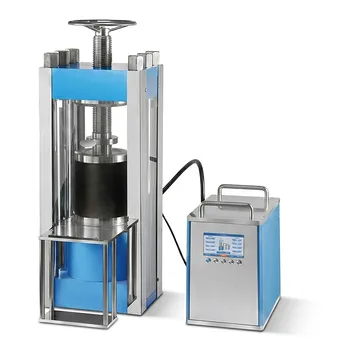
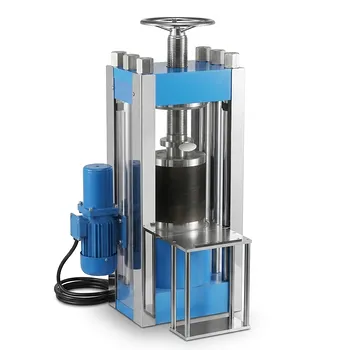
A heated laboratory press is the vital tool for manipulating the molecular state of lignin, the natural glue within wood fibers. By reaching the glass transition temperature ($T_g$), the press transforms rigid lignin into a flowable adhesive that fills microscopic pores and reinforces the structural network. This precise thermal application is the only way to significantly increase the compressive strength and stiffness of linerboard through densification without damaging its underlying fiber structure.
Core Takeaway: Precision temperature control allows linerboard to reach a specific "rubbery" state where lignin acts as a high-performance binder, maximizing inter-fiber bonding and eliminating internal voids to produce a superior, high-density material.
The Role of Lignin as a Structural Bio-Adhesive
Reaching the Glass Transition Temperature ($T_g$)
To increase strength, the linerboard must be heated to approximately 150°C, the point at which lignin undergoes a phase change. At this specific temperature, the amorphous components of the wood fibers transition from a rigid glassy state to a rubbery elastic state.
Activating the Natural Binding Process
Once the lignin reaches its $T_g$, it begins to soften and flow between the individual cellulose fibers. In this state, it acts as a natural binder, filling fiber pores and creating a more continuous, reinforced matrix that is significantly stronger than the original loose fiber network.
Reinforcing Inter-Fiber Bonding
The simultaneous application of heat and pressure forces these softened polymers into the gaps between fibers. This ensures that when the material cools, the lignin "sets" in its new position, providing maximum inter-fiber bonding and a permanent increase in the board’s overall stiffness.
Achieving Structural Integrity Through Precision
Eliminating Internal Voids and Air Pockets
Precision control allows for the gradual removal of residual air and the closure of micropores within the specimen. By eliminating density gradients and internal voids, the press ensures the linerboard has a consistent internal structure, which is critical for accurate mechanical performance testing.
Preventing Fiber Fracture During Densification
Without precise temperature control, the fibers remain in a brittle, glassy state and can fracture under the high pressures required for densification. A stable thermal field ensures the material is sufficiently plasticized, allowing for significant compression and thickness control without compromising the integrity of the fiber structure.
Ensuring Chemical and Mechanical Consistency
High-precision control (similar to that used in XLPE or composite preparation) ensures that thermal activation is uniform across the entire sample. This uniformity guarantees that the resulting test samples have stable mechanical properties and highly consistent geometric dimensions, ensuring repeatability in laboratory results.
Understanding the Trade-offs
Risks of Thermal Degradation
While heat is necessary to soften lignin, excessive temperatures can lead to the thermal degradation of hemicellulose and cellulose fibers. If the temperature exceeds the optimal range, the chemical bonds within the wood begin to break down, which actually decreases the structural strength and makes the board brittle.
Consequences of Pressure Inconsistency
If pressure and temperature are not synchronized, the lignin may cool and "re-glassify" before the compression process is complete. This results in internal stresses and surface flatness issues, which can lead to premature failure during compressive strength testing.
How to Apply Laboratory Press Precision to Your Project
When utilizing a heated laboratory press for linerboard or fiber composites, your settings must align with your specific material objectives:
- If your primary focus is maximum compressive strength: Set the press to reach 150°C to ensure full lignin flow and pore closure while maintaining a stable, staged pressure increase.
- If your primary focus is structural uniformity: Prioritize the synchronization of heat and pressure to eliminate internal air bubbles and density gradients throughout the specimen.
- If your primary focus is avoiding fiber damage: Ensure the material reaches its rubbery state (approx. 140°C-150°C) before applying peak densification pressure to prevent brittle fracturing.
The ultimate strength of linerboard is not just a result of pressure, but of the precise thermal management of its internal chemical architecture.
Summary Table:
| Key Factor | Optimal Range/Action | Impact on Compressive Strength |
|---|---|---|
| Temperature ($T_g$) | ~150°C | Transitions lignin into a flowable adhesive to reinforce fibers. |
| Material State | Rubbery/Plasticized | Allows densification without brittle fiber fracturing. |
| Void Management | Precision Compression | Eliminates air pockets for a consistent internal structure. |
| Uniformity | Stable Thermal Field | Ensures repeatable mechanical results and geometric precision. |
Optimize Your Material Research with KINTEK
Achieving superior compressive strength and structural integrity requires more than just pressure—it requires precision. KINTEK specializes in comprehensive laboratory pressing solutions tailored for demanding research in fiber composites and battery technology.
Our extensive lineup includes:
- Manual & Automatic Heated Presses for precise lignin activation and densification.
- Multifunctional & Glovebox-Compatible Models for sensitive research environments.
- Cold and Warm Isostatic Presses widely applied in advanced battery and material science.
Ready to enhance your lab's testing accuracy and sample consistency? Contact us today to discover how our high-precision pressing solutions can empower your next breakthrough!
References
- Motasem N. Saidan. Improvement of linerboard compressive strength by hot-pressing and addition of recovered lignin from spent pulping liquor. DOI: 10.2298/ciceq131205012s
This article is also based on technical information from Kintek Solution Knowledge Base .
Related Products
- 24T 30T 60T Heated Hydraulic Lab Press Machine with Hot Plates for Laboratory
- Automatic Large Format Laboratory Heated Hydraulic Press 400x400mm Plate Capacity
- Automatic Heated Hydraulic Lab Press Machine 200x200 Plate Size for Battery Research and Materials Science
- Automatic Heated Hydraulic Lab Press with Programmable Touch Screen Controls and Precision Temperature Regulation
- Heated Hydraulic Press Machine with Heated Plates for Vacuum Box Laboratory Hot Press
People Also Ask
- Function of a Laboratory Hydraulic Press with Heated Platens in SSE? Enhance Battery Density & Conductivity
- Why is a laboratory hydraulic press with heating plates required for PLA/TEC films? Achieve Precise Sample Integrity
- What role does a laboratory heated hydraulic press play in LTCC? Essential for High-Density Ceramic Lamination
- What is the primary function of a laboratory heated hydraulic press? Mastering Thermoplastic Carbon Fiber Composites
- What is the critical role of a laboratory heated hydraulic press? Mastering PVC Sample Prep for Testing