
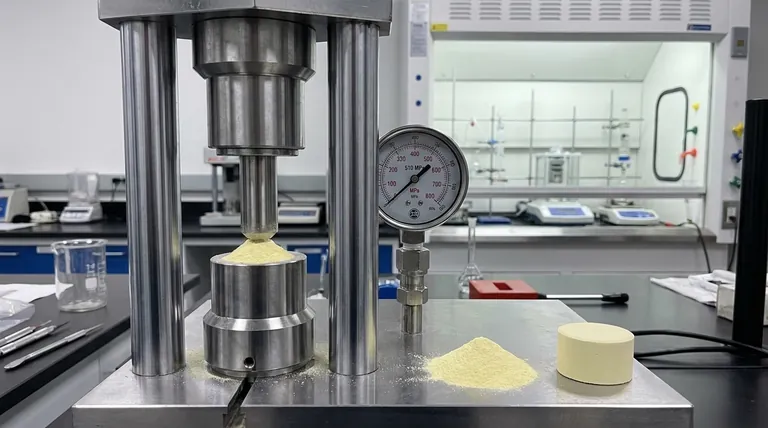
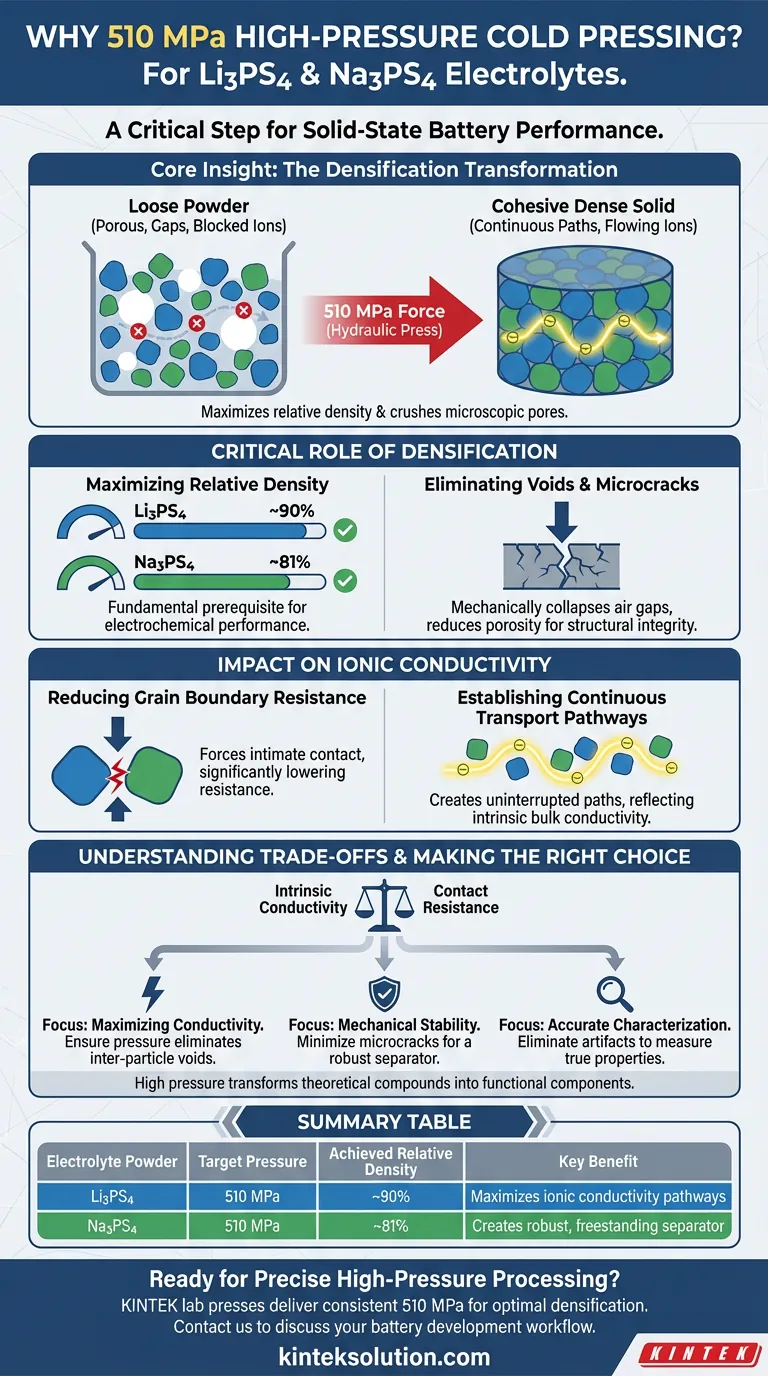
High-pressure cold pressing at 510 MPa is a critical processing step required to physically force loose Li3PS4 and Na3PS4 electrolyte powders into a cohesive, dense solid. Without this specific magnitude of force, the material retains excessive porosity, creating physical gaps that block the flow of ions and render the electrolyte ineffective for battery applications.
Core Insight Solid-state electrolytes rely entirely on physical contact for ion transport, unlike liquid electrolytes that naturally flow into voids. Applying 510 MPa is necessary to crush microscopic pores and maximize relative density—reaching 90% for Li3PS4 and 81% for Na3PS4—which minimizes resistance and unlocks the material's true potential.
The Critical Role of Densification
Maximizing Relative Density
The primary objective of applying 510 MPa is to achieve high relative density.
For Li3PS4, this pressure enables the pellet to reach approximately 90% density, while Na3PS4 reaches about 81%.
High density is not merely a structural metric; it is the fundamental prerequisite for electrochemical performance in solid-state systems.
Eliminating Voids and Microcracks
Loose powders contain significant void space (air gaps) between particles.
Under 510 MPa, these voids are mechanically collapsed.
This reduces the presence of microcracks and porosity, which are detrimental to both the structural integrity and the conductive path of the electrolyte.
Impact on Ionic Conductivity
Reducing Grain Boundary Resistance
In a powder compact, the interface between two particles is called a grain boundary.
These boundaries naturally resist the flow of ions.
By applying high pressure, you force particles into intimate contact, significantly lowering the resistance at these boundaries.
Establishing Continuous Transport Pathways
Ions cannot jump across empty space; they require a continuous solid medium.
High-pressure compaction merges discrete powder particles into a unified structure.
This creates well-defined, uninterrupted pathways for lithium or sodium ions to move through the material, allowing the system to reflect its intrinsic bulk conductivity.
Understanding the Trade-offs
Intrinsic Conductivity vs. Contact Resistance
If the pressure applied is insufficient, your performance data will be skewed.
At lower pressures, the measured resistance is dominated by poor contact between particles (contact resistance) rather than the material's actual capability.
High pressure ensures you are testing the chemistry of the electrolyte, not the quality of the pressing.
Mechanical Stability Considerations
While 510 MPa is ideal for these specific sulfides, pressure requirements vary by material.
Some materials may require up to 640 MPa for densification, while others form stable separators at 240 MPa.
The trade-off is always between achieving maximum density and avoiding damage to the pressing equipment or inducing stress fractures in the pellet itself.
Making the Right Choice for Your Goal
If your primary focus is Maximizing Conductivity: Ensure your pressing pressure is high enough (e.g., 510 MPa) to eliminate inter-particle voids, as air gaps act as insulators that sever ionic pathways.
If your primary focus is Mechanical Stability: Use high pressure to minimize microcracks, transforming loose powder into a robust, freestanding separator capable of withstanding battery assembly.
If your primary focus is Accurate Characterization: Apply constant high pressure during impedance spectroscopy to eliminate contact resistance artifacts and measure the true intrinsic properties of the material.
High-pressure processing is the bridge that transforms a theoretical chemical compound into a functional, high-performance battery component.
Summary Table:
| Electrolyte Powder | Target Pressure | Achieved Relative Density | Key Benefit |
|---|---|---|---|
| Li3PS4 | 510 MPa | ~90% | Maximizes ionic conductivity pathways |
| Na3PS4 | 510 MPa | ~81% | Creates robust, freestanding separator |
Ready to transform your solid-state electrolyte research with precise high-pressure processing?
KINTEK specializes in laboratory press machines (including automatic lab presses, isostatic presses, and heated lab presses) designed to meet the exacting demands of battery material development. Our equipment delivers the consistent 510 MPa pressure required to achieve optimal densification, eliminate contact resistance, and accurately characterize your Li3PS4 and Na3PS4 electrolytes.
Contact us today via our contact form to discuss how our lab presses can enhance your battery development workflow and help you achieve reliable, high-performance results.
Visual Guide
Related Products
- Manual Laboratory Hydraulic Pellet Press Lab Hydraulic Press
- Automatic Laboratory Hydraulic Press Lab Pellet Press Machine
- Laboratory Hydraulic Split Electric Lab Pellet Press
- Automatic Laboratory Hydraulic Press for XRF and KBR Pellet Pressing
- Laboratory Hydraulic Press Lab Pellet Press Button Battery Press
People Also Ask
- What is the primary purpose of a manual lab hydraulic pellet press? Ensure Accurate Sample Prep for XRF and FTIR
- What is the primary purpose of manual lab hydraulic pellet presses? Achieve High-Precision Sample Preparation for Spectroscopy
- What role does a lab hydraulic press play in researching squishy granular matter? Expert Insights into Material Physics
- What is the primary function of a laboratory hydraulic press in evaluating the ionic conductivity of Li6PS5X (LMSX)?
- What is the purpose of initial axial molding using a lab hydraulic press? Optimizing Electrolyte Green Bodies



















