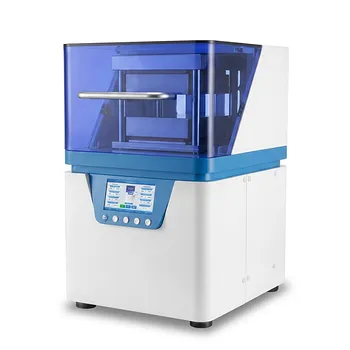
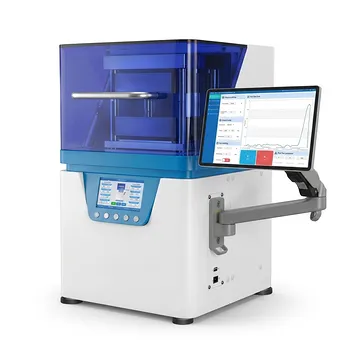
The primary role of a hydraulic press in X-ray fluorescence (XRF) preparation is to compress loose powder mixtures into solid, high-density pellets. By applying controlled force—often up to 15 tons or more—the press transforms a mixture of sample powder and binder into a stable, flat disc. This physical transformation is the prerequisite for obtaining accurate, reproducible spectroscopic data.
Core Takeaway: XRF analysis is only as good as the sample presented to the instrument. A hydraulic press eliminates porosity and surface irregularities, ensuring that X-ray signals interact uniformly with the material. This reduces scattering errors and guarantees that the data reflects true elemental composition rather than sample preparation flaws.
Creating the Ideal Sample Structure
Eliminating Voids and Porosity
The fundamental challenge with loose powder is the presence of air gaps between particles.
A hydraulic press applies immense pressure (e.g., 166 kN or 15 tons) to collapse these voids. This compaction process results in a sample with uniform internal density, which is critical for consistent X-ray penetration.
Achieving an Optical-Grade Surface
For XRF, the surface of the sample must be perfectly flat and smooth.
The press utilizes polished dies to create a pellet with an optical-grade smooth surface. This smoothness minimizes the scattering of fluorescence radiation, ensuring the detector receives a clear, strong signal.
Homogenization
While the press itself does not mix the sample, it locks the mixture into a fixed state.
By compressing the powder and binder into a rigid form, the press ensures the distribution of elements remains homogeneous during the analysis, preventing segregation that could occur in loose powders.
Impact on Analytical Data
Reducing Scattering and Matrix Effects
Irregularities in a sample cause X-rays to scatter unpredictably.
By creating a dense, flat pellet, the hydraulic press significantly reduces X-ray scattering errors. This helps mitigate "matrix effects," where the physical state of the sample interferes with the measurement of specific elements.
Improving Sensitivity and Linearity
A well-pressed pellet ensures a direct relationship between signal intensity and elemental concentration.
Because particle size effects and porosity are eliminated, the detector receives signal intensities that maintain a good linear relationship with the actual elemental concentrations. This directly improves detection sensitivity and the accuracy of quantitative analysis.
Ensuring Repeatability
In scientific analysis, a result is only valuable if it can be reproduced.
High-stability hydraulic controls apply precise, repeatable pressure to every sample. This consistency ensures that any variation in results is due to chemical differences, not variations in sample density.
Throughput and Versatility
Handling High Sample Volumes
For laboratories processing many samples, speed is essential.
Modern hydraulic presses are designed for high throughput, featuring rapid operational cycles and integrated dies. This allows for the quick extraction of finished pellets, making the instrument immediately ready for the next cycle.
Adaptability
Different materials require different pressing parameters.
The hydraulic press is a versatile instrument capable of adjusting speeds, directions, and pressures. This flexibility allows technicians to optimize the preparation method for various materials, from geological samples like basalt to biological samples like hair or nails.
Understanding the Trade-offs
The Necessity of Binders
Pressure alone is often insufficient for non-cohesive powders.
To form a stable pellet that doesn't crumble, a binder (such as wax or cellulose) is usually mixed with the sample before pressing. While necessary for structural integrity, users must ensure the binder is chemically pure to avoid contaminating the analysis.
Pressure Limits
More pressure is not always better.
While high pressure creates density, excessive force can damage the die or cause capping (lamination) in the pellet. The goal is to find the optimal pressure that achieves maximum density without structural failure of the pellet.
Making the Right Choice for Your Goal
To maximize the effectiveness of your XRF analysis, align your pressing strategy with your specific analytical requirements:
- If your primary focus is Quantitative Accuracy: Prioritize high-stability hydraulic control to ensure uniform density, as this directly correlates to linear signal intensity and reduced matrix effects.
- If your primary focus is High Throughput: Select a press with rapid operational cycles and easy-to-clean integrated dies to minimize downtime between samples.
The hydraulic press is not just a tool for shaping materials; it is a standardization device that removes physical variables, allowing the chemistry of your sample to speak clearly.
Summary Table:
| Feature | Impact on XRF Analysis | Benefit to Lab |
|---|---|---|
| Void Elimination | Removes air gaps for uniform density | Consistent X-ray penetration |
| Surface Polishing | Creates an optical-grade flat surface | Minimizes radiation scattering |
| Repeatable Pressure | Standardizes sample thickness | High data reproducibility |
| High Throughput | Rapid operational cycles | Increased sample volume capacity |
Elevate Your Spectroscopy with KINTEK Pressing Solutions
As a specialist in comprehensive laboratory pressing solutions, KINTEK provides the precision tools you need for flawless XRF sample preparation. Whether you require manual, automatic, heated, or glovebox-compatible models, our equipment is designed to eliminate sample variability and maximize analytical accuracy.
From battery research to geological studies, our cold and warm isostatic presses ensure your lab achieves superior results every time. Contact KINTEK today to find the perfect press for your lab!
Related Products
- Automatic Hydraulic Hot Press with Large Plate and Precision Temperature Control for Advanced Material Sample Preparation and Industrial Research
- Automatic Hydraulic Heat Press Machine with Multi Stage Programmable Control and Integrated Water Cooling Plate Size 180x180mm
- Automatic High Temperature Heated Hydraulic Press Machine with Heated Plates for Lab
- Automatic Heated Hydraulic Lab Press with Programmable Touch Screen Controls and Precision Temperature Regulation
- Manual Heated Hydraulic Lab Press with Integrated Hot Plates Hydraulic Press Machine
People Also Ask
- What are the specific features and applications of hydraulic hot press machines? Precision Solutions for Modern Labs
- How does an automatic hydraulic press operate? Achieve Precision and Consistency in Lab Pelleting
- What are the advantages and common applications of an automatic hydraulic press? Elevate Your Lab's Precision
- What is the technical significance of setting a precise dwell time? Achieve Peak Material Density and Stability
- When is an automatic hydraulic press more suitable than a manual press? Scale Your Lab with Precision & Speed