
The primary purpose of using a hydraulic press for sequential and co-pressing is to overcome the inherent lack of "wetting" in solid materials by mechanically forcing an intimate physical contact. In the absence of liquid electrolytes that naturally permeate porous electrodes, this mechanical force is the only mechanism available to eliminate microscopic voids. The sequential process first creates a stable, flat substrate, while the subsequent co-pressing merges the cathode and electrolyte into a single, dense unit with minimized interfacial impedance.
The Core Reality Solid-state batteries face a fundamental physical hurdle: solids do not flow like liquids to fill gaps. The hydraulic press acts as a fabrication tool to mechanically mimic the "wetting" process, utilizing extreme pressure to turn distinct powder layers into a unified, conductive network essential for ion transport.
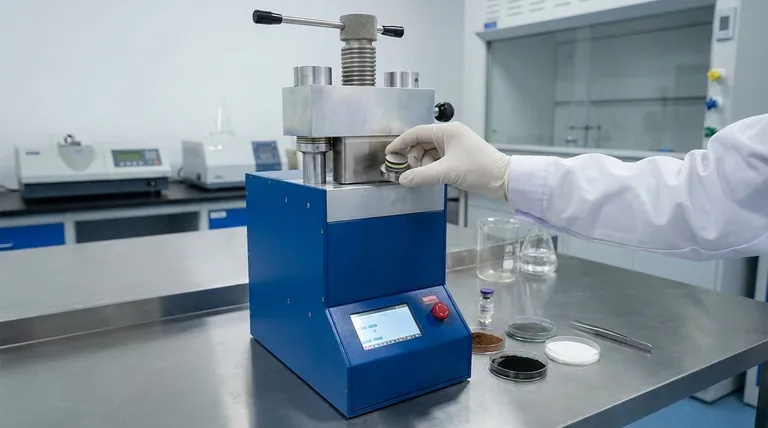
The Engineering Challenge: The Solid-Solid Interface
The Problem of Voids
In liquid batteries, the electrolyte flows into every pore of the cathode. In solid-state batteries, the cathode and electrolyte are distinct solid layers.
Without intervention, the interface between them remains rough and porous. These microscopic gaps (voids) act as insulators, blocking the flow of lithium ions.
The Role of Mechanical Force
To bridge these gaps, external force is required to deform the particles.
A hydraulic press applies the massive tonnage needed to physically crush solid electrolyte particles against the cathode material, maximizing the active contact area.
Why the Procedure is Sequential (Pre-Pressing)
Establishing Structural Integrity
The first step usually involves pressing one component—either the cathode composite or the solid electrolyte powder—at a relatively low pressure (e.g., 40 to 120 MPa).
This "pre-press" transforms loose powder into a cohesive, handleable pellet or layer.
Creating a Uniform Substrate
This initial step eliminates the majority of bulk voids within the single layer.
It creates a flat, dense surface that serves as a high-quality foundation for the subsequent addition of the next layer.
Why Co-Pressing is Critical (The High-Pressure Step)
Achieving Interfacial Fusion
Once the second layer is added, the stack undergoes co-pressing at significantly higher pressures (e.g., 250 to 700 MPa).
This step is not just about compaction; it is about adhesion. It forces the cathode and electrolyte materials to interlock at the microscopic level.
Formation of Transport Networks
This high-pressure phase establishes continuous pathways for both ions and electrons.
By densifying the composite structure, the press ensures that lithium ions can move rapidly between the electrode and the electrolyte without encountering "dead zones" caused by air gaps.
Understanding the Trade-offs
Uniaxial vs. Isostatic Pressure
A standard hydraulic press applies uniaxial pressure (force from one direction). While effective for simple layer stacking, it can create pressure gradients, meaning the edges might be less dense than the center.
Isostatic pressing (pressure from all directions via fluid/gas) is sometimes preferred for complex shapes to ensure uniform densification throughout the entire cell, though it is more complex to execute.
The Role of Temperature (Hot Pressing)
Pressure alone has limits, especially with harder materials.
Integrating heat (Hot Pressing) can soften polymer binders or solid electrolyte particles (often below 150°C). This allows particles to flow plastically at lower pressures (e.g., 20 MPa), resulting in a denser interface and improved crystallinity without the risk of crushing active materials.
Making the Right Choice for Your Goal
How to Apply This to Your Project
- If your primary focus is reducing internal resistance: Prioritize the high-pressure co-pressing step (up to 700 MPa) to maximize particle-to-particle contact area.
- If your primary focus is manufacturing efficiency: Utilize a heated hydraulic press to achieve sufficient densification at lower pressures, which reduces wear on the die and equipment.
- If your primary focus is structural stability: Ensure a distinct pre-pressing step to form a flat, dense electrolyte pellet before introducing the cathode material.
Ultimatley, the hydraulic press is not merely shaping the battery; it is engineering the electrochemical performance by physically constructing the ion conduction highways.
Summary Table:
| Step | Pressure Range | Purpose |
|---|---|---|
| Sequential (Pre-Press) | 40 - 120 MPa | Creates a stable, flat substrate from loose powder. |
| Co-Pressing | 250 - 700 MPa | Fuses cathode & electrolyte layers, minimizing interfacial impedance. |
| Hot Pressing | ~20 MPa (with heat) | Softens materials for densification at lower pressures. |
Ready to engineer superior all-solid-state batteries? The right lab press is critical for achieving the dense, low-impedance interfaces your research demands. KINTEK specializes in lab press machines—including automatic, isostatic, and heated lab presses—designed to meet the precise pressure and temperature control needs of battery development. Contact us today (#ContactForm) to discover how our expertise can help you build a more efficient and powerful energy storage future.
Visual Guide

Related Products
- Automatic High Temperature Heated Hydraulic Press Machine with Heated Plates for Lab
- Heated Hydraulic Press Machine with Heated Plates for Vacuum Box Laboratory Hot Press
- Manual Heated Hydraulic Lab Press with Integrated Hot Plates Hydraulic Press Machine
- Laboratory Hydraulic Press 2T Lab Pellet Press for KBR FTIR
- Laboratory Hydraulic Press Lab Pellet Press Machine for Glove Box
People Also Ask
- Function of a Laboratory Hydraulic Press with Heated Platens in SSE? Enhance Battery Density & Conductivity
- What are the requirements for electrode pressing with high-viscosity ionic liquids like EMIM TFSI? Optimize Performance
- How does a laboratory heated hydraulic press facilitate PBN sample prep for WAXS? Achieve Precise X-Ray Scattering
- What are the industrial applications of heated hydraulic presses? Master Heat & Force for Precision Manufacturing
- Why is a laboratory hydraulic press with heating plates required for PLA/TEC films? Achieve Precise Sample Integrity



















