
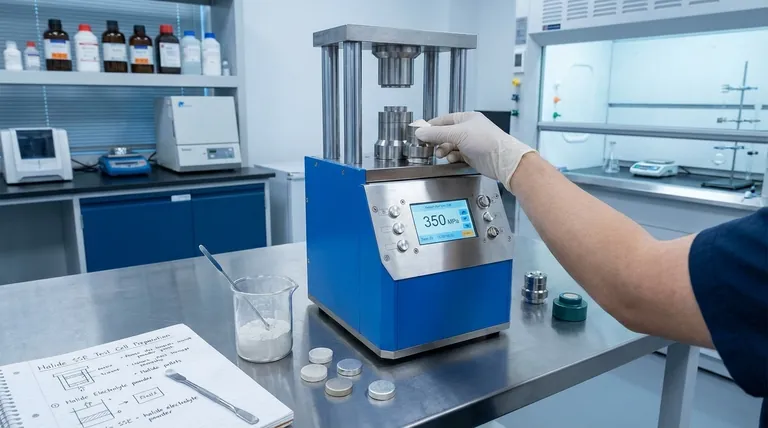
A laboratory hydraulic press is the critical enabler for converting loose halide electrolyte powder into a functional solid-state component. By applying significant, uniform pressure—often reaching hundreds of megapascals—the press transforms porous powder into a dense, mechanically stable pellet required for accurate electrochemical testing.
The Core Insight
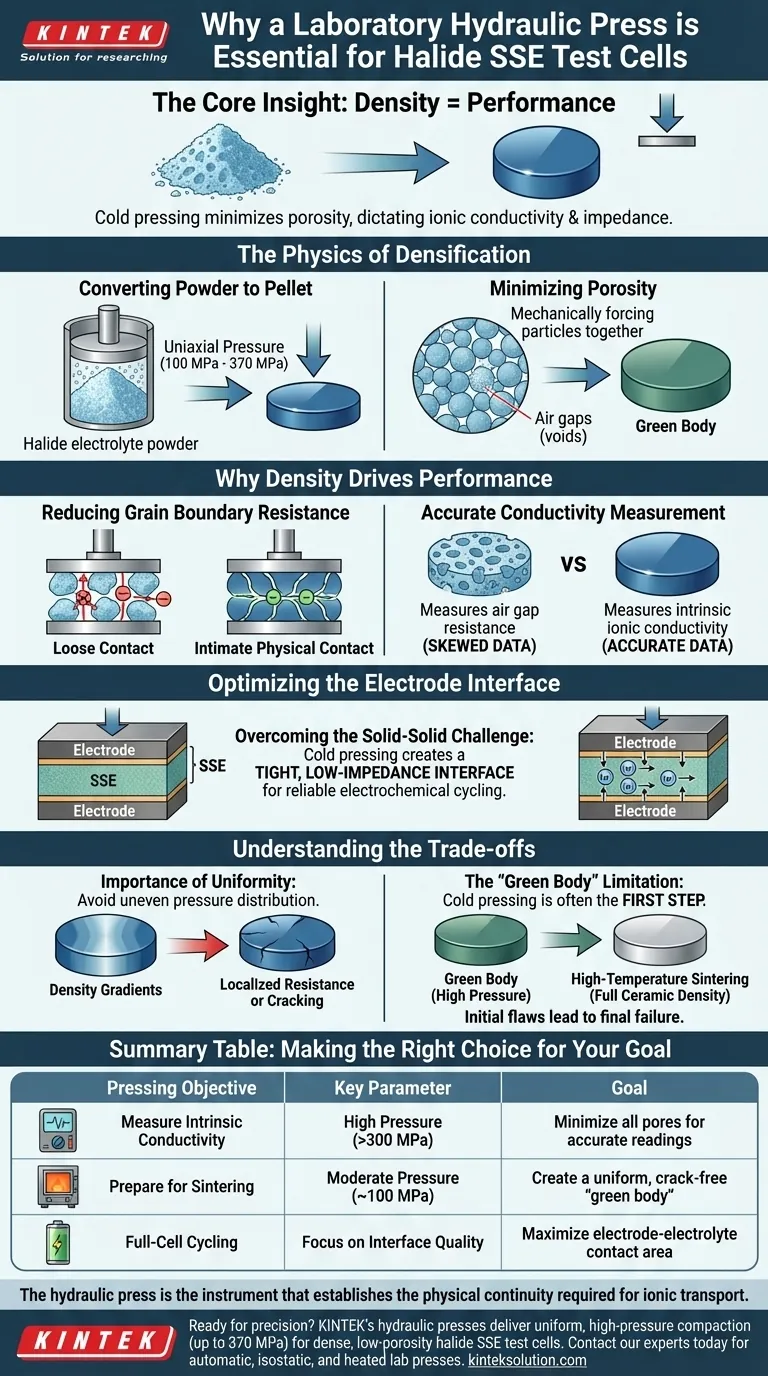
In solid-state battery research, density equates to performance. Cold pressing is not merely about shaping the material; it is a fundamental process to minimize porosity and maximize particle contact, which directly dictates the ionic conductivity and impedance of the final test cell.
The Physics of Densification
Converting Powder to Pellet
Synthesized halide electrolytes begin as loose powders with significant void space between particles.
To create a viable test cell, you must apply uniaxial pressure to compact this powder. References indicate that pressures typically range from 100 MPa to 370 MPa, depending on the specific material composition.
Minimizing Porosity
The primary function of the hydraulic press is to drastically reduce internal porosity.
By mechanically forcing particles together, you eliminate the air gaps (voids) that naturally exist in the bulk powder. This results in a high-density "green body," which is the structural foundation for any subsequent testing or sintering steps.
Why Density Drives Performance
Reducing Grain Boundary Resistance
For a battery to function, ions must travel through the electrolyte material.
Loose contact between powder grains creates high resistance, blocking this movement. High-pressure compaction ensures intimate physical contact between grains, reducing grain boundary resistance and creating continuous pathways for ionic conduction.
Accurate Conductivity Measurement
If a pellet is porous, you are measuring the resistance of the air gaps rather than the material itself.
A dense pellet allows researchers to measure the material's intrinsic ionic conductivity. Without the high compaction provided by a hydraulic press, performance data would be skewed by the physical defects of the sample rather than the chemical properties of the halide.
Optimizing the Electrode Interface
Overcoming the Solid-Solid Challenge
Unlike liquid electrolytes, which naturally flow into pores, solid electrolytes generally do not conform to electrode surfaces on their own.
Cold pressing is essential for creating a tight, low-impedance interface between the electrolyte and the electrodes.
Ensuring Electrochemical Cycling
A high-quality interface is non-negotiable for battery cycling.
The hydraulic press applies the force necessary to adhere the materials, ensuring the structural integrity required for the battery to charge and discharge without losing electrical contact.
Understanding the Trade-offs
The Importance of Uniformity
While high pressure is necessary, the application of that pressure must be uniform.
Uneven pressure distribution can lead to density gradients within the pellet. This can cause localized areas of high resistance or structural weaknesses that lead to cracking.
The "Green Body" Limitation
For some processes, cold pressing is only the first step.
While it creates a dense "green body" with initial strength, some materials may still require high-temperature sintering to achieve full ceramic density. The cold press prepares the material for this step; if the initial pressing is flawed, the final sintered ceramic will likely crack or fail.
Making the Right Choice for Your Goal
To ensure valid results, align your pressing parameters with your specific testing objectives:
- If your primary focus is measuring intrinsic conductivity: Ensure you apply sufficient pressure (often >300 MPa) to minimize all inter-particle pores, as porosity will artificially lower your conductivity readings.
- If your primary focus is preparing for sintering: Focus on creating a uniform, crack-free green body at moderate pressures (around 100 MPa) to ensure the pellet survives the thermal expansion and contraction of sintering.
- If your primary focus is full-cell cycling: Prioritize the interface quality; use the press to maximize the contact area between the electrolyte and electrode layers to reduce impedance.
The hydraulic press is not just a shaping tool; it is the instrument that establishes the physical continuity required for ionic transport.
Summary Table:
| Pressing Objective | Key Parameter | Goal |
|---|---|---|
| Measure Intrinsic Conductivity | High Pressure (>300 MPa) | Minimize all pores for accurate readings. |
| Prepare for Sintering | Moderate Pressure (~100 MPa) | Create a uniform, crack-free 'green body'. |
| Full-Cell Cycling | Focus on Interface Quality | Maximize electrode-electrolyte contact area. |
Ready to fabricate high-density solid-state electrolyte pellets with precision?
KINTEK's laboratory hydraulic presses deliver the uniform, high-pressure compaction (up to 370 MPa) essential for creating dense, low-porosity halide SSE test cells. Ensure accurate ionic conductivity measurements and robust electrochemical cycling performance in your solid-state battery research.
Contact our experts today to discuss how our automatic lab presses, isostatic presses, and heated lab presses can meet your specific R&D needs.
Visual Guide
Related Products
- Automatic Laboratory Hydraulic Press for XRF and KBR Pellet Pressing
- Manual Cold Isostatic Pressing CIP Machine Pellet Press
- Laboratory Hydraulic Pellet Press for XRF KBR FTIR Lab Press
- Laboratory Hydraulic Split Electric Lab Pellet Press
- Manual Laboratory Hydraulic Pellet Press Lab Hydraulic Press
People Also Ask
- Why is pressing powder into a pellet critical before sintering? Ensure Dense, Conductive Solid-State Electrolytes
- What is the role of a laboratory pressure machine and KBr in FTIR? Master Sample Preparation for Flame Retardants
- What are the advantages of using a laboratory automatic hydraulic press for HEA green compact forming?
- What are the advantages of using a lab automatic hydraulic press for HEA green body molding? Ensure Material Integrity
- How does an automatic laboratory hydraulic press improve KBr pellet preparation? Achieve Precision IR Spectroscopy



















