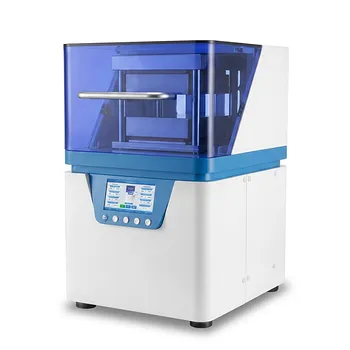
A laboratory hydraulic press with an electric heating system is the fundamental tool for achieving structural homogeneity in polymer composites. By simultaneously applying high temperatures—often reaching 220°C—and substantial clamping forces like 300kN, the system ensures that polymer granules reach a viscous flow state. This dual action allows the material to fill the mold cavity completely while purging trapped air, eliminating the microscopic defects that would otherwise compromise the structural integrity of the composite plate.
The core necessity of a heated hydraulic press lies in its ability to simultaneously control thermal and mechanical variables to transform raw materials into dense, standardized specimens. Without this precise synergy, internal voids and inconsistent density make accurate mechanical testing and material characterization impossible.
The Synergy of Heat and Pressure
Facilitating Viscous Flow
To create a high-performance plate, the polymer matrix must be fully re-melted and flowable. The integrated electric heating system provides the thermal energy required to transition polymers into a viscous state, allowing them to encapsulate reinforcements or fillers.
Eliminating Internal Voids via Degassing
High pressure (clamping force) is required to force the molten polymer into every corner of the mold. This pressurized degassing process expels trapped air and volatiles, which prevents the formation of internal micropores that act as stress concentrators during usage.
Ensuring Uniform Density
Unlike manual molding, a hydraulic press applies controllable and uniform pressure across the entire surface of the specimen. This eliminates internal density gradients, ensuring that the physical and mechanical properties are consistent from the center of the plate to its edges.
Facilitating Complex Chemical Transformations
Supporting Vulcanization and Cross-linking
For materials like EPDM or thermoset elastomers, the press acts as a chemical reactor. It provides the specific temperature environment (e.g., 165°C) and pressure required to induce vulcanization and cross-linking, transforming the material from a thermoplastic state into a durable, heat-resistant elastomer.
Enhancing Filler Integration and Nanocomposites
In advanced composites, the press facilitates the intercalation or exfoliation of additives like clay layers or inorganic fillers. The controlled pressure ensures tight packing and thermal fusion, which optimizes the interface between the polymer matrix and the reinforcement, enhancing properties like ionic conductivity or mechanical flexibility.
Enabling Bond Re-crosslinking
For specialized recyclable polymers based on Diels-Alder reactions, the press is essential for material repair. It provides the uniform contact and heat necessary to induce chemical bond re-crosslinking at fracture surfaces, allowing for repair efficiencies that can approach 100%.
Understanding the Trade-offs
Thermal Degradation Risks
Maintaining a high temperature for too long can lead to thermal degradation of the polymer chains, which weakens the final specimen. Precision control systems are necessary to balance the time required for flow with the stability of the polymer chemistry.
Flash and Material Loss
If the clamping force is insufficient or the temperature is too high (lowering viscosity excessively), material may leak from the mold, known as flash. This results in inconsistent specimen thickness and can damage the heating platens if not properly managed.
Cooling Rate Sensitivity
The transition from a heated state to a solid plate must be managed carefully. Uncontrolled cooling can cause internal stresses or warping, making "standardized" test plates unusable for high-precision mechanical analysis.
Making the Right Choice for Your Goal
To achieve the best results with a laboratory hydraulic press, your operational parameters must align with your specific material objectives.
- If your primary focus is Standardized Mechanical Testing: Prioritize a press with high-precision pressure control and cooling cycles to ensure consistent specimen thickness and eliminate internal voids.
- If your primary focus is Nanocomposite Development: Focus on systems with highly accurate temperature increments to facilitate the delicate process of intercalation and filler integration.
- If your primary focus is Thermoset or Elastomer Research: Ensure the press can maintain stable temperatures for extended periods to support complete vulcanization and chemical cross-linking.
- If your primary focus is Material Recycling and Repair: Select a press that offers uniform pressure distribution to ensure maximum contact at fracture surfaces for chemical bond restoration.
By mastering the balance of thermal energy and mechanical force, you transform inconsistent raw materials into the high-performance, defect-free composites required for modern engineering.
Summary Table:
| Key Feature | Functional Role | Impact on Composite Quality |
|---|---|---|
| Integrated Heating | Enables viscous flow of polymer matrix | Ensures mold filling & encapsulation of fillers |
| High Pressure (300kN) | Facilitates pressurized degassing | Eliminates internal voids and microscopic defects |
| Uniform Force Distribution | Standardizes density across specimen | Provides consistent mechanical properties for testing |
| Thermal Precision | Supports vulcanization & cross-linking | Critical for EPDM, elastomers, and nanocomposites |
| Controlled Cooling | Manages phase transition | Prevents warping and internal thermal stresses |
Elevate Your Material Research with KINTEK Precision
Unlock the full potential of your polymer research with KINTEK’s specialized laboratory pressing solutions. Whether you are advancing battery research or developing next-generation nanocomposites, our comprehensive range—including manual, automatic, heated, multifunctional, and glovebox-compatible models, as well as cold and warm isostatic presses—is designed to deliver the precise synergy of heat and pressure your materials require.
Why choose KINTEK?
- Precision Control: Eliminate internal voids and ensure uniform density in every specimen.
- Versatility: Solutions tailored for everything from standardized mechanical testing to complex chemical cross-linking.
- Expertise: Trusted by laboratories worldwide for high-performance composite synthesis.
Contact us today to find the perfect pressing solution for your lab!
References
- Mihai Georgescu, Dana Gurău. New Polymeric Compounds with High Temperature and Impact Resistance. DOI: 10.24264/icams-2016.i.12
This article is also based on technical information from Kintek Solution Knowledge Base .
Related Products
- Manual Heated Hydraulic Lab Press with Integrated Hot Plates Hydraulic Press Machine
- Automatic Heated Hydraulic Press Machine with Heated Plates for Laboratory
- 24T 30T 60T Heated Hydraulic Lab Press Machine with Hot Plates for Laboratory
- Automatic Heated Hydraulic Press Machine with Hot Plates for Laboratory
- Cylindrical Lab Electric Heating Press Mold for Laboratory Use
People Also Ask
- Why is a laboratory hydraulic press with heating plates required for PLA/TEC films? Achieve Precise Sample Integrity
- Why is a manual hydraulic heated lab press essential for compleximer materials? Unlock Advanced Material Synthesis
- Function of a Laboratory Hydraulic Press with Heated Platens in SSE? Enhance Battery Density & Conductivity
- What role does a lab manual hydraulic press play in Li9B19S33 ionic conductivity? Optimize Pellet Characterization
- What are the main benefits of performing proper maintenance on a heated lab press? Ensure Accuracy & Safety