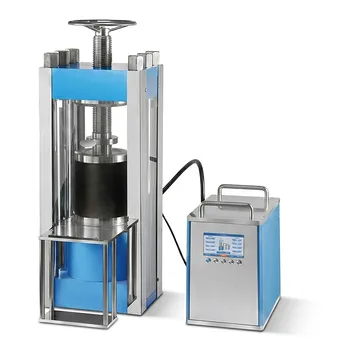
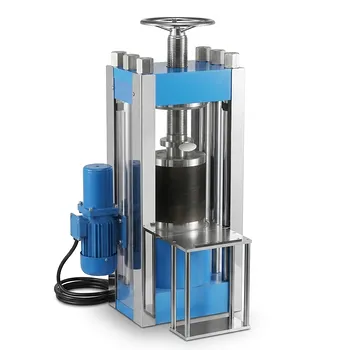
A multifunctional laboratory press is the superior choice for poplar wood densification because it synchronizes thermal energy with mechanical force to achieve a plasticized state in the material. This integration allows for higher compression efficiency at lower mechanical loads while significantly improving the uniformity and surface quality of the final densified layer.
The core advantage of a heated laboratory press lies in its ability to transform wood densification from a simple mechanical crushing process into a controlled thermo-mechanical molding event. By softening the wood's cellular structure before compression, researchers can achieve higher material density and structural integrity with less energy and fewer internal defects.
The Role of Plasticization in Wood Densification
Softening the Lignocellulosic Matrix
Poplar wood is composed of complex polymers that are rigid at room temperature. The integrated heating system raises the temperature of the wood to an optimal plasticized state, making the fibers more pliable and easier to reform without fracturing.
Enhancing Compression Efficiency
Because the wood is softened, the press can achieve significant densification using lower mechanical loads. This reduces the strain on the laboratory equipment and prevents the "spring-back" effect often seen in cold-pressed materials, where fibers attempt to return to their original shape.
Improving Surface Quality
The simultaneous application of heat and pressure ensures that the surface of the densified wood is smooth and uniform. This thermal-assisted smoothing creates a high-quality finish that cold pressing—which often results in surface cracking or uneven density—cannot replicate.
Enhancing Internal Structure and Stability
Reducing Rheological Resistance
Heat significantly reduces the internal friction and rheological resistance of the wood fibers during the compression phase. This allows the material to flow and rearrange more effectively, filling internal voids and creating a more homogenous structure.
Promoting Interfacial Bonding
The combined thermal and mechanical action facilitates better contact and interfacial bonding between the wood's internal components. This leads to a "melt-like" consistency in the densified zone, which improves the overall strength and durability of the specimen.
Increasing Dimensional Stability
Densification under heat helps "set" the wood in its new form by promoting solid-state diffusion and chemical stabilization. This results in a final product that is more resistant to moisture and environmental changes compared to wood that has only been mechanically compressed.
Understanding the Trade-offs and Risks
Energy and Time Requirements
A heated press requires a warm-up period and constant energy consumption to maintain precise temperatures. If your experiment requires rapid, high-volume throughput of low-precision samples, the time overhead of a heating system may be a factor.
Risk of Thermal Degradation
Poplar wood is sensitive to extreme temperatures; exceeding the optimal range can lead to thermal degradation or charring. Precise temperature control is mandatory to ensure the wood is plasticized rather than chemically damaged.
Increased System Complexity
Multifunctional presses with integrated platens are more complex to calibrate and maintain than standard hydraulic jacks. Researchers must manage both the pressure field and the temperature field simultaneously to ensure reproducible results.
Making the Right Choice for Your Research Goal
To select the appropriate pressing method, you must align the technology with your specific experimental outcomes.
- If your primary focus is Maximum Material Strength: Use a heated press to ensure deep plasticization and superior interfacial bonding between fibers.
- If your primary focus is Surface Aesthetics and Uniformity: A multifunctional press is essential to prevent the surface micro-cracking common in cold-densified poplar.
- If your primary focus is Dimensional Stability: The heated system is required to "lock" the densified structure and reduce the likelihood of the wood expanding post-compression.
- If your primary focus is High-Speed Prototyping of Non-Structural Parts: A standard cold press may suffice if density consistency and surface finish are not critical variables.
By integrating thermal control into the compression cycle, you transition from simply crushing wood to engineering a high-performance composite material.
Summary Table:
| Feature | Heated Multifunctional Press | Standard Cold Press |
|---|---|---|
| Mechanism | Thermo-mechanical molding | Mechanical compression |
| Material State | Plasticized (softened) | Rigid/Brittle |
| Compression Load | Lower load required | High load required |
| Surface Quality | Smooth, uniform finish | Risk of cracking/unevenness |
| Dimensional Stability | High (prevents spring-back) | Low (prone to expansion) |
| Primary Goal | High-performance composites | Rapid, non-structural parts |
Elevate Your Research Precision with KINTEK
Unlock superior material performance with KINTEK, your specialist in comprehensive laboratory pressing solutions. Whether you are engineering high-performance wood composites or advancing battery research, our diverse range of manual, automatic, heated, multifunctional, and glovebox-compatible models, alongside cold and warm isostatic presses, provides the exact thermal and mechanical control your experiments demand.
Don't settle for mechanical crushing—transition to controlled material engineering. Contact our experts today to find the ideal press for your laboratory's unique requirements!
References
- Qiaofang Zhou, Kaifu Li. Surface densification of poplar solid wood: Effects of the process parameters on the density profile and hardness. DOI: 10.15376/biores.14.2.4814-4831
This article is also based on technical information from Kintek Solution Knowledge Base .
Related Products
- 24T 30T 60T Heated Hydraulic Lab Press Machine with Hot Plates for Laboratory
- Automatic Large Format Laboratory Heated Hydraulic Press 400x400mm Plate Capacity
- Automatic Heated Hydraulic Lab Press Machine 200x200 Plate Size for Battery Research and Materials Science
- Automatic Heated Hydraulic Lab Press with Programmable Touch Screen Controls and Precision Temperature Regulation
- Heated Hydraulic Press Machine with Heated Plates for Vacuum Box Laboratory Hot Press
People Also Ask
- Function of a Laboratory Hydraulic Press with Heated Platens in SSE? Enhance Battery Density & Conductivity
- Why is a laboratory hydraulic press with heating plates required for PLA/TEC films? Achieve Precise Sample Integrity
- What role does a laboratory heated hydraulic press play in LTCC? Essential for High-Density Ceramic Lamination
- What is the primary function of a laboratory heated hydraulic press? Mastering Thermoplastic Carbon Fiber Composites
- What is the critical role of a laboratory heated hydraulic press? Mastering PVC Sample Prep for Testing