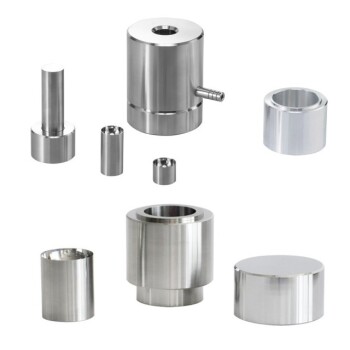
A pressure of 600 MPa is the critical threshold required to achieve a relative density of 88% to 92% in metal powder specimens. This specific force induces plastic deformation in the particles, mechanically locking them together to create a "green compact" with sufficient structural integrity. Without this density, the particles lack the contact area needed for atomic diffusion during the subsequent sintering phase.
The application of 600 MPa is not arbitrary; it is the force required to deform metal particles until they reach approximately 90% relative density. This pre-compaction is essential to maximize surface contact area, which serves as the bridge for atoms to diffuse and form permanent bonds during high-temperature sintering.
The Mechanics of Compaction
To transform loose powder into a solid component, you must overcome the material's natural resistance to shape change.
Forcing Plastic Deformation
Ideally, metal powders are not just packed closer together; they are physically altered.
The 600 MPa pressure forces the particles to undergo plastic deformation, changing their shape permanently.
Creating the Green Compact
This deformation causes the particles to adhere and mechanically interlock.
The result is a green compact—a pressed part that holds its shape and has specific structural strength even before it is heated.
The Link to Sintering Success
The pressing stage is essentially preparation for the sintering (heating) stage. The success of sintering is dictated by the density achieved during pressing.
Hitting the Density Target
The 600 MPa benchmark is specifically aimed at achieving a relative density of 88% to 92%.
At this density level, the porosity of the material is reduced to a level that supports high-quality metallurgical bonding.
Facilitating Atomic Diffusion
Sintering relies on atoms moving across particle boundaries to fuse the material.
The high density ensures that there is sufficient particle contact area to allow this atomic diffusion to occur efficiently.
Forming Sintering Necks
As atoms diffuse across these contact points, they form connections known as sintering necks.
These necks are the physical bridges that turn a pressed powder compact into a robust, solid metal component.
Understanding the Risks of Insufficient Pressure
While 600 MPa is a target, it is important to understand why falling short of this pressure compromises the final product.
Poor Green Strength
If the pressure is too low, the particles will not undergo enough plastic deformation to interlock.
This results in a fragile green compact that may crumble during handling before it can even reach the furnace.
Weak Sintered Bonds
Low pressure leads to low relative density and insufficient contact area between particles.
Without adequate contact, robust sintering necks cannot form, resulting in a final product with poor structural strength and high porosity.
Optimizing Your Pressing Process
To ensure you are producing high-quality powder metallurgy specimens, align your equipment capabilities with your density goals.
- If your primary focus is final part strength: Verify that your press consistently delivers 600 MPa to guarantee the 88-92% density needed for robust sintering necks.
- If your primary focus is process consistency: Monitor the green compact for stability, as this is the primary indicator that sufficient plastic deformation has occurred.
Applying the correct pressure is the single most important variable in transitioning from loose powder to a solid, durable metal component.
Summary Table:
| Process Variable | 600 MPa Threshold | Below 600 MPa Risk |
|---|---|---|
| Relative Density | 88% - 92% | Low density / high porosity |
| Material State | Plastic deformation | Insufficient particle interlocking |
| Green Strength | High (stable for handling) | Fragile (prone to crumbling) |
| Sintering Result | Strong atomic diffusion/necks | Weak metallurgical bonds |
Elevate Your Battery Research with KINTEK Precision
At KINTEK, we specialize in comprehensive laboratory pressing solutions tailored for high-stakes material science. Whether you require manual, automatic, heated, or multifunctional models, our equipment is engineered to deliver the precise pressures—up to 600 MPa and beyond—necessary for optimal powder metallurgy specimens.
From glovebox-compatible units to advanced cold and warm isostatic presses, KINTEK provides the structural integrity your green compacts demand. Maximize your sintering success and ensure robust atomic diffusion today.
Contact KINTEK Experts to Find Your Pressing Solution
References
- Milad Hojati, Herbert Danninger. Impact Fracture Behaviour of Powder Metallurgy Steels Sintered at Different Temperatures. DOI: 10.1007/s00501-024-01428-w
This article is also based on technical information from Kintek Solution Knowledge Base .
Related Products
- Lab Round Bidirectional Press Mold
- XRF KBR Steel Ring Lab Powder Pellet Pressing Mold for FTIR
- Lab Polygon Press Mold
- XRF KBR Plastic Ring Lab Powder Pellet Pressing Mold for FTIR
- Lab XRF Boric Acid Powder Pellet Pressing Mold for Laboratory Use
People Also Ask
- What is the purpose of incorporating cartridge heaters into a lab press mold for MLCC block compression? Optimize Results
- Why is precise cooling management of the lab press mold necessary? Protect Core Integrity in Thermoforming
- What is the function of a pressing tool in thermoplastic panels? Master Precision Shaping & Fusion Bonding
- Why is a high-performance laboratory molding press critical for in-situ electrolyte formation? Unlock Battery Success
- How do the design and geometric precision of pressing molds and mandrels affect the quality of PTFE composite samples?