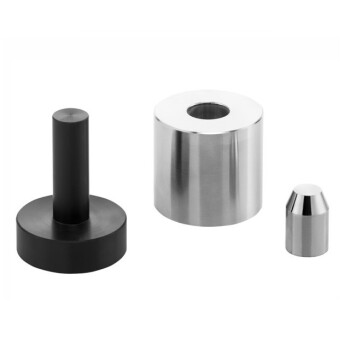
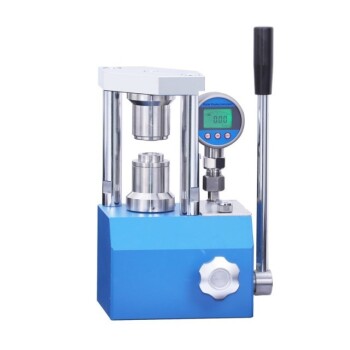
The application of constant limiting pressure is a fundamental requirement for all-solid-state lithium-sulfur batteries due to the massive volumetric changes inherent to sulfur chemistry. During the lithiation and delithiation processes, sulfur expands and contracts by up to 78 percent, creating a mechanical instability that creates gaps between internal components. A mold device applying significant pressure (typically around 60 MPa) is necessary to physically constrain this expansion, prevent material detachment, and maintain the essential contact required for the battery to cycle effectively.
Core Insight: Unlike liquid electrolyte systems that can flow to fill voids, solid-state batteries possess rigid interfaces that cannot self-heal. External pressure acts as a mechanical bridge, forcing active materials to maintain the continuous contact necessary for ion transport despite the drastic physical swelling and shrinking of the sulfur cathode.
The Mechanics of Volume Management
Controlling Massive Expansion
The primary driver for this requirement is the nature of sulfur itself. As sulfur reacts with lithium, it undergoes a volume change of nearly 78 percent.
Without external confinement, this expansion pushes components apart. The pressure mold acts as a containment vessel, ensuring the overall geometry of the cell remains stable despite internal fluctuations.
Suppressing Material Detachment
When the sulfur contracts during delithiation, it naturally pulls away from the electrolyte and conductive additives.
This leads to "island formation," where active material becomes electrically isolated and inactive. Constant limiting pressure effectively suppresses this detachment, forcing the materials to stay in proximity and reducing rapid capacity decay.
Optimizing the Solid-Solid Interface
Overcoming Interface Rigidity
In solid-state batteries, the interface between the cathode, anode, and electrolyte consists of rigid solids rather than adaptable liquids.
These solids have microscopic roughness that prevents perfect contact. High pressure (often around 80 MPa in testing) is required to deform these materials slightly, minimizing physical gaps and establishing a continuous path for lithium ions.
Minimizing Interfacial Resistance
Physical gaps at the interface act as barriers to ion movement, drastically increasing interfacial resistance.
By forcing full contact at these organic/inorganic boundaries, pressure ensures that lithium ions can migrate smoothly. This is critical for achieving acceptable current densities and ensuring the battery does not fail due to high impedance.
Utilizing Lithium Creep
During discharge, lithium is stripped from the anode, potentially creating voids that break contact.
External pressure leverages the creep properties of lithium metal, essentially squeezing the lithium to fill these voids as they form. This self-healing mechanism, driven by pressure, is vital for maintaining long-term cycling stability.
Understanding the Trade-offs
The Weight and Volume Penalty
While high pressure (60–80 MPa) solves electrochemical problems, it introduces significant engineering challenges.
The heavy steel molds or hydraulic presses required to maintain this force add immense weight and volume. This creates a disparity between the high energy density of the material level and the potentially low energy density of the complete system level.
Scalability Concerns
Replicating a constant 60 MPa pressure environment outside of a laboratory press is difficult for commercial applications.
Standard battery packs in electric vehicles cannot easily accommodate the heavy clamping mechanisms used in lab testing. This necessitates the search for solid electrolytes that can function at lower pressures or new cell designs that apply force more efficiently.
Making the Right Choice for Your Goal
When designing your testing protocols or battery architecture, the application of pressure dictates your results.
- If your primary focus is fundamental material research: Apply high constant pressure (60–80 MPa) to eliminate contact resistance as a variable and isolate the true electrochemical capability of your materials.
- If your primary focus is commercial viability: Experiment with the lowest functional pressure thresholds to identify the minimum mechanical overhead required for a practical cell design.
Ultimately, the pressure mold is not just a testing accessory; it is an integral component of the battery's operating system, compensating for the lack of fluidity in solid-state chemistry.
Summary Table:
| Factor | Impact on Solid-State Li-S Batteries | Role of Constant Pressure |
|---|---|---|
| Sulfur Volume Change | Up to 78% expansion/contraction | Constrains expansion & prevents structural failure |
| Interface Contact | Rigid solids create gaps/voids | Forces physical contact for ion transport |
| Material Attachment | Active materials detach (island formation) | Suppresses detachment to maintain conductivity |
| Interfacial Resistance | Increases significantly without contact | Minimizes resistance by closing microscopic gaps |
| Lithium Anode | Void formation during stripping | Leverages lithium creep to self-heal voids |
Elevate Your Battery Research with KINTEK Precision
Achieving the critical 60-80 MPa pressure required for all-solid-state lithium-sulfur battery cycling demands robust and precise equipment. KINTEK specializes in comprehensive laboratory pressing solutions, offering a range of manual, automatic, and heated models designed to maintain the rigorous constant limiting pressure your research requires.
Whether you are focusing on fundamental material behavior or commercial scalability, our tools—including multifunctional, glovebox-compatible, and isostatic presses—ensure your solid-state interfaces remain stable and conductive.
Ready to optimize your battery performance? Contact our experts today to find the perfect pressing solution for your lab!
References
- Yuta Kimura, Saneyuki Ohno. Unraveling Asymmetric Macroscopic Reaction Dynamics in Solid‐State Li–S Batteries During Charge–Discharge Cycles: Visualizing Ionic Transport Limitations with <i>Operando</i> X‐Ray Computed Tomography. DOI: 10.1002/aenm.202503863
This article is also based on technical information from Kintek Solution Knowledge Base .
Related Products
- Warm Isostatic Press for Solid State Battery Research Warm Isostatic Press
- Lab Isostatic Pressing Molds for Isostatic Molding
- Electric Lab Cold Isostatic Press CIP Machine
- Manual Cold Isostatic Pressing CIP Machine Pellet Press
- Automatic Lab Cold Isostatic Pressing CIP Machine
People Also Ask
- Why must composite cathodes be sealed in vacuum lamination bags for WIP? Ensure Battery Stability and Density
- How do sacrificial volume materials (SVM) maintain microchannels in isostatic pressing? Ensure Structural Integrity
- What is the function of elastic molds in warm isostatic pressing? Achieve Uniform Density in Composite Particles
- What is the role of the flexible material in warm isostatic pressing? Key to Uniform Density & Precision
- What are the advantages of using a Warm Isostatic Press (WIP) for batteries? Achieve Superior Interface Contact