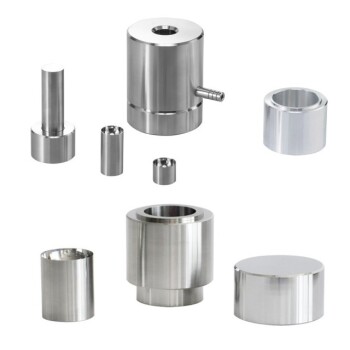
Pre-hardened stainless steel is the critical material of choice for MLCC compression molds because it provides the necessary structural rigidity to withstand extreme processing conditions. It ensures the mold retains its exact shape and surface integrity, preventing deformation that would compromise the geometric accuracy of the final product.
The core value of pre-hardened stainless steel lies in its ability to resist deformation under compressive stresses as high as 100 MPa. This stability is essential for preserving the geometric dimensional accuracy of MLCC blocks throughout the molding process.
Maintaining Structural Integrity Under Pressure
Withstanding Extreme Loads
The compression molding process for Multi-Layer Ceramic Capacitors (MLCC) subjects the mold to intense physical forces.
Pre-hardened stainless steel is selected specifically for its high structural rigidity. This property allows the mold to endure compressive stresses reaching 100 MPa without yielding or warping.
Preserving Geometric Accuracy
The primary risk during high-pressure molding is the physical distortion of the mold itself.
If the mold deforms, the dimensions of the MLCC block will be inaccurate. By maintaining its shape under load, this material ensures that the geometric dimensional accuracy of every sample is strictly preserved.
Durability and Measurement Precision
Resisting Mechanical Wear
Beyond static pressure, the molding process involves dynamic forces.
The high hardness of pre-hardened stainless steel provides exceptional wear resistance. This allows the mold to withstand repeated mechanical impacts inherent in the production cycle without degrading over time.
Ensuring Accurate Displacement Data
Mold surface integrity is directly improved by this hardness.
Because the material resists wear and deformation, it enables the accurate measurement of lateral displacement in MLCC blocks. A softer material would likely distort, introducing errors into these critical measurements.
The Consequence of Material Failure
The Risk of Deformation
The selection of this specific steel grade is not arbitrary; it is a countermeasure against failure.
Using a material with lower rigidity would lead to immediate deformation under the 100 MPa load. This would result in rejected samples due to geometric variances, rendering the molding process ineffective.
The Impact on Data Reliability
Material durability is inextricably linked to process control.
If the mold surface wears down due to repeated impact, the baseline for measuring lateral displacement shifts. Pre-hardened stainless steel eliminates this variable, ensuring that data collected mirrors the behavior of the MLCC block, not the degradation of the mold.
Making the Right Choice for Your Process
To ensure high-yield MLCC production, material selection must align with specific stress factors.
- If your primary focus is Geometric Accuracy: Prioritize pre-hardened stainless steel to eliminate mold deformation under high compressive stresses (up to 100 MPa).
- If your primary focus is Measurement Reliability: Rely on the high hardness of this material to resist wear from repeated mechanical impacts, ensuring consistent lateral displacement readings.
Success in MLCC compression molding depends fundamentally on the mold's ability to remain immutable under pressure.
Summary Table:
| Feature | Benefit | Application Impact |
|---|---|---|
| High Rigidity | Resists up to 100 MPa stress | Prevents mold warping & geometric errors |
| Pre-hardened State | Consistent surface integrity | Ensures accurate lateral displacement data |
| Wear Resistance | Withstands mechanical impacts | Extends mold lifespan & maintains tolerances |
| Material Stability | Minimal deformation | Preserves strict MLCC block dimensions |
Maximize Your MLCC Research Precision with KINTEK
At KINTEK, we understand that high-yield laboratory results depend on equipment that stays immutable under pressure. Whether you are conducting advanced battery research or developing complex ceramic components, our comprehensive laboratory pressing solutions—including manual, automatic, heated, and glovebox-compatible models—are engineered to meet the most rigorous industry standards.
From high-performance isostatic presses to precision-engineered molds, KINTEK provides the structural reliability your data demands. Contact us today to discuss how our specialized pressing equipment can enhance your lab's efficiency and measurement accuracy.
References
- Fumio NARUSE, Naoya TADA. OS18F003 Deformation Behavior of Multilayered Ceramic Sheets with Printed Electrodes under Compression. DOI: 10.1299/jsmeatem.2011.10._os18f003-
This article is also based on technical information from Kintek Solution Knowledge Base .
Related Products
- Lab Anti-Cracking Press Mold
- Lab Isostatic Pressing Molds for Isostatic Molding
- Lab Cylindrical Press Mold for Laboratory Use
- Assemble Lab Cylindrical Press Mold for Laboratory Use
- Assemble Square Lab Press Mold for Laboratory Use
People Also Ask
- What is the purpose of incorporating cartridge heaters into a lab press mold for MLCC block compression? Optimize Results
- What is the function of a pressing tool in thermoplastic panels? Master Precision Shaping & Fusion Bonding
- Why is precise cooling management of the lab press mold necessary? Protect Core Integrity in Thermoforming
- What are the requirements for pressing molds when using SSCG? Key Materials for Complex Single Crystal Production
- How do industrial-grade pressure molds affect zinc metal pouch cells? Maximize Energy Density & Performance