
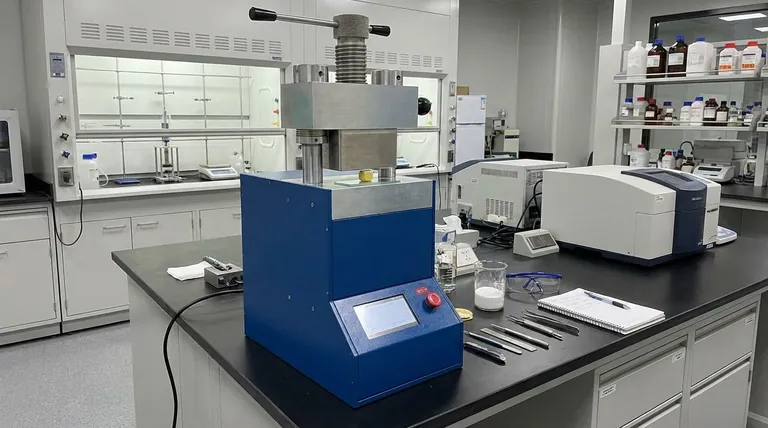
The primary reason cold pressing is the standard preparation method for sulfide solid-state electrolytes is their unique material ductility. Unlike ceramic electrolytes that require high-temperature sintering to bond, sulfide powders possess sufficient plasticity to deform and fuse into dense, conductive pellets solely through the application of high pressure at room temperature.
The Core Insight Cold pressing is not merely a shaping technique; it is a densification mechanism that capitalizes on the softness of sulfide materials. By applying mechanical force, you eliminate insulating voids and create a continuous, highly conductive ionic highway without the complexity or thermal risks of high-temperature processing.
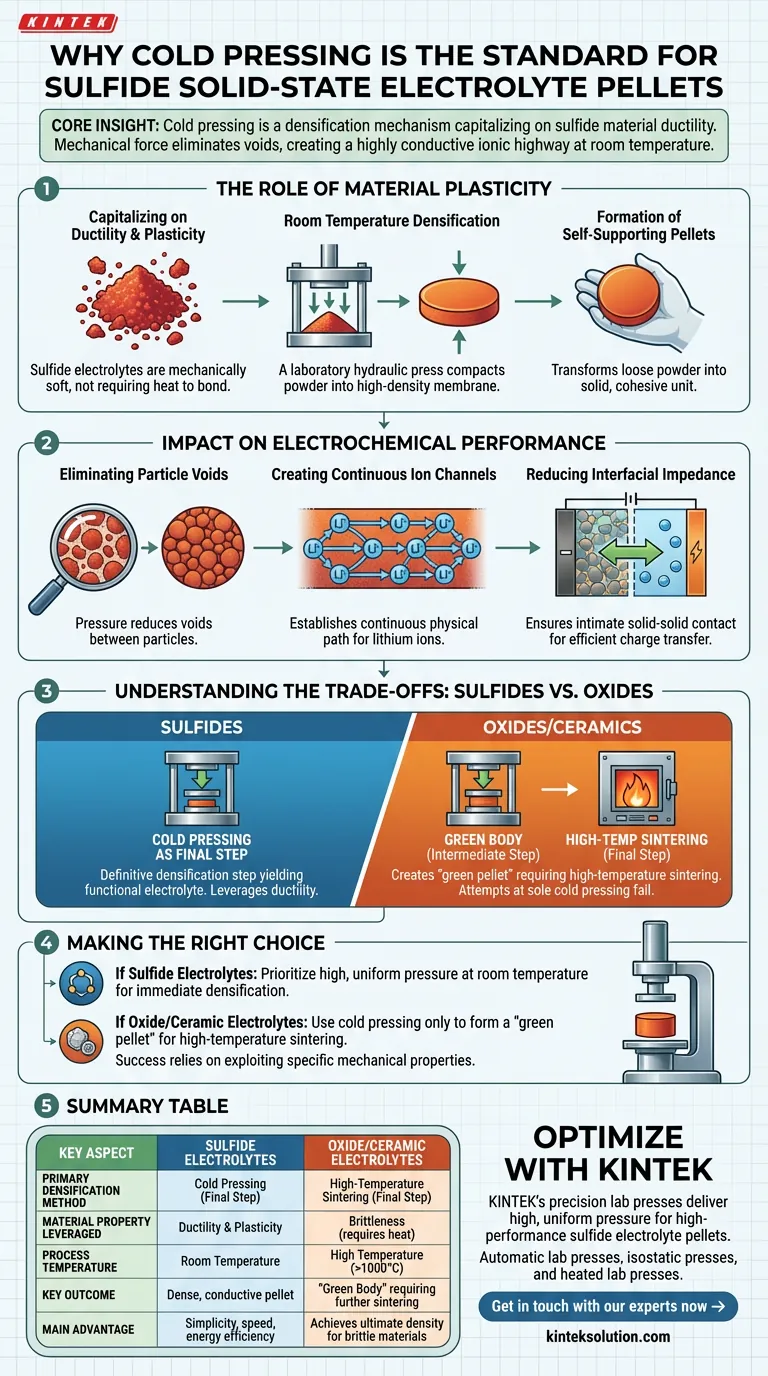
The Role of Material Plasticity
Capitalizing on Ductility
Sulfide electrolytes, such as Li6PS5Cl, differ fundamentally from oxide ceramics due to their mechanical softness. They exhibit excellent ductility and plasticity.
Room Temperature Densification
Because of this plasticity, these materials do not require heat to bond particles together. A laboratory hydraulic press can compact the powder into a high-density membrane at room temperature, making the manufacturing process significantly faster and more energy-efficient.
Formation of Self-Supporting Pellets
The pressure effectively transforms loose powder into a solid, cohesive unit. This results in a membrane with sufficient mechanical strength to be handled and integrated into battery cells without crumbling.
Impact on Electrochemical Performance
Eliminating Particle Voids
The primary enemy of ionic conductivity is porosity. Cold pressing mechanically forces particles together, significantly reducing or eliminating the voids between them.
Creating Continuous Ion Channels
By closing these gaps, the process establishes a continuous physical path for lithium ions to travel. This connectivity is a fundamental prerequisite for achieving high ionic conductivity in the final cell.
Reducing Interfacial Impedance
Performance depends on the quality of the contact between the electrolyte and the electrode. Cold pressing ensures intimate solid-solid contact, which drastically lowers interfacial impedance and facilitates efficient charge transfer.
Understanding the Trade-offs: Sulfides vs. Oxides
Cold Pressing as a Final Step vs. Intermediate Step
It is critical to distinguish how this process is used across different material classes. For sulfides, cold pressing is often the definitive densification step that yields a functional electrolyte.
The "Green Body" Limitation for Ceramics
For oxide electrolytes (like LLZO or LAGP), cold pressing is only an intermediate step. It creates a "green pellet"—a compacted but porous body that must undergo subsequent high-temperature sintering to achieve full density. Attempting to use cold pressing as the sole densification method for brittle oxides will result in poor conductivity and mechanical failure.
Making the Right Choice for Your Goal
To maximize the effectiveness of your solid-state electrolyte preparation, align your processing method with your material properties:
- If your primary focus is Sulfide Electrolytes: Prioritize high, uniform pressure at room temperature to leverage ductility for immediate densification and void reduction.
- If your primary focus is Oxide/Ceramic Electrolytes: Use cold pressing only to form a uniform "green pellet" intended for high-temperature sintering, rather than as the final densification step.
Success in solid-state battery fabrication relies on exploiting the specific mechanical properties of your electrolyte to achieve maximum density with minimum processing complexity.
Summary Table:
| Key Aspect | Sulfide Electrolytes (e.g., Li6PS5Cl) | Oxide/Ceramic Electrolytes (e.g., LLZO) |
|---|---|---|
| Primary Densification Method | Cold Pressing (Final Step) | High-Temperature Sintering (Final Step) |
| Material Property Leveraged | Ductility & Plasticity | Brittleness (requires heat for bonding) |
| Process Temperature | Room Temperature | High Temperature (> 1000°C often required) |
| Key Outcome | Dense, conductive pellet ready for use | "Green Body" requiring further sintering |
| Main Advantage | Simplicity, speed, energy efficiency | Achieves ultimate density for brittle materials |
Ready to Optimize Your Solid-State Electrolyte Pellet Preparation?
KINTEK's precision lab presses are engineered to deliver the high, uniform pressure required to fabricate high-performance sulfide electrolyte pellets.
Whether you are developing next-generation solid-state batteries or refining your material synthesis process, our automatic lab presses, isostatic presses, and heated lab presses provide the control and reliability you need to achieve maximum density and ionic conductivity.
Contact us today to discuss your specific requirements. Let our expertise help you streamline your research and accelerate your development timeline.
Get in touch with our experts now →
Visual Guide
Related Products
- Manual Cold Isostatic Pressing CIP Machine Pellet Press
- Automatic Laboratory Hydraulic Press for XRF and KBR Pellet Pressing
- XRF KBR Plastic Ring Lab Powder Pellet Pressing Mold for FTIR
- Lab XRF Boric Acid Powder Pellet Pressing Mold for Laboratory Use
- XRF KBR Steel Ring Lab Powder Pellet Pressing Mold for FTIR
People Also Ask
- Why is Cold Isostatic Pressing (CIP) necessary for SBN ceramics? Achieve High-Density and Crack-Free Sintering
- Why is Cold Isostatic Pressing (CIP) applied after uniaxial pressing? Optimize Superconductor Precursor Density
- What are the process advantages of using Cold Isostatic Pressing (CIP) for LSMO? Achieve Defect-Free Density
- What types of equipment are available for cold isostatic pressing? Explore CIP Solutions for Labs and Production
- What are the technical advantages of cold isostatic pressing equipment compared to uniaxial compression equipment? Learn More!

















