
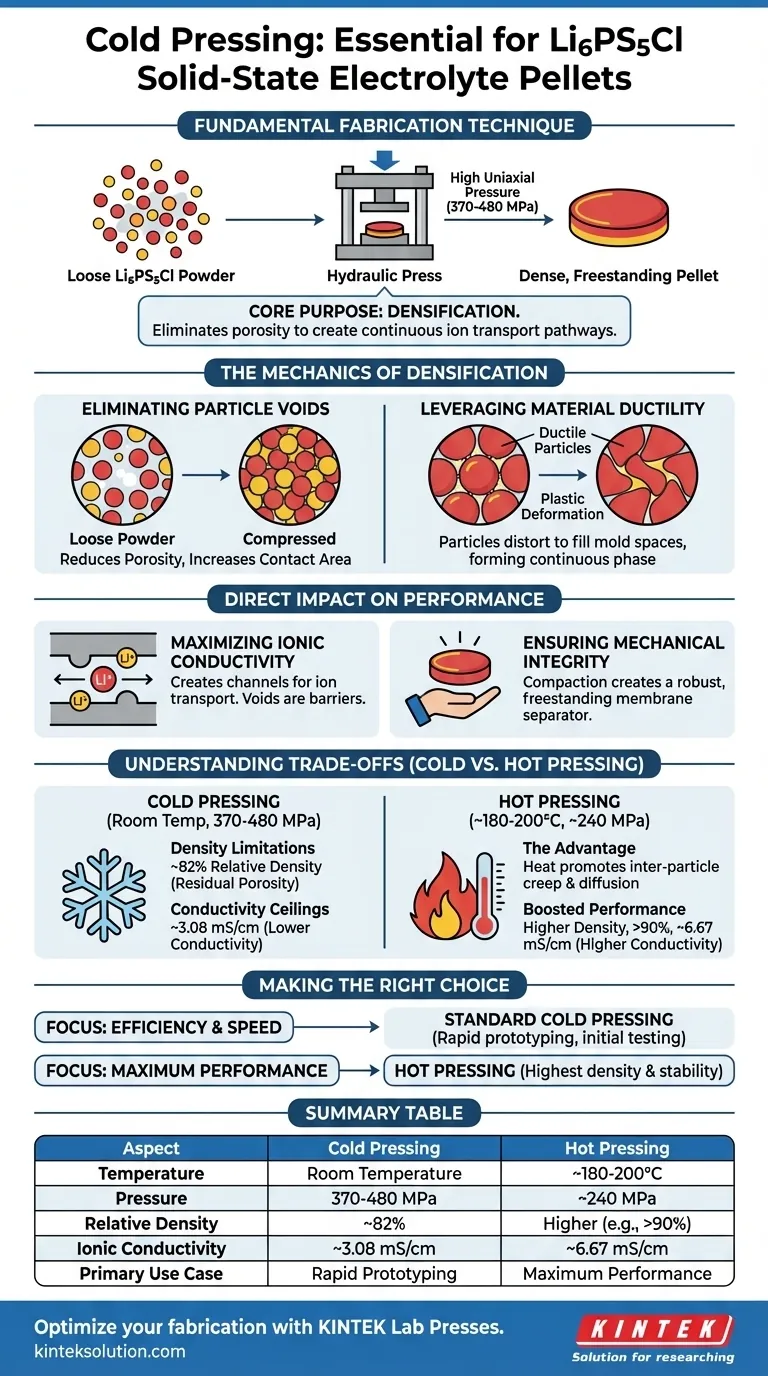
Cold pressing is the fundamental fabrication technique used to transform loose Li6PS5Cl sulfide powder into a functional, solid-state electrolyte component. By applying high uniaxial pressure, typically between 370 and 480 MPa, this process compacts the material into a dense, freestanding pellet capable of conducting ions.
The core purpose of cold pressing is densification. It leverages the natural ductility of sulfide materials to eliminate porosity and create continuous pathways for lithium-ion transport, which is the prerequisite for a functioning solid-state battery.
The Mechanics of Densification
Eliminating Particle Voids
The primary challenge with loose Li6PS5Cl powder is the presence of air gaps, or voids, between particles. Cold pressing forces these particles together, significantly reducing porosity.
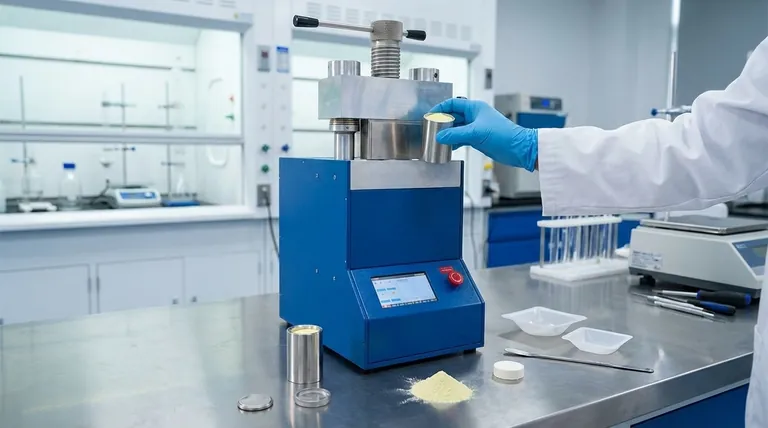
By applying pressure via a laboratory hydraulic press, you increase the contact area between particles. This transforms a discontinuous powder into a cohesive solid mass.
Leveraging Material Ductility
Sulfide electrolytes possess a specific advantage: good mechanical ductility. Unlike brittle ceramics that might fracture under stress, Li6PS5Cl particles can deform plastically.
When compressed at room temperature, the particles distort to fill the empty spaces within the mold. This deformation is critical for creating a continuous material phase out of discrete powder grains.
The Direct Impact on Performance
Maximizing Ionic Conductivity
For a battery to function, lithium ions must move freely from the anode to the cathode. Voids act as barriers to this movement.
Cold pressing creates a continuous channel for ion transport by ensuring intimate particle-to-particle contact. Without this densification, the ionic conductivity would be too low for practical battery operation.
Ensuring Mechanical Integrity
Beyond electrical performance, the electrolyte must be physically robust. The pellet serves as a separator between electrodes.
Compaction creates a freestanding membrane with sufficient mechanical strength to withstand handling and subsequent battery assembly steps. It ensures the component does not crumble during cell fabrication.
Understanding the Trade-offs
While cold pressing is efficient and straightforward, it has distinct limitations compared to hot pressing. It is vital to understand these constraints when optimizing for maximum performance.
Density Limitations
Cold pressing typically achieves a relative density of approximately 82%. While functional, this leaves residual porosity that hinders the material from reaching its theoretical potential.
Conductivity Ceilings
Because of the remaining voids, cold-pressed pellets generally exhibit lower ionic conductivity (e.g., 3.08 mS/cm) compared to those processed with heat.
The "Hot Pressing" Advantage
Applying heat (e.g., 180°C) simultaneously with pressure softens the particles further. This promotes inter-particle creep and diffusion, allowing the material to fuse more completely.
Hot pressing can boost conductivity significantly (e.g., to 6.67 mS/cm) by creating a more intimate solid-solid interface that cold pressing alone cannot achieve.
Making the Right Choice for Your Goal
The choice between simple cold pressing and advanced hot pressing depends on your specific performance targets and manufacturing capabilities.
- If your primary focus is Efficiency and Speed: Use standard cold pressing (room temperature, ~370-480 MPa) to quickly generate functional pellets suitable for initial testing and assembly.
- If your primary focus is Maximum Performance: Implement hot pressing (e.g., 200°C, 240 MPa) to maximize density, double your ionic conductivity, and ensure the highest possible mechanical stability.
Ultimately, while hot pressing yields superior metrics, cold pressing remains the essential baseline method for establishing the physical structure of sulfide electrolytes.
Summary Table:
| Aspect | Cold Pressing | Hot Pressing |
|---|---|---|
| Temperature | Room Temperature | ~180-200°C |
| Pressure | 370-480 MPa | ~240 MPa |
| Relative Density | ~82% | Higher (e.g., >90%) |
| Ionic Conductivity | ~3.08 mS/cm | ~6.67 mS/cm |
| Primary Use Case | Rapid prototyping, initial testing | Maximum performance, high-density requirements |
Ready to optimize your solid-state battery electrolyte fabrication? KINTEK specializes in lab press machines, including automatic lab presses, isostatic presses, and heated lab presses, designed to meet the precise demands of laboratory research and development. Whether you need reliable cold pressing for initial pellet formation or advanced hot pressing for peak performance, our equipment ensures consistent, high-quality results. Contact us today to discuss how our solutions can accelerate your battery development process!
Visual Guide
Related Products
- Manual Cold Isostatic Pressing CIP Machine Pellet Press
- Automatic Laboratory Hydraulic Press for XRF and KBR Pellet Pressing
- Manual Laboratory Hydraulic Pellet Press Lab Hydraulic Press
- Automatic Laboratory Hydraulic Press Lab Pellet Press Machine
- Laboratory Hydraulic Pellet Press for XRF KBR FTIR Lab Press
People Also Ask
- Why is Cold Isostatic Pressing (CIP) necessary for SBN ceramics? Achieve High-Density and Crack-Free Sintering
- What are the process advantages of using Cold Isostatic Pressing (CIP) for LSMO? Achieve Defect-Free Density
- Why is Cold Isostatic Pressing (CIP) applied after uniaxial pressing? Optimize Superconductor Precursor Density
- What types of equipment are available for cold isostatic pressing? Explore CIP Solutions for Labs and Production
- What are the technical advantages of cold isostatic pressing equipment compared to uniaxial compression equipment? Learn More!


















