
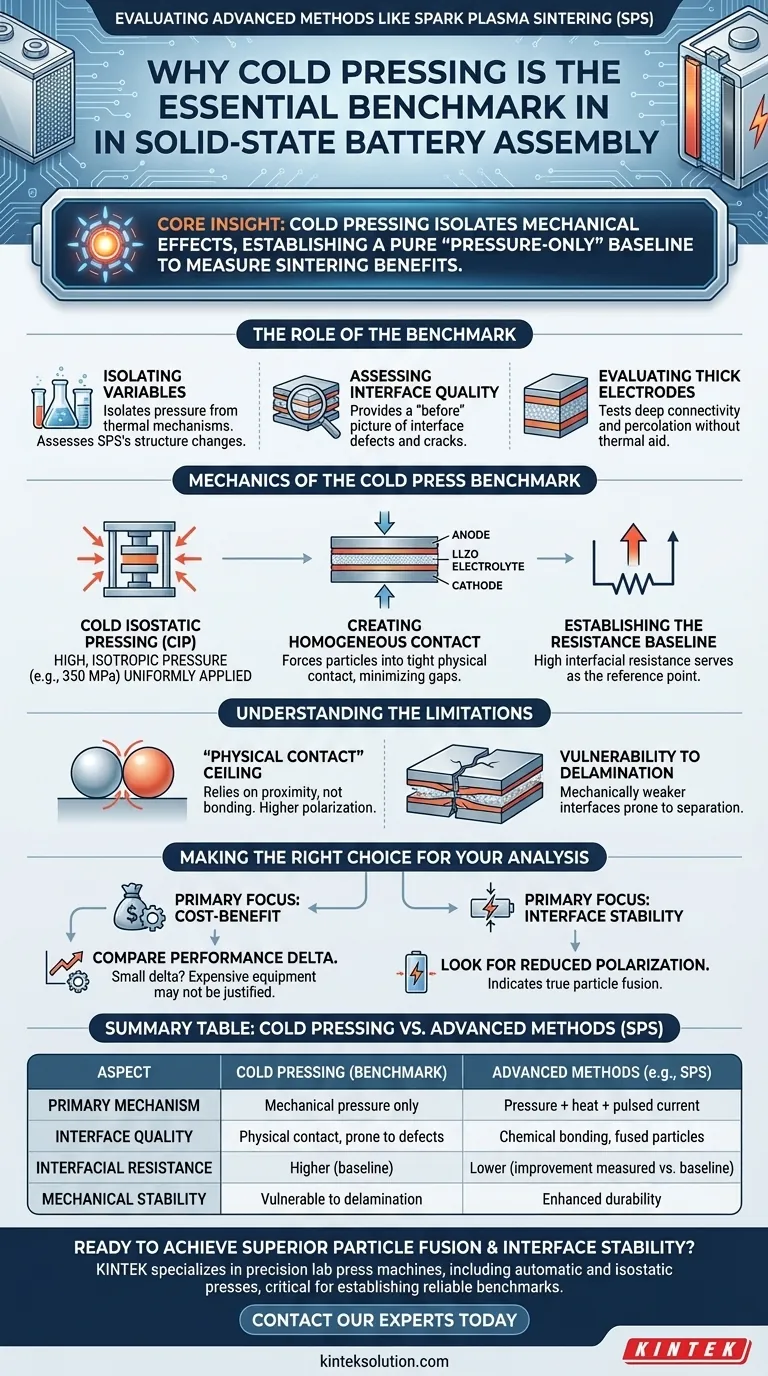
The cold pressing technique serves as the essential baseline for evaluating advanced assembly methods because it isolates the effects of mechanical pressure from thermal sintering mechanisms. By establishing the performance limits of a pure "pressure-only" approach, researchers can quantitatively measure the specific benefits—such as reduced polarization and improved particle contact—introduced by complex techniques like Spark Plasma Sintering (SPS).
Core Insight: In all-solid-state batteries, the critical challenge is achieving perfect contact between solid layers. Cold pressing acts as the control variable, proving that performance gains in advanced methods stem from superior sintering mechanics rather than just material densification.
The Role of the Benchmark
Isolating Variables in Assembly
To understand the value of a complex process like SPS, you must first understand the performance floor.
Cold pressing represents the fundamental method of powder compaction. It relies solely on mechanical force to bind materials.
By using this as a benchmark, engineers can strictly assess how the addition of heat and pulsed current in SPS alters the material structure.
Assessing Interface Quality
The primary failure point in solid-state batteries is the interface between the anode, electrolyte, and cathode.
Cold pressing provides a clear "before" picture regarding interface defects.
Comparing this to SPS reveals if the advanced method successfully eliminates interface cracks or merely compresses them.
Evaluating Thick Electrodes
Thick electrodes are desirable for energy density but difficult to manufacture.
Cold pressing allows researchers to test how deep the connectivity goes in these thick layers without thermal aid.
This comparison highlights whether advanced sintering is necessary to achieve percolation in high-loading designs.
Mechanics of the Cold Press Benchmark
Utilizing Cold Isostatic Pressing (CIP)
The benchmark often relies on Cold Isostatic Pressing to ensure the comparison is fair and rigorous.
CIP applies high, isotropic pressure—often around 350 megapascals—uniformly from all directions.
Creating Homogeneous Contact
This uniform pressure forces the lithium metal anode, LLZO electrolyte, and composite cathode into tight physical contact.
The goal is to minimize gaps between particles without altering their chemical structure through heat.
Establishing the Resistance Baseline
Even with high pressure, cold pressing often results in higher interfacial resistance compared to sintered methods.
This high-resistance state serves as the reference point.
Any reduction in resistance observed in SPS can then be directly attributed to improved inter-particle bonding and fusion.
Understanding the Limitations
The "Physical Contact" Ceiling
Cold pressing relies on physical proximity, not chemical bonding.
While it creates tight contact, it cannot fuse particles together the way sintering does.
This often leads to a limit in how well lithium ions can transport across the boundary, resulting in higher polarization.
Vulnerability to Delamination
Without thermal fusion, the interfaces created by cold pressing are mechanically weaker.
They are more distinct and prone to separation or cracking during battery cycling.
This limitation is exactly what advanced methods like SPS aim to solve, making the comparison vital for proving durability.
Making the Right Choice for Your Analysis
When reviewing data on solid-state battery assembly, use the cold pressing benchmark to interpret the efficacy of the proposed method.
- If your primary focus is determining cost-benefit: Compare the performance delta between cold pressing and the advanced method; a small delta suggests the expensive equipment may not be justified.
- If your primary focus is optimizing interface stability: Look for data showing how the advanced method reduces polarization compared to the cold pressed sample, as this indicates true particle fusion.
Ultimately, the cold pressing benchmark ensures that any claim of "advanced performance" is backed by a measurable improvement in physical and electrochemical integration.
Summary Table:
| Aspect | Cold Pressing (Benchmark) | Advanced Methods (e.g., SPS) |
|---|---|---|
| Primary Mechanism | Mechanical pressure only | Pressure + heat + pulsed current |
| Interface Quality | Physical contact, prone to defects | Chemical bonding, fused particles |
| Interfacial Resistance | Higher (baseline) | Lower (improvement measured vs. baseline) |
| Mechanical Stability | Vulnerable to delamination | Enhanced durability |
Ready to achieve superior particle fusion and interface stability in your solid-state battery research?
KINTEK specializes in precision lab press machines, including automatic lab presses and isostatic presses, which are critical for establishing reliable benchmarks like cold pressing. Our equipment helps researchers like you isolate variables and accurately measure the performance gains of advanced sintering techniques.
Contact our experts today to find the perfect press for your laboratory's needs and advance your battery development with confidence!
Visual Guide
Related Products
- Electric Lab Cold Isostatic Press CIP Machine
- Manual Cold Isostatic Pressing CIP Machine Pellet Press
- Automatic Lab Cold Isostatic Pressing CIP Machine
- Electric Split Lab Cold Isostatic Pressing CIP Machine
- Laboratory Hydraulic Pellet Press for XRF KBR FTIR Lab Press
People Also Ask
- What are the applications of electric lab cold isostatic presses in research settings? Advance Material R&D with High-Pressure CIPs
- What role do electric lab cold isostatic presses play in industrial contexts? Bridge R&D and Manufacturing with Precision
- How does electrical Cold Isostatic Pressing (CIP) contribute to cost savings? Unlock Efficiency and Reduce Expenses
- What are some research applications of electric lab CIPs? Unlock Uniform Powder Densification for Advanced Materials
- What are the characteristics of standard off-the-shelf electric lab CIP solutions? Achieve Immediate, Cost-Effective Processing



















