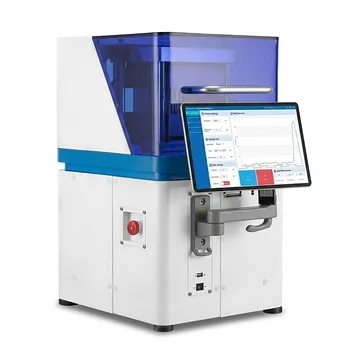
The necessity of high-pressure molding in all-solid-state battery (ASSB) assembly stems from the fundamental challenge of creating a seamless solid-solid interface. Unlike traditional batteries that use liquid electrolytes to wet electrode surfaces, solid components cannot naturally fill microscopic gaps, requiring extreme external force—often between 360 MPa and 436.7 MPa—to eliminate voids and establish the dense physical contact required for lithium-ion and electron transport.
Building a functional solid-state battery requires transforming discrete powder particles into a single, cohesive unit. High-pressure molding is the critical catalyst that enables plastic deformation, which minimizes interfacial resistance and creates the continuous pathways necessary for efficient electrochemical performance.
The Physics of Solid-Solid Interfaces
Overcoming Interfacial Resistance
In a solid-state system, the contact between the electrode and the electrolyte is inherently inefficient because solid surfaces are microscopically rough.
A laboratory hydraulic press applies the force needed to overcome these physical gaps, forcing the cathode, electrolyte, and anode layers into a dense, mechanical interlock.
This process reduces contact resistance to a level that allows charge to flow freely, which is the physical foundation for high rate performance and long cycle life.
Inducing Plastic Deformation
To create a truly dense structure, materials must give way under pressure; this is known as plastic deformation.
Ultra-high pressures (such as 400 MPa) force solid electrolyte particles—particularly sulfides—to deform and fill the "valley" spaces between active material grains.
This deformation establishes atom-level contact at the interfaces, ensuring that lithium ions have a direct, unobstructed path to travel during charge and discharge cycles.
Structural Integrity and Ion Transport
Eliminating Voids and Air Pockets
Internal voids and air holes act as insulators, blocking the movement of ions and causing localized "hot spots" of high resistance.
The hydraulic press acts to purge air from the internal structure of the cell, compacting the trilayer architecture into a monolithic body.
By removing these "dead zones," the molding process prevents overpotential during cycling and ensures the battery operates at its maximum theoretical efficiency.
Establishing Continuous Pathways
For a battery to function, there must be a continuous network for both ion and electron transport.
High-pressure molding ensures that the composite cathode particles are in constant contact with the solid electrolyte layer.
This creates a reliable trilayer architecture that remains stable without the need for liquid additives, maintaining internal connectivity throughout the experimental process.
Understanding the Trade-offs
Pressure-Induced Mechanical Damage
While high pressure is necessary for density, exceeding the mechanical limits of the materials can cause particle cracking or internal short circuits.
Excessive force may lead to the penetration of the electrolyte layer by cathode particles, which destroys the cell's ability to hold a charge.
Precision monitoring via the hydraulic press is essential to find the "sweet spot" where density is maximized without compromising the structural integrity of the materials.
Mechanical Relaxation and Spring-Back
Solid materials often exhibit a degree of mechanical relaxation after the external pressure is removed.
If the initial molding pressure is insufficient, the layers may delaminate or "spring back," re-introducing the very voids the process was meant to eliminate.
Using a high-precision press ensures that the materials reach a state of deep mechanical interlocking, which helps the interface remain stable even in a pressure-free testing state.
How to Apply This to Your Project
Recommendations for Optimal Assembly
When assembling solid-state cells, your pressure strategy should align with your specific material choices and research goals.
- If your primary focus is maximizing ion conductivity: Prioritize higher pressures (up to 400-436 MPa) to induce maximum plastic deformation and eliminate all internal voids.
- If your primary focus is long-term cycle stability: Use a press with precise monitoring to achieve a stable mechanical interlock while avoiding the over-compression that leads to particle fracturing.
- If your primary focus is sulfide-based electrolytes: Focus on the "cold-pressing" method at approximately 250-360 MPa to capitalize on the high deformability of sulfide grains.
The laboratory hydraulic press is the bridge between a collection of individual solid particles and a high-performance, integrated electrochemical system.
Summary Table:
| Key Factor | Impact on Battery Performance | Technical Requirement |
|---|---|---|
| Interfacial Resistance | Minimizes gaps to allow free charge flow | High-pressure mechanical interlocking |
| Plastic Deformation | Establishes atom-level contact between grains | 360 MPa to 436.7 MPa force |
| Void Elimination | Removes air pockets to prevent high-resistance "hot spots" | Monolithic trilayer compaction |
| Ion/Electron Transport | Creates continuous pathways for cycling | Reliable dense internal architecture |
| Mechanical Interlock | Prevents delamination and "spring-back" | Precision monitoring and stability |
Master Your Solid-State Battery Assembly with KINTEK Precision
Building high-performance all-solid-state batteries requires exact pressure control to achieve the perfect solid-solid interface. KINTEK specializes in comprehensive laboratory pressing solutions tailored for battery research. We offer a diverse range of manual, automatic, heated, multifunctional, and glovebox-compatible models, as well as cold and warm isostatic presses capable of reaching the extreme pressures necessary for sulfide and oxide-based electrolyte systems.
Don't let interfacial resistance hinder your research. Our high-precision equipment ensures you find the "sweet spot" for plastic deformation while protecting your materials from mechanical damage.
Optimize your battery research—contact KINTEK today!
References
- Yushi Fujita, Akitoshi Hayashi. Efficient Ion Diffusion and Stable Interphases for Designing Li <sub>2</sub> S‐Based Positive Electrodes of All‐Solid‐State Li/S Batteries. DOI: 10.1002/batt.202500274
This article is also based on technical information from Kintek Solution Knowledge Base .
Related Products
- Laboratory Hydraulic Press Lab Pellet Press Button Battery Press
- Warm Isostatic Press for Solid State Battery Research Warm Isostatic Press
- Automatic Heated Hydraulic Lab Press Machine 200x200 Plate Size for Battery Research and Materials Science
- 24T 30T 60T Heated Hydraulic Lab Press Machine with Hot Plates for Laboratory
- Automatic Heated Hydraulic Press Machine with Heated Plates for Laboratory
People Also Ask
- How is a laboratory hydraulic press used for HAP composite gels? Master Mineral Substrate Standardization
- What role does a laboratory hydraulic press play in the preparation of piezoelectric ceramic discs for DC-PG? | KINTEK
- What role does a laboratory hydraulic press play in reaction pellets? Optimizing Lunar Soil and Metal Fuel Density
- Why is a laboratory hydraulic press required for PBAT and PLA sample preparation? Achieve Flawless Characterization
- What role does a laboratory hydraulic press play in the assembly of all-solid-state battery test cells? Expert Guide