
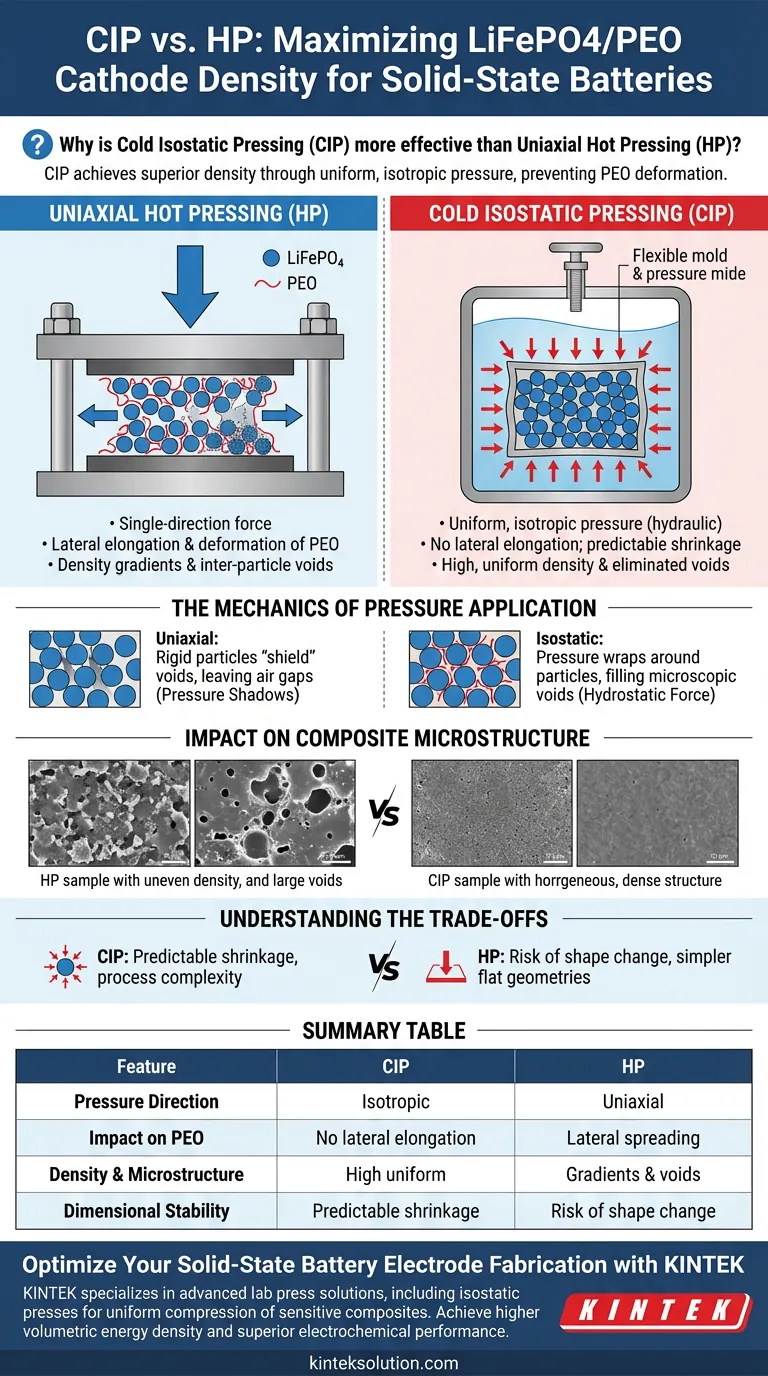
Cold isostatic pressing (CIP) achieves superior density in LiFePO4/PEO composites because it utilizes uniform, isotropic pressure applied from all directions, rather than the single-direction force used in uniaxial hot pressing (HP). While hot pressing often causes the soft polymer electrolyte to spread laterally—leading to deformation—CIP compresses the active particles and electrolyte in a three-dimensional space, effectively eliminating inter-particle voids without distorting the electrode's shape.
Core Insight In composite cathodes utilizing soft polymers like PEO, density is defined by how well the electrolyte fills the spaces between active particles. Uniaxial hot pressing tends to flatten and widen the sample, whereas CIP forces components together from every angle, maximizing packing density and structural uniformity.
The Mechanics of Pressure Application
The Directionality of Force
The fundamental difference lies in the vector of the applied force. Uniaxial hot pressing applies mechanical force vertically. In a composite material, this often creates a density gradient, where the material is denser near the pressing surfaces and less dense in the center or edges.
Hydraulic vs. Mechanical Compression
CIP utilizes a liquid medium to apply pressure. This ensures the force is hydrostatic and omnidirectional. Every surface of the cathode material experiences the exact same amount of pressure simultaneously.
Elimination of Pressure Shadows
In uniaxial pressing, rigid particles can "shield" adjacent voids from the vertical force, leaving air gaps. CIP’s isotropic nature ensures that pressure wraps around particles, forcing the pliable PEO electrolyte into these microscopic voids from the side and bottom, not just the top.
Impact on Composite Microstructure
Preventing Lateral Elongation
A critical failure mode in hot pressing PEO-based cathodes is lateral elongation. Because PEO is soft, excessive vertical pressure squeezes the polymer out toward the sides, changing the dimensions of the film rather than densifying the internal structure.
3D Spatial Compression
CIP avoids this "squishing" effect. By compressing the material from all sides, it forces the LiFePO4 active particles, conductive agents, and PEO solid electrolyte closer together in 3D space.
Uniformity and Surface Finish
The result of this uniform compression is a cathode with a homogenous interior structure. Unlike hot pressed samples which may have uneven density distributions, CIP produces a smoother surface and a consistent internal density, which is vital for reliable electrochemical performance.
Understanding the Trade-offs
Dimensional Stability vs. Shape Change
While CIP is superior for density, it requires careful handling of the "green body" (the unfired material). The process results in predictable shrinkage in all dimensions.
Process Complexity
Uniaxial hot pressing is often faster and simpler to implement for flat geometries. CIP requires the sample to be sealed against the liquid medium, adding a step to the manufacturing workflow. However, this trade-off is often necessary to achieve the high green strength and corrosion resistance required for high-performance solid-state batteries.
Making the Right Choice for Your Goal
When optimizing the fabrication of LiFePO4/PEO cathodes, your choice of pressing method dictates the quality of the particle-electrolyte interface.
- If your primary focus is maximizing volumetric energy density: Prioritize CIP, as the isotropic pressure minimizes void volume and maximizes the amount of active material packed into the electrode structure.
- If your primary focus is maintaining precise film dimensions: Be cautious with HP, as you must carefully balance pressure to avoid lateral elongation; CIP offers more predictable, uniform shrinkage.
Ultimately, for PEO-based composites, isotropic compression is the only reliable method to achieve high density without sacrificing the structural integrity of the polymer matrix.
Summary Table:
| Feature | Cold Isostatic Pressing (CIP) | Uniaxial Hot Pressing (HP) |
|---|---|---|
| Pressure Direction | Isotropic (all directions) | Uniaxial (single direction) |
| Impact on PEO Polymer | No lateral elongation; uniform compression | Lateral spreading and deformation |
| Density & Microstructure | High, uniform density; eliminates voids | Density gradients; potential voids |
| Dimensional Stability | Predictable shrinkage in all dimensions | Risk of shape change and uneven thickness |
Optimize Your Solid-State Battery Electrode Fabrication with KINTEK
Struggling with density gradients or polymer deformation in your LiFePO4/PEO cathodes? KINTEK specializes in advanced lab press solutions, including isostatic presses designed for uniform compression of sensitive composite materials. Our equipment ensures maximal particle-electrolyte interface contact, leading to higher volumetric energy density and superior electrochemical performance.
Whether you are developing next-generation solid-state batteries or optimizing electrode manufacturing processes, our expertise can help you achieve reproducible, high-density results.
Contact our experts today to discuss how our lab press machines can enhance your research and development!
Visual Guide
References
- Benoît Denis Louis Campéon, Naoaki Yabuuchi. Virtues of Cold Isostatic Pressing for Preparation of All‐Solid‐State‐Batteries with Poly(Ethylene Oxide). DOI: 10.1002/cssc.202301054
This article is also based on technical information from Kintek Solution Knowledge Base .
Related Products
- Manual Cold Isostatic Pressing CIP Machine Pellet Press
- Electric Split Lab Cold Isostatic Pressing CIP Machine
- Automatic Lab Cold Isostatic Pressing CIP Machine
- Electric Lab Cold Isostatic Press CIP Machine
- Lab Isostatic Pressing Molds for Isostatic Molding
People Also Ask
- Why is Cold Isostatic Pressing (CIP) necessary for SBN ceramics? Achieve High-Density and Crack-Free Sintering
- What are the process advantages of using Cold Isostatic Pressing (CIP) for LSMO? Achieve Defect-Free Density
- Why is Cold Isostatic Pressing (CIP) applied after uniaxial pressing? Optimize Superconductor Precursor Density
- What types of equipment are available for cold isostatic pressing? Explore CIP Solutions for Labs and Production
- What are the technical advantages of cold isostatic pressing equipment compared to uniaxial compression equipment? Learn More!






