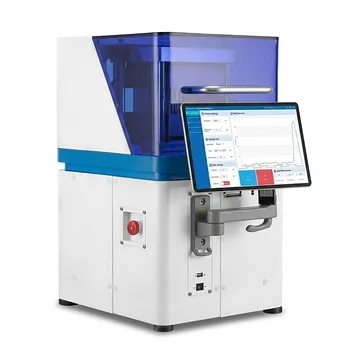
Laboratory press pellets serve as the fundamental bridge between raw chemical powders and finalized pharmaceutical products. By compressing drug formulations into specific, uniform shapes and sizes, these presses allow researchers to establish consistency in dosage and release properties, which is a prerequisite for all subsequent research, development, and quality control.
The core value of laboratory press pellets is simulation: they allow scientists to replicate industrial compression forces on a small scale, enabling the optimization of formula ratios and the verification of drug efficacy before high-cost mass production begins.
Achieving Dosage Uniformity
Precision in Dimensions and Weight
In pharmaceutical development, consistency is paramount. Laboratory presses compress powders or granules into solid pills or tablets with precise dimensions and weights.
This mechanical precision eliminates variability, ensuring that every sample tested represents the exact intended dosage.
Defining Release Properties
The force applied during compression dictates how a tablet holds together and, consequently, how it breaks down in the body. By controlling the shape and density of the pellet, researchers determine the drug's release profile.
This ensures the medication dissolves at the correct rate to be effective for the patient.
The Role in R&D and Formula Screening
Simulating Industrial Conditions
A laboratory press acts as a proxy for the factory floor. It simulates the working environment of industrial-scale pellet extruders but in a controlled, low-volume setting.
This allows R&D teams to study how pressure, temperature, and dwell time affect the final product without running large machinery.
Optimizing Formulation Ratios
Before a drug enters mass production, the specific mixture of active ingredients and binders (biomass materials) must be perfected. Researchers use the press for formula screening in small-scale experiments.
By adjusting the ratios of materials and observing the bonding strength at a microscopic scale, scientists can lock in the most stable and effective formula.
Quality Control and Efficacy Testing
Preparation for Dissolution Testing
Hydraulic presses are critical for preparing samples for dissolution testing, a key quality control process.
To evaluate efficacy, a drug must be formed into a consistent solid state before being subjected to chemical dissolution. The press creates the standardized sample necessary to verify that the drug breaks down and releases its potency as predicted.
Analyzing Mechanical Strength
Beyond chemical properties, the physical integrity of the tablet is tested. The press applies stress to the drug to analyze its structural limits.
This ensures the tablet is robust enough to survive packaging and transport, yet fragile enough to break down properly upon ingestion.
Understanding the Trade-offs
The Scale-Up Discrepancy
While laboratory presses simulate industrial environments, they are not identical. A hydraulic lab press typically applies static pressure, whereas industrial rotary presses apply dynamic, high-speed pressure.
This difference can sometimes lead to discrepancies in granule bonding when a formula is moved from the lab to the production line.
Dwell Time Sensitivity
In a manual or semi-automatic lab press, the "dwell time" (how long pressure is held) is often longer than in mass production.
If researchers do not account for this, they may create pellets in the lab that are harder or denser than what can be achieved at high production speeds, potentially skewing dissolution data.
Making the Right Choice for Your Goal
To utilize laboratory press pellets effectively, align your usage with your specific development stage:
- If your primary focus is Formulation R&D: Use the press to varying pressure and temperature parameters to identify the optimal binder ratios for microscopic fiber bonding.
- If your primary focus is Quality Control: Focus on the repeatability of the compression force to ensure every sample used for dissolution testing is physically identical.
Success in pharmaceutical compression relies not just on the force applied, but on the consistency of the data derived from it.
Summary Table:
| Application Phase | Key Function | Primary Benefit |
|---|---|---|
| Formulation R&D | Formula screening & binder optimization | Identifies the most stable drug-to-binder ratios |
| Simulation | Mimicking industrial compression forces | Reduces costs by perfecting formulas before mass production |
| Quality Control | Preparing samples for dissolution testing | Ensures consistent drug release profiles and efficacy |
| Mechanical Testing | Analyzing structural integrity | Guarantees tablets survive transport and packaging |
| Precision Control | Weight and dimension standardization | Eliminates dosage variability across research samples |
Elevate Your Pharmaceutical R&D with KINTEK Precision
Transitioning from raw powder to a market-ready pharmaceutical product requires absolute consistency. KINTEK specializes in comprehensive laboratory pressing solutions designed to bridge the gap between small-scale research and industrial manufacturing.
Our extensive range of equipment includes manual, automatic, heated, multifunctional, and glovebox-compatible models, as well as cold and warm isostatic presses—all widely applied in battery research and pharmaceutical development. Whether you need to simulate industrial dwell times or ensure the mechanical strength of your pellets, KINTEK provides the reliability your lab demands.
Ready to optimize your formulation process? Contact us today to find the perfect press for your lab.
Related Products
- Laboratory Hydraulic Press Lab Pellet Press Button Battery Press
- Laboratory Hydraulic Press Lab Pellet Press Machine for Glove Box
- Laboratory Split Manual Heated Hydraulic Press Machine with Hot Plates
- Laboratory Hydraulic Split Electric Lab Pellet Press
- Laboratory Hydraulic Pellet Press for XRF KBR FTIR Lab Press
People Also Ask
- How is a laboratory hydraulic press used for HAP composite gels? Master Mineral Substrate Standardization
- What role does a laboratory hydraulic press play in reaction pellets? Optimizing Lunar Soil and Metal Fuel Density
- What role does a laboratory hydraulic press play in the preparation of piezoelectric ceramic discs for DC-PG? | KINTEK
- Why is a laboratory hydraulic press required for PBAT and PLA sample preparation? Achieve Flawless Characterization
- What role does a laboratory hydraulic press play in the assembly of all-solid-state battery test cells? Expert Guide