
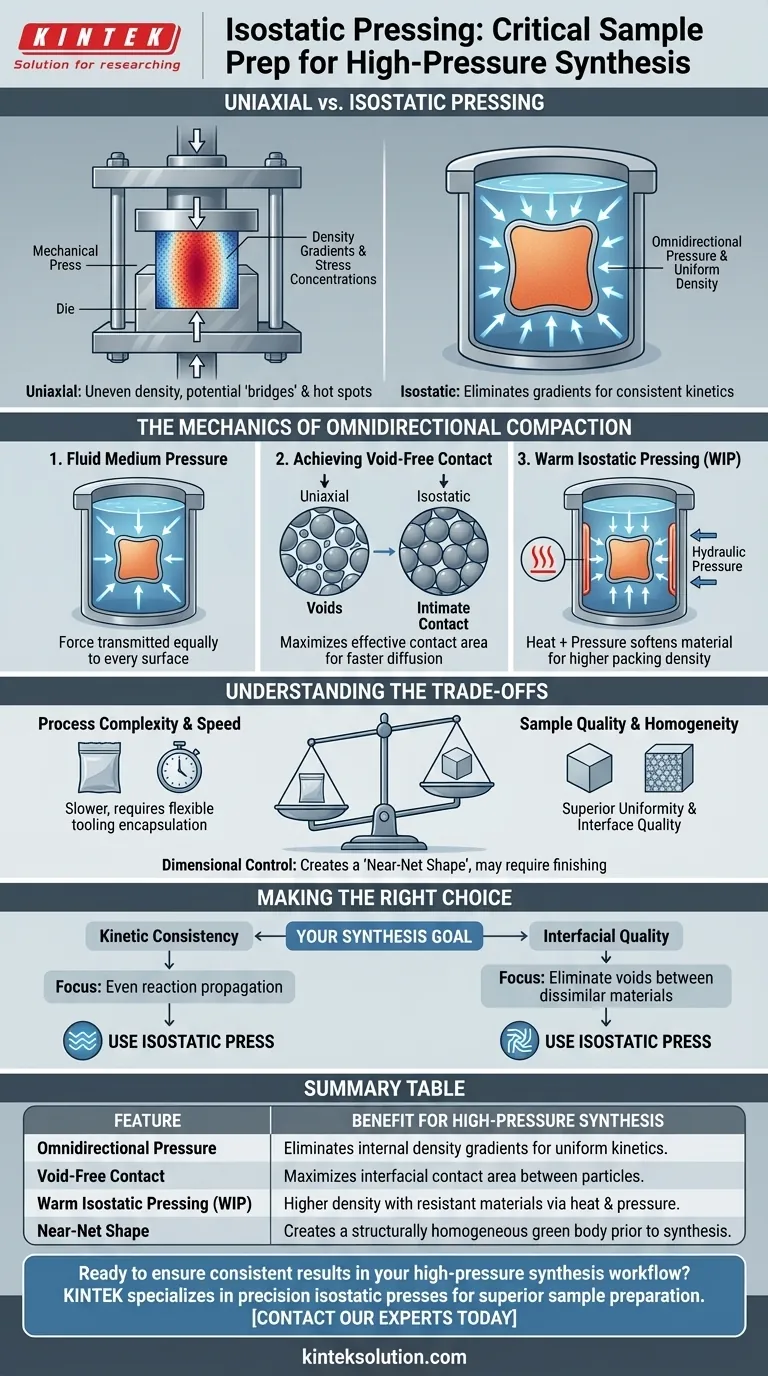
An isostatic press serves as a critical preparation tool for high-pressure synthesis by compacting solid precursors into a uniformly dense state before they enter the reactor. Unlike standard mechanical presses that apply force from a single direction, an isostatic press utilizes a fluid medium to apply pressure equally from all sides. This omnidirectional force eliminates internal density gradients, ensuring the sample is structurally homogeneous prior to the synthesis reaction.
Core Insight: The primary value of isostatic pressing in this context is the elimination of "density gradients." By ensuring every part of the precursor sample is compacted equally, you guarantee consistent reaction kinetics and a homogeneous final product once the sample is subjected to the extreme conditions of the reactor.
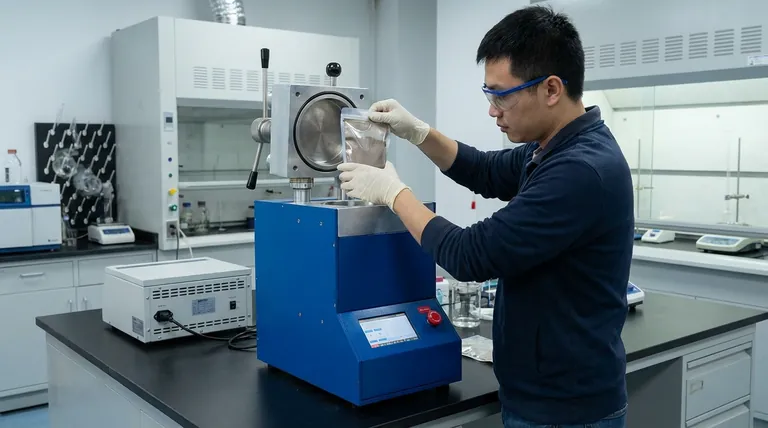
The Mechanics of Isostatic Compaction
Applying Omnidirectional Pressure
Standard uniaxial presses apply force from the top and bottom, often leaving the center of the sample less dense than the edges.
In contrast, an isostatic press submerges the sample (typically sealed in a flexible mold) within a pressure vessel filled with a liquid or gas medium. By pressurizing this medium, force is transmitted equally to every surface of the sample simultaneously.
Eliminating Density Gradients
The uniformity of the pressure application prevents the formation of stress concentrations or "bridges" between particles that commonly occur in dry pressing.
This results in a "green body" (the compacted powder) that possesses uniform density throughout its volume. This uniformity is essential because variations in precursor density can lead to uneven heating or incomplete reactions during the subsequent high-pressure synthesis phase.
Enhancing Material Interfaces
Achieving Void-Free Contact
Isostatic pressing is particularly superior when working with composite precursors or distinct layers, such as minimizing impedance between soft and rigid materials.
Just as this method ensures intimate contact between electrodes and electrolytes in battery assembly, it forces synthesis precursors into void-free contact. This maximizes the effective contact area between reacting particles, facilitating faster and more complete diffusion.
The Role of Warm Isostatic Pressing (WIP)
For materials that resist consolidation at room temperature, Warm Isostatic Pressing can be utilized.
In this process, a liquid medium (often water) is heated and injected into the cylinder by a booster source. The combination of thermal energy and hydraulic pressure softens the powder material slightly, allowing for better particle rearrangement and significantly higher packing density than cold pressing alone.
Understanding the Trade-offs
Process Complexity and Speed
While isostatic pressing yields superior sample quality, it is significantly slower and more complex than uniaxial pressing.
The process requires sealing samples in flexible tooling (bags or molds) to prevent contact with the hydraulic fluid. This encapsulation step adds time to the workflow and introduces a potential source of contamination if the tooling fails.
Dimensional Control
Because the pressure compresses the sample from all directions, the final dimensions are determined by the uniform shrinkage of the powder.
Unlike a rigid die used in uniaxial pressing, which guarantees a specific diameter, isostatic pressing creates a "near-net shape." You may need to machine or polish the sample after pressing if the high-pressure synthesis reactor requires extremely precise sample geometry.
Making the Right Choice for Your Goal
To determine if isostatic pressing is necessary for your synthesis workflow, consider your specific requirements for the final product.
- If your primary focus is kinetic consistency: Use isostatic pressing to ensure the reaction propagates evenly through the sample, avoiding "hot spots" or unreacted cores.
- If your primary focus is interfacial quality: Use this method to eliminate voids between dissimilar materials, ensuring maximum contact area for diffusion-limited reactions.
By prioritizing density uniformity during the preparation stage, you remove the variables that most often lead to synthesis failure in high-pressure environments.
Summary Table:
| Feature | Benefit for High-Pressure Synthesis |
|---|---|
| Omnidirectional Pressure | Eliminates internal density gradients for uniform reaction kinetics. |
| Void-Free Contact | Maximizes interfacial contact area between precursor particles. |
| Warm Isostatic Pressing (WIP) | Combines heat and pressure for higher density with resistant materials. |
| Near-Net Shape | Creates a structurally homogeneous green body prior to synthesis. |
Ready to eliminate density gradients and ensure consistent results in your high-pressure synthesis workflow? KINTEK specializes in precision lab press machines, including isostatic presses designed for superior sample preparation. Our equipment helps you achieve the uniform, void-free compaction essential for reliable and repeatable reactions. Contact our experts today to find the perfect press for your laboratory's needs.
Visual Guide
Related Products
- Warm Isostatic Press for Solid State Battery Research Warm Isostatic Press
- Electric Lab Cold Isostatic Press CIP Machine
- Automatic Lab Cold Isostatic Pressing CIP Machine
- Lab Isostatic Pressing Molds for Isostatic Molding
- Manual Cold Isostatic Pressing CIP Machine Pellet Press
People Also Ask
- Why must composite cathodes be sealed in vacuum lamination bags for WIP? Ensure Battery Stability and Density
- How do sacrificial volume materials (SVM) maintain microchannels in isostatic pressing? Ensure Structural Integrity
- What is the function of elastic molds in warm isostatic pressing? Achieve Uniform Density in Composite Particles
- How does Warm Isostatic Pressing differ from traditional pressing methods? Unlock Uniform Density for Complex Parts
- What is the mechanism of a Warm Isostatic Press (WIP) on cheese? Master Cold Pasteurization for Superior Safety



















