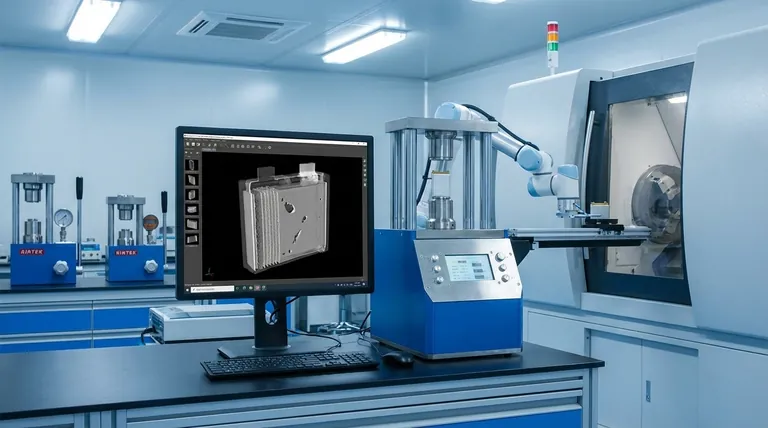
The effectiveness of the pressing process is best evaluated using X-ray computed tomography (CT), a non-destructive three-dimensional imaging tool. This technology allows engineers to visualize the battery's internal structure without disassembly, providing direct evidence of layer adhesion and the presence of any defects.
Core Takeaway The goal of pressing in solid-state batteries is to maximize physical contact between solid components to reduce resistance. X-ray CT imaging serves as the critical validation step, confirming that pressure and temperature parameters have successfully eliminated performance-killing voids and delamination.
Visualizing Internal Integrity via X-ray CT
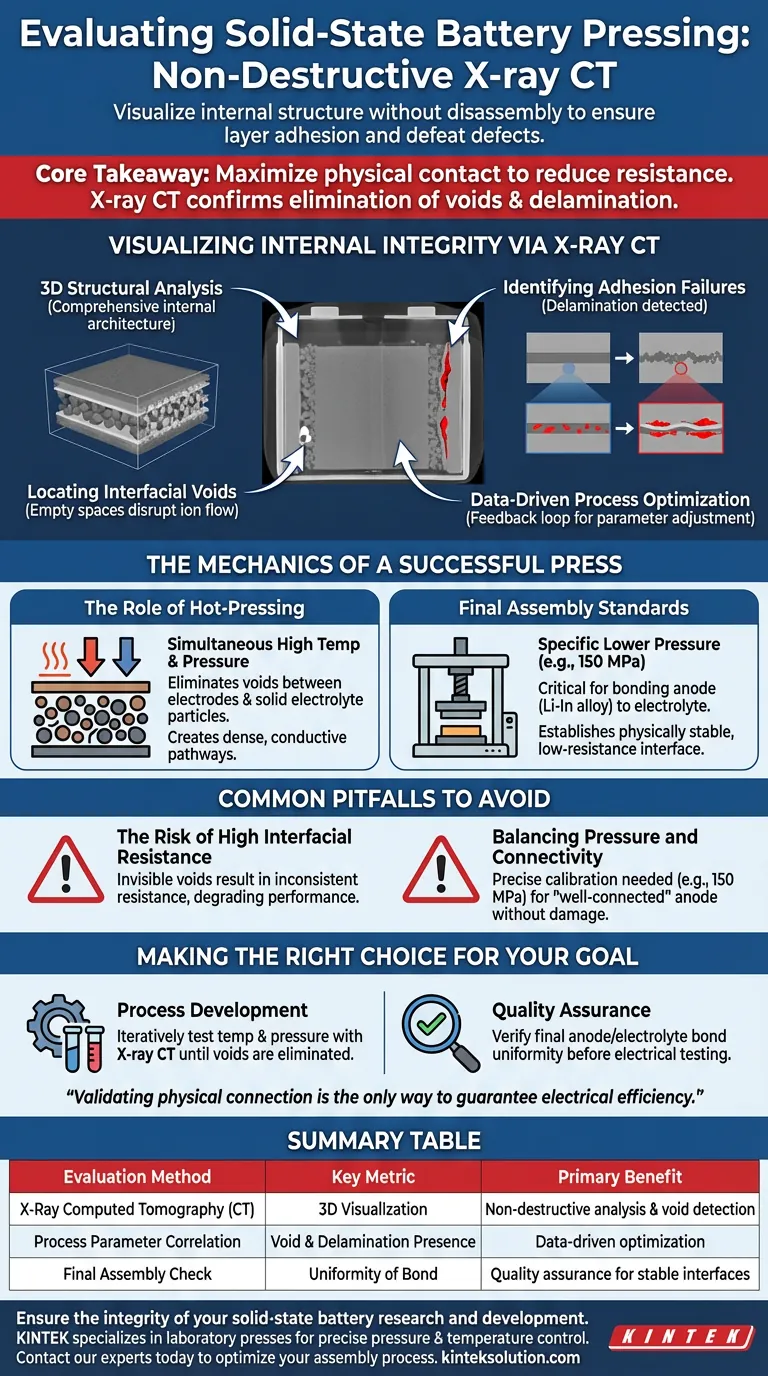
3D Structural Analysis
X-ray computed tomography (CT) offers a window into the sealed battery cell. Unlike destructive cross-sectioning, which destroys the sample, CT scanning generates a comprehensive three-dimensional model of the internal architecture.
Identifying Adhesion Failures
The primary metric for success is the quality of the interface between layers. CT imaging clearly distinguishes between well-bonded surfaces and areas suffering from delamination.
Locating Interfacial Voids
The scan specifically targets voids—empty spaces at the interfaces where materials failed to connect. Identifying these gaps is crucial, as they disrupt the ion flow necessary for battery operation.
Data-Driven Process Optimization
Visual evidence from CT scans creates a feedback loop for manufacturing. By correlating visual defects with specific pressing settings, engineers can precisely optimize the parameters to ensure consistent, high-quality interfacial contact.
The Mechanics of a Successful Press
The Role of Hot-Pressing
The fundamental purpose of hot-pressing is the simultaneous application of high temperature and pressure. This process is designed to eliminate voids between the positive/negative electrodes and the solid electrolyte particles.
By applying heat and pressure, the effective contact area between these solid-state components is significantly increased, creating a dense, conductive pathway.
Final Assembly Standards
During final assembly, specifically after the cathode/electrolyte pellet is prepared, a laboratory press is used to apply specific, lower pressures (such as 150 MPa).
This step is critical for bonding anode materials, such as lithium-indium alloy sheets, to the electrolyte layer. The objective is to establish a physically stable interface that maintains low resistance.
Common Pitfalls to Avoid
The Risk of High Interfacial Resistance
If the pressing process is not validated, invisible voids often remain at the contact points. These voids result in inconsistent interfacial resistance, which severely degrades the battery's performance during charge and discharge cycles.
Balancing Pressure and Connectivity
The pressing process is not simply about applying maximum force; it requires specific calibration. For example, the 150 MPa standard is used to ensure the anode is "well-connected" without potentially damaging the structural integrity of the composite layers.
Making the Right Choice for Your Goal
To ensure your solid-state battery assembly meets performance standards, apply these evaluation strategies:
- If your primary focus is Process Development: Use X-ray CT to iteratively test different temperature and pressure combinations until voids are completely eliminated.
- If your primary focus is Quality Assurance: Utilize 3D imaging to verify that the final anode/electrolyte bond is uniform and free of delamination before electrical testing.
Validating the physical connection between layers is the only way to guarantee the electrical efficiency of a solid-state battery.
Summary Table:
| Evaluation Method | Key Metric | Primary Benefit |
|---|---|---|
| X-Ray Computed Tomography (CT) | 3D Visualization of Internal Structure | Non-destructive analysis of layer adhesion and void detection |
| Process Parameter Correlation | Interfacial Void & Delamination Presence | Data-driven optimization of pressure and temperature settings |
| Final Assembly Check | Uniformity of Anode/Electrolyte Bond | Quality assurance for stable, low-resistance interfaces |
Ensure the integrity of your solid-state battery research and development.
Accurate and reliable pressing is fundamental to creating high-performance solid-state batteries. KINTEK specializes in laboratory press machines, including automatic lab presses and heated lab presses, designed to deliver the precise pressure and temperature control required for consistent, void-free layer bonding.
Contact our experts today to discuss how our presses can optimize your solid-state battery assembly process. Let us help you achieve superior interfacial contact and maximize your battery's electrical efficiency.
Visual Guide
Related Products
- Warm Isostatic Press for Solid State Battery Research Warm Isostatic Press
- Lab Button Battery Tablet Press Sealing Mold
- Laboratory Hydraulic Press Lab Pellet Press Button Battery Press
- Button Battery Sealing Press Machine for Lab
- Carbide Lab Press Mold for Laboratory Sample Preparation
People Also Ask
- Why must composite cathodes be sealed in vacuum lamination bags for WIP? Ensure Battery Stability and Density
- What is the function of elastic molds in warm isostatic pressing? Achieve Uniform Density in Composite Particles
- How do sacrificial volume materials (SVM) maintain microchannels in isostatic pressing? Ensure Structural Integrity
- What are the advantages of using a Warm Isostatic Press (WIP) for batteries? Achieve Superior Interface Contact
- What is the mechanism of a Warm Isostatic Press (WIP) on cheese? Master Cold Pasteurization for Superior Safety