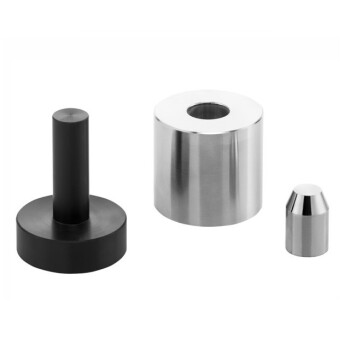
High-precision steel molds are the critical determinant of structural integrity and consistency when pressing refractory bricks in a laboratory setting. By leveraging high surface hardness and an exceptional finish, these molds significantly reduce friction between the powder and mold walls, ensuring that hydraulic pressure is transmitted effectively to the center of the sample rather than being lost at the edges.
Core Takeaway: The primary function of a high-precision mold is to minimize density gradients within the "green body" (the unfired brick). Uniform density is the only reliable defense against deformation and cracking caused by uneven shrinkage during the subsequent high-temperature sintering process.
The Mechanics of Pressure Transmission
Overcoming Wall Friction
In standard powder pressing, friction is the enemy of uniformity. As the hydraulic press applies force, the powder drags against the side of the mold.
High-precision steel molds utilize a superior surface finish to drastically lower this coefficient of friction. This ensures the applied force is used to compress the powder, rather than fighting resistance at the mold walls.
Achieving Core Densification
When friction is minimized, the applied pressure is not concentrated solely at the perimeter.
Instead, the force acts hydrostatically, transmitting effectively to the geometric center of the powder mass. This ensures the core of the brick reaches the same density as the outer shell.
From Green Body to Sintered Product
Eliminating Density Gradients
The immediate result of effective pressure transmission is a homogenous "green body."
Without precision molding, the brick would suffer from density gradients—areas of high compaction mixed with areas of loose packing. High-precision molds constrain the geometry rigorously, ensuring the powder packs evenly throughout the entire volume.
Preventing Sintering Defects
The true value of the mold is revealed during the sintering (firing) stage.
If a green body has uneven density, it will shrink unevenly when heated. This differential shrinkage creates internal stress, which leads to warping, deformation, or catastrophic cracking. Uniform molding prevents these structural failures before they happen.
Understanding the Trade-offs
The Reality of Mold Wear
While high-precision molds offer superior performance, they are sensitive to degradation.
Over time, abrasive powders can cause adhesive wear or create surface debris, compromising the mold's finish. This increases friction and reintroduces the density gradients you are trying to avoid.
Monitoring Ejection Forces
To maintain precision, you cannot rely on visual inspection alone.
Advanced systems track ejection force—the force required to push the brick out of the mold. An unexplained rise in ejection force is often an early indicator of mold wear or coating failure, signaling the need for maintenance before sample quality degrades.
Making the Right Choice for Your Goal
To select the right molding strategy for your laboratory, consider your specific end-goals:
- If your primary focus is Defect Prevention: Prioritize molds with the highest possible surface finish to minimize wall friction and eliminate sintering cracks.
- If your primary focus is Consistency: Implement a system that monitors ejection force to detect mold wear and ensure every sample is pressed under identical friction conditions.
- If your primary focus is Structural Integrity: Ensure your mold design allows for directional pressure application to expel trapped air and fully compact the powder matrix.
High-precision molding is not just about shaping the brick; it is about controlling the internal stress distribution that defines the material's final performance.
Summary Table:
| Feature | Impact on Performance | Long-term Benefit |
|---|---|---|
| Superior Surface Finish | Reduces wall friction & internal stress | Prevents cracks and warping during sintering |
| High Surface Hardness | Maintains geometric consistency | Ensures repeatable sample dimensions |
| Core Densification | Eliminates density gradients | Uniform shrinkage and higher structural integrity |
| Ejection Force Monitoring | Identifies early mold wear | Extends mold life and ensures batch consistency |
Optimize Your Material Research with KINTEK Precision Solutions
Don't let uneven density gradients compromise your research outcomes. KINTEK specializes in comprehensive laboratory pressing solutions, offering a versatile range of manual, automatic, heated, and multifunctional models, alongside specialized cold and warm isostatic presses for advanced battery and refractory research.
Our high-precision steel molds and pressing systems are engineered to minimize friction and ensure the structural integrity of every sample. Whether you require glovebox-compatible equipment or heavy-duty industrial molds, KINTEK provides the reliability your lab needs.
Ready to achieve superior sample uniformity? Contact KINTEK today for a consultation!
References
- Cristian Gómez-Rodríguez, Luis Felipe Verdeja González. MgO Refractory Doped with ZrO2 Nanoparticles: Influence of Cold Isostatic and Uniaxial Pressing and Sintering Temperature in the Physical and Chemical Properties. DOI: 10.3390/met9121297
This article is also based on technical information from Kintek Solution Knowledge Base .
Related Products
- Lab Polygon Press Mold
- XRF KBR Steel Ring Lab Powder Pellet Pressing Mold for FTIR
- Infrared Heating Quantitative Flat Plate Mold for Precise Temperature Control
- Special Shape Lab Press Mold for Laboratory Applications
- Lab Round Bidirectional Press Mold
People Also Ask
- What is the purpose of incorporating cartridge heaters into a lab press mold for MLCC block compression? Optimize Results
- How do the design and geometric precision of pressing molds and mandrels affect the quality of PTFE composite samples?
- What role do precision positioning and pressure molds play in single-lap joints? Ensure 100% Data Integrity
- What are the requirements for pressing molds when using SSCG? Key Materials for Complex Single Crystal Production
- How do industrial-grade pressure molds affect zinc metal pouch cells? Maximize Energy Density & Performance