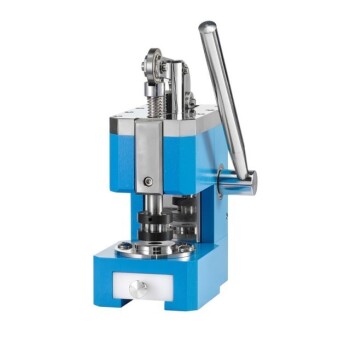
Precision is the bedrock of reliable electrochemical data. Laboratory disc cutters and precision molds contribute to test consistency by strictly controlling the physical geometry of your electrode sheets. By ensuring that every sample has identical dimensions and clean, burr-free edges, these tools eliminate physical variables that would otherwise introduce noise or failure into your experimental results.
Standardizing the physical shape of your electrodes is a prerequisite for accurate science. Precision cutting ensures uniform current density and prevents internal short circuits, creating the baseline repeatability needed for valid statistical comparison across multiple samples.
The Physical Foundation of Reliability
To understand why your test results vary, you must look at the physical variation between your samples. Precision tools bridge the gap between material synthesis and reliable data collection.
Achieving Geometric Standardization
In electrochemical testing, the active surface area must be known and constant.
Manual cutting methods inevitably introduce variances in diameter and area. Precision molds ensure completely consistent geometric dimensions for every electrode produced.
This standardization guarantees that when you calculate specific capacity or current density, the math is based on physical reality, not an approximation.
The Critical Role of Neat Edges
The quality of the electrode edge is just as important as the surface area.
Poor cutting techniques leave rough edges or "burrs" (small projections of metal). Precision cutters are engineered to produce perfectly neat edges.
Eliminating these imperfections is crucial because edge burrs are a primary cause of internal short circuits, which lead to immediate cell failure or erratic voltage drops during cycling.
Electrochemical Implications
Physical consistency directly translates to electrochemical stability. The goal is to ensure that any variation in your data comes from the chemistry, not the sample preparation.
Uniform Current Density Distribution
Current follows the path of least resistance. Irregular shapes or frayed edges alter how current flows through the electrode.
By maintaining a standardized physical shape, precision tools promote uniform current density distribution. This ensures the active material is utilized evenly across the entire surface of the electrode.
Improving Repeatability and Accuracy
Scientific validity relies on the ability to reproduce results.
When physical variables are removed, you can trust the repeatability and accuracy of your data.
This allows for true comparative analysis across multiple experimental samples, confirming that differences in performance are due to material properties rather than inconsistent cutting.
Common Pitfalls to Avoid
While precision tools are essential, they are not set-and-forget solutions. Understanding their limitations is key to maintaining data integrity.
Tool Maintenance and Wear
Even the best precision cutter will degrade over time.
Dull blades or worn molds can re-introduce the very burrs they were designed to prevent. Regular inspection of the cutting die is necessary to maintain the neat edges required for safety.
Material Compatibility
Not all electrode coatings react the same way to shear force.
Thick or brittle coatings may crack even under precision cutting. It is critical to match your cutter's clearance and pressure capabilities to the specific thickness and density of your current collector and active material.
Making the Right Choice for Your Goal
To maximize the consistency of your electrode preparation, align your usage with your specific research objectives.
- If your primary focus is Cycle Life Testing: Prioritize the quality of the edge cut to eliminate micro-burrs that cause slow, long-term internal shorts.
- If your primary focus is Rate Capability: Prioritize geometric precision to ensure the calculated current density is strictly accurate across all C-rates.
By rigorously controlling the physical variables of your electrodes, you allow the true electrochemical performance of your materials to be measured with confidence.
Summary Table:
| Factor | Impact on Test Consistency | Benefit of Precision Tools |
|---|---|---|
| Geometric Dimensions | Fluctuating surface area affects capacity math | Guarantees identical diameter and known active area |
| Edge Quality | Burrs cause internal short circuits and cell failure | Produces neat, burr-free edges for safety and stability |
| Current Density | Irregular shapes cause uneven material utilization | Promotes uniform current distribution across the electrode |
| Data Reliability | Physical noise masks chemical performance | Enables valid statistical comparison across multiple samples |
Elevate Your Battery Research with KINTEK Precision
Consistency in electrode preparation is the difference between breakthrough data and failed experiments. KINTEK specializes in comprehensive laboratory pressing and cutting solutions designed to meet the rigorous demands of battery research.
Whether you require manual, automatic, heated, or multifunctional models, or specialized cold and warm isostatic presses, our equipment ensures your samples are perfectly standardized and glovebox-compatible. Don't let physical imperfections compromise your electrochemical insights.
Contact KINTEK today to find the perfect precision mold or disc cutter for your lab!
References
- Qiushi Miao. Quantifying the Effect of Sulfur Content on the Kinetics of Sulfurized Polyacrylonitrile Cathode Materials. DOI: 10.1149/1945-7111/ae2210
This article is also based on technical information from Kintek Solution Knowledge Base .
Related Products
- Lab Manual Microtome Slicer for Tissue Sectioning
- Laboratory Hydraulic Split Electric Lab Pellet Press
- Laboratory Hydraulic Press Lab Pellet Press Machine for Glove Box
- Automatic Laboratory Hydraulic Press Lab Pellet Press Machine
- Assemble Lab Cylindrical Press Mold for Laboratory Use
People Also Ask
- Why is a precision disc cutter used to process samples? Ensure Accuracy in Gel Content and Swelling Ratio Testing
- Why is it necessary to use a high-precision disc cutter for coin cells? Ensure Data Accuracy and Prevent Shorts
- How does a precision disc puncher ensure experimental accuracy? Standardize Your Battery Research Samples
- How do chemical etchants assist in Micro EDM microstructure analysis? Reveal Heat-Affected Zones and Recast Layers
- Why is a blade grinder necessary for PLA composites? Master Pretreatment for Perfect Hot-Press Molding