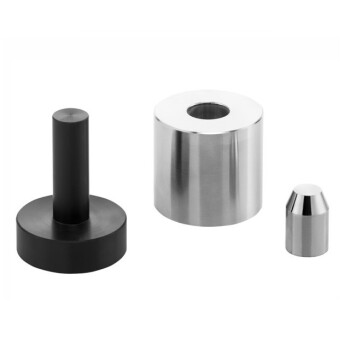
Precision metal molds act as the primary geometric authority during the composite fabrication process. They function by providing a rigid, fixed constraint that converts the uni-directional force of a laboratory press into uniform internal pressure, compacting loose powders or laminates into solid "green bodies" with exact dimensions and homogeneous internal structures.
The Core Function: While the laboratory press supplies the energy, the mold dictates the integrity of the sample. By enforcing strict boundary constraints, precision molds eliminate geometric variability, ensuring that any differences observed in subsequent testing result from material chemistry, not inconsistent fabrication.
The Mechanics of Constraint and Force
Establishing Geometric Boundaries
The fundamental role of the mold is to provide a fixed containment zone, such as a 13mm or 25mm diameter cylinder. This rigid boundary prevents lateral expansion of the material when vertical force is applied. By locking the material into a specific shape, the mold ensures the final output matches the precise design requirements needed for testing.
Uniform Force Transmission
For composite powders, applying force without a precision mold often results in uneven compaction. The mold ensures that the force generated by the press is transmitted uniformly throughout the material. This uniformity is non-negotiable for creating samples with consistent density gradients and structural integrity.
Friction Reduction and Surface Integrity
High-quality molds feature extremely smooth inner walls (often tool steel or stainless steel). This smoothness minimizes friction between the powder particles and the mold surface during compression. Lower friction allows particles to slide past one another more easily, promoting higher internal density and ensuring the sample surface remains intact upon ejection.
Impact on Microstructure and Material Performance
Optimizing Particle Contact
In applications like solid-state battery research, molds are critical for compressing active substances and electrolytes. The high compaction pressure facilitated by the mold reduces contact resistance between particles. This establishes the necessary ion and electron transport networks required for electrochemical activity.
Controlling Fiber Architecture
When processing laminates, the rigidity of the mold is essential for maintaining the orderly arrangement of glass fiber layers. Under pressures as high as 20 MPa, a less rigid mold might deform, distorting the fiber orientation. Precision molds maintain their shape, ensuring the fiber volume fraction is optimized (e.g., excluding excess resin) to achieve high specific strength.
Thermal Conductivity Management
In processes requiring heat, such as gelation or hot-pressing laminates, the material of the mold (often stainless steel) acts as a thermal conduit. It facilitates rapid and uniform heat transfer from the press platens to the composite material. This ensures that curing or phase changes occur evenly throughout the specimen.
Critical Operational Considerations
Pressure Limits and Deformation
While molds are designed for high rigidity, they are not indestructible. Operating limits—such as the 50 MPa threshold mentioned for specific tool steel molds—must be respected. Exceeding these limits can cause the mold walls to bow or deform, which immediately compromises the geometric accuracy of the sample.
The "Wall Effect"
Despite smooth surfaces, some friction is inevitable. In very deep molds, friction at the walls can lead to a density gradient where the edges of the sample are denser than the center. Understanding the ratio of sample diameter to height is crucial to mitigating this effect.
Standardization for Scientific Validity
Eliminating Geometric Bias
Scientific validity relies on the ability to compare "apples to apples." Precision molds ensure that every specimen produced—regardless of composition—has identical dimensions (e.g., 50.0 mm x 20.0 mm). This standardization eliminates shape-based variables that could skew results.
Enabling Accurate Calculations
Many physical property calculations, such as linear shrinkage, water absorption, and apparent porosity, depend on precise initial volume measurements. Because the mold guarantees the initial dimensions of the green body, researchers can calculate these properties with a high degree of confidence.
Making the Right Choice for Your Goal
To select the correct mold configuration for your specific laboratory press application:
- If your primary focus is Electrochemical Performance: Prioritize molds capable of high-compaction pressures to minimize particle contact resistance and maximize ion transport.
- If your primary focus is Structural Mechanics: Ensure the mold has high rigidity and thermal conductivity to maintain fiber alignment and uniform resin curing under heat and pressure.
- If your primary focus is Comparative Data Analysis: Select a mold with high wear resistance to guarantee that the 100th sample has the exact same geometry as the first, ensuring reproducible datasets.
Ultimately, the precision mold transforms raw force into scientific accuracy, turning variable raw materials into standardized, testable specimens.
Summary Table:
| Function | Description | Key Benefit |
|---|---|---|
| Geometric Constraint | Provides rigid, fixed boundaries for material | Ensures exact dimensions and consistency |
| Force Transmission | Converts uni-directional press force to internal pressure | Achieves uniform density and structural integrity |
| Friction Reduction | Smooth inner walls minimize particle resistance | Improves surface finish and particle sliding |
| Thermal Conduit | Facilitates heat transfer from press platens | Ensures even curing and phase changes |
| Standardization | Eliminates shape-based variables | Enables valid scientific comparisons |
Elevate Your Research with KINTEK Precision Solutions
Maximize your material science outcomes with KINTEK’s comprehensive laboratory pressing solutions. Whether you are conducting cutting-edge battery research or testing advanced structural laminates, our range of manual, automatic, heated, and multifunctional presses—including specialized cold and warm isostatic models—are designed for absolute precision.
Why choose KINTEK?
- Unmatched Accuracy: Our glovebox-compatible and high-pressure molds ensure standardized, repeatable results.
- Optimized Microstructure: Achieve superior particle contact and fiber alignment for high-performance composites.
- Expert Engineering: Built to withstand rigorous laboratory environments with integrated thermal management.
Ready to transform raw force into scientific accuracy? Contact KINTEK today to find the perfect pressing solution for your lab!
References
- Tahir Ahmad, Othman Mamat. The Development and Characterization of Zirconia-Silica Sand Nanoparticles Composites. DOI: 10.4236/wjnse.2011.11002
This article is also based on technical information from Kintek Solution Knowledge Base .
Related Products
- Lab Polygon Press Mold
- Lab Anti-Cracking Press Mold
- Infrared Heating Quantitative Flat Plate Mold for Precise Temperature Control
- Lab Button Battery Tablet Press Sealing Mold
- Special Shape Lab Press Mold for Laboratory Applications
People Also Ask
- What is the purpose of incorporating cartridge heaters into a lab press mold for MLCC block compression? Optimize Results
- How do the design and geometric precision of pressing molds and mandrels affect the quality of PTFE composite samples?
- What role do precision positioning and pressure molds play in single-lap joints? Ensure 100% Data Integrity
- What are the requirements for pressing molds when using SSCG? Key Materials for Complex Single Crystal Production
- How do industrial-grade pressure molds affect zinc metal pouch cells? Maximize Energy Density & Performance