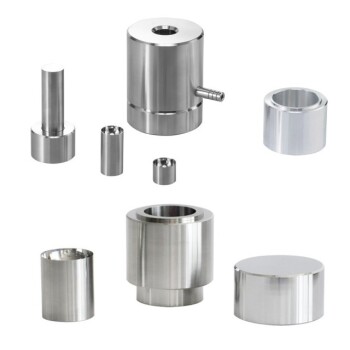
Precision mold sets function as the primary constraint mechanism during the cold pressing of Ti-Al-Nb-Mn-Si-Sn alloy powders. By utilizing die sleeves and matched rods to strictly limit the radial flow of the powder, these tools ensure that axial pressure is transmitted uniformly throughout the charge, producing a dimensionally accurate and structurally consistent green compact.
The core value of a precision mold set is its ability to convert applied force into uniform density. By preventing radial expansion, it forces the powder particles to compact evenly, eliminating the severe density gradients that compromise structural integrity.
Achieving Structural Integrity and Precision
Restricting Radial Flow
The fundamental role of the mold set—specifically the die sleeve—is to create a rigid boundary. When pressure is applied, the alloy powder naturally seeks to expand outward.
The mold restricts this movement, forcing the particles to rearrange and bond with one another. This confinement is the primary driver for achieving high-density compaction.
Ensuring Uniform Axial Pressure
The upper and lower rods work in tandem within the sleeve to apply force along the central axis. Because the radial path is blocked, the pressure wave transmits effectively through the depth of the powder charge.
This mechanism ensures that the force is not lost to lateral expansion but is instead utilized entirely for compaction.
Eliminating Density Gradients
A major challenge in powder metallurgy is creating a part that is equally dense at the core and the surface. Precision molds mitigate this issue by maintaining a stable pressing volume.
This stability results in a cylindrical green compact with precise dimensions—such as a specific 53 mm diameter—and a uniform internal structure free of weak points.
Monitoring Mold Health and Performance
Utilizing Ejection Force Data
Beyond the physical pressing, the mold set interacts with hydraulic press sensors to provide critical operational data. High-precision load sensors measure the force required to eject the compact from the mold.
Identifying Surface Wear
Technicians can analyze real-time changes in these ejection forces to diagnose the condition of the mold. An unexpected rise in force often serves as an indirect indicator of adhesive wear or the accumulation of wear debris.
Evaluating Coating Effectiveness
This data feedback loop allows operators to assess the performance of mold coatings. By monitoring ejection trends, you can scientifically determine the optimal replacement cycle for the mold before quality degrades.
Understanding the Operational Trade-offs
Sensitivity to Surface Condition
While precision molds ensure density, they are highly sensitive to surface degradation. The accumulation of debris or minor adhesive wear can rapidly alter the friction coefficient, affecting the uniformity of the pressure transmission.
Maintenance Requirements
To maintain the precise tolerances required for alloys like Ti-Al-Nb-Mn-Si-Sn, the mold requires rigorous monitoring. Relying solely on the physical tool without analyzing sensor data can lead to undetected wear and inconsistent batch quality.
Optimizing Your Cold Pressing Process
To maximize the quality of your Ti-Al-Nb-Mn-Si-Sn compacts, you must balance mechanical precision with data-driven maintenance.
- If your primary focus is Dimensional Accuracy: Prioritize the rigidity and fit of the die sleeve to ensure zero radial expansion during the pressure stroke.
- If your primary focus is Process Consistency: Implement real-time monitoring of ejection forces to detect adhesion early and schedule predictive maintenance.
Precise tooling is not merely a container; it is the active control variable that dictates the structural success of your alloy powder compaction.
Summary Table:
| Feature | Function in Cold Pressing | Impact on Ti-Al-Nb-Mn-Si-Sn Alloys |
|---|---|---|
| Die Sleeve | Restricts radial flow | Ensures dimensional accuracy and high-density compaction |
| Matched Rods | Transmits axial pressure | Promotes uniform density and eliminates internal weak points |
| Load Sensors | Monitors ejection force | Detects adhesive wear and evaluates mold coating health |
| Rigid Boundary | Forces particle bonding | Creates structurally sound green compacts without expansion |
Elevate Your Powder Metallurgy Precision with KINTEK
Achieving the perfect green compact requires more than just pressure—it requires absolute control. KINTEK specializes in comprehensive laboratory pressing solutions designed to meet the rigorous demands of advanced material science. Whether you are conducting battery research or developing high-performance titanium alloys, our diverse range of manual, automatic, heated, and multifunctional presses, alongside specialized isostatic solutions, ensures your success.
Our value to you:
- Unmatched Precision: Rigid mold designs to eliminate radial expansion and density gradients.
- Versatile Solutions: Equipment optimized for glovebox compatibility and specialized alloy research.
- Data-Driven Quality: Tools designed to work seamlessly with sensors for predictive maintenance and consistent batch quality.
Contact KINTEK Today to find the ideal pressing solution for your laboratory and optimize your structural alloy production!
References
- John Ellard, A.S. Bolokang. Effects of Sn on the densification and microstructure of a Ti-48Al-2Nb-0.7Mn-0.3Si-1Sn alloy fabricated from cold-pressed powders through vacuum melting. DOI: 10.1051/matecconf/202338803009
This article is also based on technical information from Kintek Solution Knowledge Base .
Related Products
- Lab Polygon Press Mold
- Lab Anti-Cracking Press Mold
- Lab Round Bidirectional Press Mold
- Square Lab Press Mold for Laboratory Use
- Special Shape Lab Press Mold for Laboratory Applications
People Also Ask
- What is the purpose of incorporating cartridge heaters into a lab press mold for MLCC block compression? Optimize Results
- How do the design and geometric precision of pressing molds and mandrels affect the quality of PTFE composite samples?
- What role do precision positioning and pressure molds play in single-lap joints? Ensure 100% Data Integrity
- What are the requirements for pressing molds when using SSCG? Key Materials for Complex Single Crystal Production
- How do industrial-grade pressure molds affect zinc metal pouch cells? Maximize Energy Density & Performance