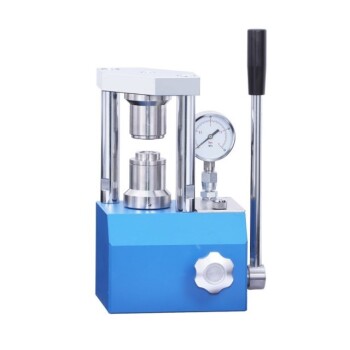
A laboratory hydraulic press guarantees testing accuracy by applying uniform, constant pressure during the assembly of Lithium-Oxygen (Li-O2) coin cells. This mechanical precision ensures intimate physical contact between the oxygen electrode, separator, and metallic lithium anode while establishing a hermetic seal. Without this controlled force, environmental contamination and variable internal resistance would render test data unreliable.
Core Insight: Precision assembly transforms variable components into a unified electrochemical system. By standardizing the physical compression and sealing force, the machine ensures that data regarding internal impedance and reaction kinetics remains reproducible across hundreds of test cycles.
The Critical Role of Physical Contact
Reducing Interfacial Impedance
For a Li-O2 battery to function correctly, ions must move freely between layers. The press applies precise force to ensure tight physical contact between the metallic lithium anode, the separator, and the oxygen electrode.
Eliminating Air Gaps
Microscopic gaps between components act as barriers to ion flow. By applying uniform pressure, the press eliminates these air gaps. This promotes uniform ion distribution across the interface, which is essential for accurate electrochemical readings.
Ensuring Connectivity
The pressure forces the electrode materials into tight contact with the current collectors (such as copper foil). This significantly reduces interfacial contact resistance, ensuring that the impedance measured is intrinsic to the chemistry, not a result of poor assembly.
Environmental Isolation and Sealing
Preventing Electrolyte Evaporation
Li-O2 batteries rely on liquid electrolytes that can evaporate if the cell is not perfectly sealed. The hydraulic press provides the stable force necessary for the sealing mold to mechanically crimp the battery case edges. This creates a reliable airtight seal that retains the electrolyte over long testing periods.
Blocking Moisture Ingress
Lithium metal is highly reactive to moisture. A precision seal acts as a barrier against the external environment. This prevents water vapor from entering the cell, which ensures that the reaction kinetics observed during testing are not skewed by side reactions with atmospheric moisture.
Standardization and Reproducibility
Consistent Layer Thickness
Manual assembly often leads to variations in electrode thickness and porosity. A precision press ensures high consistency in compression. This uniformity allows researchers to achieve repeatable performance tests across different batches of batteries.
Reliable Long-Term Data
To measure cycle life (e.g., hundreds of cycles or 5000-hour performance), the cell's internal structure must remain stable. The initial application of uniform pressure ensures that the internal resistance does not fluctuate wildly due to mechanical shifting, providing valid data on the battery's long-term stability.
Common Pitfalls to Avoid
While pressure is vital, excessive force can be detrimental. Over-compression may damage the porous structure of the separator, leading to short circuits or blocked ion pathways. Conversely, insufficient pressure results in high contact resistance and poor cycle life. The value of a precision machine lies in its ability to dial in the exact force required—balancing connectivity with structural integrity—rather than simply applying maximum force.
Making the Right Choice for Your Goal
To maximize the accuracy of your Li-O2 testing, align your assembly process with your specific data requirements:
- If your primary focus is Electrochemical Impedance Spectroscopy (EIS): Prioritize precision pressure control to minimize contact resistance and optimize internal porosity for clean, representative data.
- If your primary focus is Long-Term Cycle Life: Prioritize the sealing capability of the machine to ensure absolute airtightness, preventing electrolyte loss and moisture contamination over weeks of testing.
Accuracy in battery testing is not just about the chemistry; it begins with the mechanical integrity of the assembly.
Summary Table:
| Key Factor | Impact on Li-O2 Testing Accuracy | Mechanism |
|---|---|---|
| Interfacial Contact | Reduces internal impedance | High-precision pressure eliminates microscopic air gaps. |
| Airtight Sealing | Prevents moisture & evaporation | Mechanical crimping ensures stable electrolyte levels. |
| Uniform Pressure | Standardizes ion distribution | Prevents electrode shifting and ensures consistent layer thickness. |
| Force Control | Protects structural integrity | Avoids separator damage while minimizing contact resistance. |
Elevate Your Battery Research with KINTEK Precision
Unlock superior electrochemical reproducibility with KINTEK’s industry-leading laboratory pressing solutions. As specialists in comprehensive laboratory pressing, we provide manual, automatic, heated, and multifunctional models, alongside glovebox-compatible presses and isostatic systems specifically engineered for rigorous battery research.
Why choose KINTEK?
- Precision Control: Eliminate variable internal resistance with exact pressure application.
- Versatile Solutions: Equipment designed to integrate seamlessly into inert gas environments.
- Reliable Data: Ensure hermetic seals that protect your Lithium-Oxygen cells from moisture and electrolyte loss.
Don't let mechanical variability compromise your research. Contact KINTEK experts today to find the perfect pressing solution for your lab.
References
- Mengtian Yu, Yuqi Fan. Scheelite ZnMoO4 cathode catalyst boosts the cycle durability at a wide range temperature of Li-O2 batteries through crystal structure rearrangement by oxygen vacancy. DOI: 10.1007/s42114-025-01240-1
This article is also based on technical information from Kintek Solution Knowledge Base .
Related Products
- Laboratory Hydraulic Press Lab Pellet Press Button Battery Press
- Lab Infrared Press Mold for Laboratory Applications
- Warm Isostatic Press for Solid State Battery Research Warm Isostatic Press
- Carbide Lab Press Mold for Laboratory Sample Preparation
- Button Battery Sealing Press Machine for Lab
People Also Ask
- How is a laboratory hydraulic press used for HAP composite gels? Master Mineral Substrate Standardization
- What role does a laboratory hydraulic press play in reaction pellets? Optimizing Lunar Soil and Metal Fuel Density
- What role does a laboratory hydraulic press play in the preparation of piezoelectric ceramic discs for DC-PG? | KINTEK
- Why is a laboratory hydraulic press required for PBAT and PLA sample preparation? Achieve Flawless Characterization
- What role does a laboratory hydraulic press play in the assembly of all-solid-state battery test cells? Expert Guide