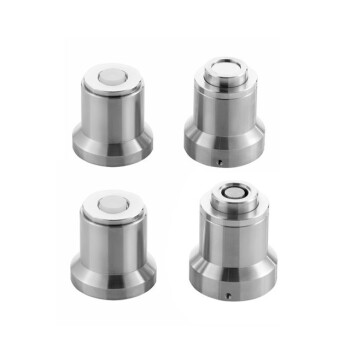
A tapered die fundamentally drives structural solidification by utilizing a gradually contracting internal chamber to generate escalating extrusion pressure. As the biomass material is pushed forward into this narrowing space, the increasing compression forces particles to bond, reinforcing the overall densification of the briquette.
The tapered die acts as a pressure vessel that transforms loose biomass into a solid unit by balancing forward force with geometric constriction. It ensures the final product possesses the necessary friction-induced back pressure to achieve high cold strength and resistance to fragmentation.
The Mechanics of Densification
The Contracting Chamber
The core mechanism of a tapered die is its gradually contracting internal chamber. As biomass moves through the die, the available volume decreases, forcing the material to occupy a smaller space.
This physical restriction generates increasing extrusion pressure. The deeper the material is pushed into the taper, the higher the compressive force becomes, eliminating air pockets and forcing particles into a solid matrix.
The Role of the Sizing Section
Once the material has been compressed by the taper, it enters the sizing section. This portion of the die ensures the briquette reaches its final, regulated geometry, such as a precise cylindrical shape.
This section acts as a stabilizer. It locks in the density achieved during the tapered phase, ensuring the briquette maintains its form as it exits the machine.
Friction and Structural Integrity
Generating Back Pressure
The interaction between the biomass and the die walls is critical. The friction generated at this interface provides necessary back pressure.
This resistance works against the forward force of the extruder. It creates a high-pressure zone that is essential for the mechanical interlocking of biomass fibers.
Ensuring Cold Strength
The ultimate goal of this pressure and friction is to establish cold strength. This refers to the briquette's ability to remain solid after it has left the hot die and cooled down.
Without the specific compression provided by the tapered die, the briquette would lack cohesion. The friction ensures the structure is dense enough to resist fragmentation during storage and handling.
Understanding the Trade-offs
Balancing Friction and Energy
While friction is necessary for solidification, it comes at a cost. Higher friction generates better density but requires significantly more energy to push the material through the die.
Wear and Maintenance
The same forces that compress the biomass also abrade the die walls. The high-pressure environment within the tapered section subjects the metal to intense wear, requiring regular monitoring to maintain precise geometry.
Making the Right Choice for Your Process
Optimizing your briquetting process requires balancing pressure generation with equipment longevity.
- If your primary focus is maximum density: Prioritize a die design with a taper that maximizes back pressure to ensure superior cold strength and durability.
- If your primary focus is dimensional consistency: Ensure the sizing section of the die is long enough to set the final geometry rigidly after the compression phase.
The tapered die is the defining component that turns loose organic matter into a durable, valuable fuel source.
Summary Table:
| Component | Role in Solidification | Outcome |
|---|---|---|
| Tapered Chamber | Volume reduction & extrusion pressure | Eliminates air pockets; creates a solid matrix |
| Sizing Section | Geometric regulation & stabilization | Ensures dimensional consistency & shape retention |
| Friction Interface | Generates back pressure | Facilitates mechanical interlocking of fibers |
| Pressure Balance | Balances forward force vs. resistance | Achieves high cold strength & fragment resistance |
Maximize Your Material Density with KINTEK
Ready to optimize your briquetting and material research? KINTEK specializes in comprehensive laboratory pressing solutions, offering a full range of manual, automatic, heated, and multifunctional models. Whether you need precise glovebox-compatible presses or advanced cold and warm isostatic presses for battery research, our technology ensures superior structural solidification and cold strength for your samples.
Enhance your lab's efficiency and product durability today. Contact us now to find your ideal pressing solution!
References
- Nagini Yarramsetty, Neverov V.S.. Sustainable Energy from Biomass Waste: Design and Fabrication of a Screw Briquetting Machine with Calorific Value Assessment. DOI: 10.14445/23488360/ijme-v12i11p105
This article is also based on technical information from Kintek Solution Knowledge Base .
Related Products
- Lab Round Bidirectional Press Mold
- Lab Infrared Press Mold for No Demolding
- Square Bidirectional Pressure Mold for Lab
- Laboratory Hydraulic Split Electric Lab Pellet Press
- Lab XRF Boric Acid Powder Pellet Pressing Mold for Laboratory Use
People Also Ask
- What is the purpose of incorporating cartridge heaters into a lab press mold for MLCC block compression? Optimize Results
- Why is precise cooling management of the lab press mold necessary? Protect Core Integrity in Thermoforming
- What is the function of a pressing tool in thermoplastic panels? Master Precision Shaping & Fusion Bonding
- Why is a high-performance laboratory molding press critical for in-situ electrolyte formation? Unlock Battery Success
- How do the design and geometric precision of pressing molds and mandrels affect the quality of PTFE composite samples?