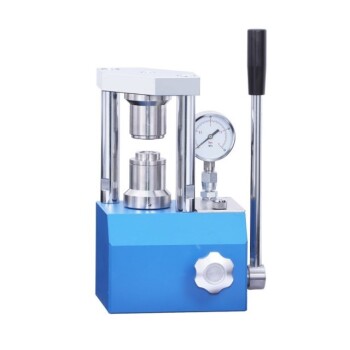
An automatic lab press contributes to accurate Critical Current Density (CCD) measurements by actively compensating for volume changes within the battery cell. During the charge-discharge cycles of a symmetrical cell, lithium deposition causes physical expansion and contraction. The press maintains a consistent mechanical force, preventing these fluctuations from breaking the contact at material interfaces.
By actively maintaining constant pressure during lithium plating and stripping, the press prevents contact resistance caused by volume fluctuation. This ensures that observed failures are due to the material's intrinsic limits, not mechanical disconnects.
The Challenge of Volume Changes in CCD Testing
Lithium Deposition and Physical Expansion
In symmetrical cells, such as those utilizing a Li|PEO-LiTFSI|LGPS|PEO-LiTFSI|Li structure, the testing process involves moving lithium ions back and forth.
As lithium deposits on the anode, the material physically expands. Conversely, as lithium is stripped away, the volume decreases.
The Risk of Contact Failure
Without an adaptive mechanical system, these volume fluctuations create instability within the cell stack.
As the volume shrinks during stripping, gaps can form between the electrode and electrolyte. This leads to contact failure, creating artificial resistance in the system.
How Constant Pressure Compensation Works
Dynamic Mechanical Adjustment
An automatic lab press is distinct from a manual static press because it features constant pressure compensation.
It actively monitors and adjusts the force applied to the battery assembly. As the cell expands or contracts, the press modulates its hold to keep the net pressure identical to the setpoint.
Maintaining Tight Interfaces
The primary function of this compensation is to suppress contact failure.
By ensuring the assembly remains under constant mechanical pressure, the press maintains a tight interface between the lithium metal and the electrolyte layers. This is essential for preventing impedance spikes that are unrelated to the material's chemistry.
Understanding the Trade-offs
The Necessity of Automation
Using a static or manual press for CCD testing introduces a significant variable: uncontrolled pressure drift.
If the pressure is not compensated automatically, volume expansion can lead to dangerous pressure spikes, or volume contraction can lead to loss of contact. The trade-off for accurate data is the requirement for equipment capable of active, real-time force regulation.
Distinguishing Failure Modes
The goal of CCD testing is to find the maximum current a material can withstand before short-circuiting.
Without constant pressure, a test failure might be misdiagnosed as a material limit when it was actually a mechanical loss of contact. The automatic press eliminates this ambiguity, isolating the material performance.
Making the Right Choice for Your Goal
To obtain reliable Critical Current Density data, the mechanical environment of the cell must be as controlled as the electrochemical environment.
- If your primary focus is determining maximum current limits: Use constant pressure compensation to ensure that short-circuits or failures are caused by material breakdown, not interface gaps.
- If your primary focus is testing soft solid electrolytes (like PEO): Rely on automatic pressure regulation to maintain interface contact without crushing the soft polymer layers during expansion events.
Using constant pressure compensation transforms CCD testing from a mechanical balancing act into a precise electrochemical measurement.
Summary Table:
| Feature | Impact on CCD Measurement | Benefit for Battery Research |
|---|---|---|
| Constant Pressure Compensation | Neutralizes volume expansion/contraction | Prevents artificial resistance & contact loss |
| Dynamic Adjustment | Maintains setpoint force in real-time | Isolates material limits from mechanical failure |
| Interface Maintenance | Keeps tight contact at electrode/electrolyte | Ensures reliable impedance & voltage data |
| Automated Control | Eliminates manual pressure drift | Enhances repeatability for critical current testing |
Elevate Your Battery Research with KINTEK Laboratory Solutions
Precise Critical Current Density (CCD) measurements demand more than just a static hold; they require dynamic mechanical control. KINTEK specializes in comprehensive laboratory pressing solutions, offering manual, automatic, heated, multifunctional, and glovebox-compatible models, as well as cold and warm isostatic presses widely applied in battery research.
Whether you are testing soft solid electrolytes or determining the performance limits of lithium metal, our automated presses provide the constant pressure compensation necessary to eliminate interface failures and deliver reliable data.
Ready to optimize your cell testing environment? Contact us today to find the perfect pressing solution for your lab!
References
- Ujjawal Sigar, Felix H. Richter. Low Resistance Interphase Formation at the PEO‐LiTFSI|LGPS Interface in Lithium Solid‐State Batteries. DOI: 10.1002/admi.202500705
This article is also based on technical information from Kintek Solution Knowledge Base .
Related Products
- Automatic Lab Cold Isostatic Pressing CIP Machine
- Laboratory Hydraulic Press Lab Pellet Press Button Battery Press
- Lab Cylindrical Press Mold for Laboratory Use
- Button Battery Sealing Press Machine for Lab
- Lab Infrared Press Mold for Laboratory Applications
People Also Ask
- What are the key features of automated laboratory Cold Isostatic Press (CIP) systems? Achieve Precise, High-Pressure Powder Consolidation
- Why is an Isostatic Press (CIP) Necessary After Uniaxial Pressing? Achieve Transparency in Nd:Y2O3 Ceramics
- How does a Cold Isostatic Press (CIP) increase Bi-2223/Ag current density? Boost Superconductivity with Uniform Pressure
- What is the primary function of a Cold Isostatic Press (CIP) in NASICON preparation? Achieve 96% Theoretical Density
- How does a Cold Isostatic Press (CIP) facilitate the preparation of CaO-doped silicon carbide (SiC) green bodies?