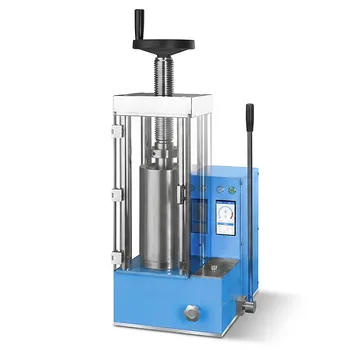
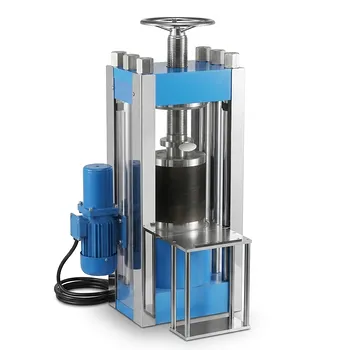
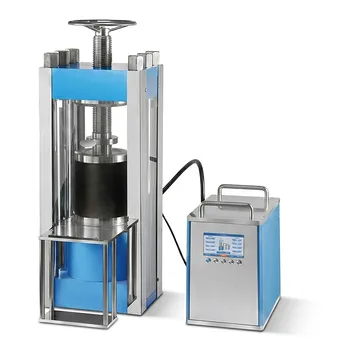
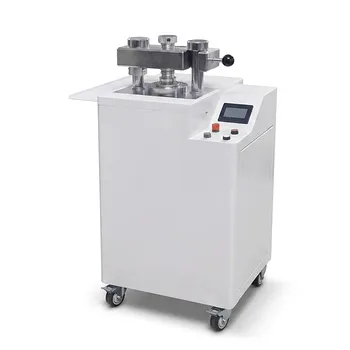
Isostatic pressing is a powder consolidation process used to transform granular materials into solid, high-density components with exceptional structural integrity. The technique works by enclosing powdered material within a flexible mold or sealed container and submerging it in a pressurized medium, typically a liquid like water or oil. By applying this high pressure evenly from all directions, the process effectively crushes internal voids and air pockets to create a uniform solid.
The core advantage of isostatic pressing is its ability to apply force omnidirectionally (from all sides), unlike traditional methods that press from only one direction. This ensures that the final part has consistent density throughout, regardless of its size or geometric complexity.
The Mechanics of the Process
Encapsulation of Material
The process begins by placing the powder mixture into a flexible mold or membrane. This container, often made of polyurethane or rubber, acts as a pressure barrier that holds the shape of the part while preventing the pressurizing medium from contaminating the powder.
Application of Omnidirectional Pressure
Once sealed, the mold is placed inside a pressure vessel. The vessel is filled with a fluid medium, such as water or oil, which acts as the transfer mechanism for the force.
Uniform Compaction
The system pressurizes the fluid, exerting extreme force equally against every point of the flexible mold's surface. This causes the powder particles inside to bond together tightly. Because the pressure is hydrostatic—meaning it pushes inward from every angle—the material compacts uniformly without the friction or density gradients common in rigid die pressing.
The Results and Benefits
Superior Density and Strength
The primary result of this uniform compression is the elimination of porosity. By forcing out air pockets and minimizing voids, the process yields parts with significantly higher density and superior mechanical strength compared to other compaction methods.
Consistent Internal Structure
Because the pressure is not applied unidirectionally, the material density is consistent throughout the entire part. This reduces internal stresses and eliminates the "weak spots" often found in parts pressed in a rigid die.
High Dimensional Accuracy
The process allows for the creation of components with high dimensional accuracy, even for complex shapes. While the part shrinks during compaction, it does so uniformly, making the final dimensions predictable and consistent.
Understanding the Trade-offs
Production Speed
Isostatic pressing, particularly the "wet bag" method where molds are submerged individually, can be slower than automated dry pressing techniques. It is often better suited for lower-volume production or large, complex parts rather than mass manufacturing of simple shapes.
Surface Finish Requirements
While the internal structure is superior, the flexible mold may leave a surface texture that requires attention. Parts often require subsequent finishing or machining to achieve the final required surface smoothness or precise tolerances.
Equipment Complexity
The process requires specialized pressure vessels capable of handling immense hydrostatic forces. Whether using liquids or gases (such as argon for high-temperature variants), the infrastructure is generally more complex than standard mechanical presses.
Making the Right Choice for Your Goal
Isostatic pressing is not a universal replacement for all manufacturing methods, but it is the definitive choice for specific engineering requirements.
- If your primary focus is material integrity: The process delivers maximum density and strength by removing internal flaws and voids that could lead to failure.
- If your primary focus is geometric complexity: Isostatic pressing allows you to form intricate shapes with uniform properties that would be impossible to achieve with unidirectional die compaction.
By leveraging the physics of uniform pressure, isostatic pressing bridges the gap between raw powder and high-performance, defect-free components.
Summary Table:
| Feature | Isostatic Pressing | Traditional Die Pressing |
|---|---|---|
| Pressure Direction | Omnidirectional (All sides) | Unidirectional (One or two sides) |
| Density Distribution | Uniform throughout | Gradient (higher near the punch) |
| Shape Complexity | High (Complex/Large geometries) | Low (Simple/Symmetric shapes) |
| Internal Voids | Effectively eliminated | Potential for air pockets |
| Structural Integrity | Exceptional/High strength | Variable (Risk of weak spots) |
Elevate Your Material Research with KINTEK Isostatic Solutions
Unlock the full potential of your powder consolidation with KINTEK’s comprehensive laboratory pressing solutions. Whether you are advancing battery research or developing high-performance ceramics, our range of manual, automatic, heated, and multifunctional presses provides the precision you need.
We specialize in both Cold (CIP) and Warm Isostatic Presses (WIP), including glovebox-compatible models designed for sensitive environments. Our technology ensures your components achieve maximum density and uniform structural integrity every time.
Ready to eliminate porosity and optimize your results? Contact our experts today to find the perfect pressing solution for your lab!
Related Products
- Electric Isostatic Pressing Machine 40 Tons Automatic Laboratory Powder Compacting Press
- Warm Isostatic Press for Solid State Battery Research Warm Isostatic Press
- Split Warm Isostatic Lab Press 200 Ton Powder Compaction Chamber for Battery Research and Material Science
- Electric Lab Cold Isostatic Press CIP Machine
- Split Hot Isostatic Pressing Machine 150 Ton Laboratory Heated Isostatic Press
People Also Ask
- What are the key characteristics of the isostatic pressing process? Unlock Uniform Density and Complex Geometries
- Why is vacuum-sealed packaging necessary before isostatic pressing of CuPc thin films? Protect Integrity & Uniformity
- How is pressure applied to the material during isostatic pressing? Master Uniform Density and Complex Geometries
- How does pressure distribute during isostatic pressing of aluminum? Achieve Uniform Density for Your Lab Materials
- What are the applications of isostatic pressing in the automotive industry? Precision Manufacturing for High-Performance Parts