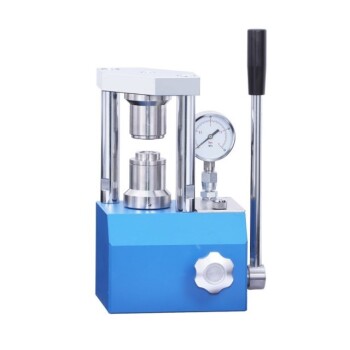
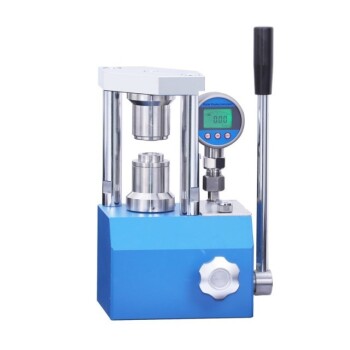
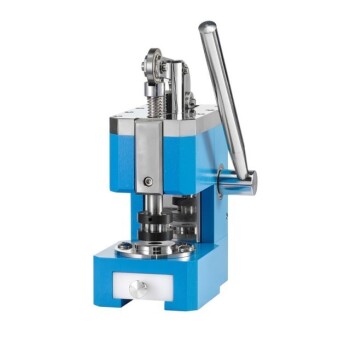
The mechanical pressure applied by a laboratory crimper is the defining factor that transforms a stack of loose components into a functional, high-performance electrochemical system. By applying stable and uniform axial force, the crimper creates an airtight seal to prevent environmental contamination and establishes the critical physical interfaces required to minimize internal resistance and suppress lithium dendrite formation.
Core Takeaway While sealing the casing is the visible function of a crimper, its primary performance driver is the application of precise axial compression. This pressure minimizes interfacial impedance by ensuring tight contact between electrodes and electrolytes, a requirement for obtaining accurate and consistent electrochemical test data.
The Critical Role of Axial Compression
The performance of a 2032-type coin cell is dictated by what happens at the microscopic interfaces between layers. The crimper controls these interfaces through mechanical pressure.
Minimizing Interfacial Impedance
For electrons and ions to flow efficiently, the internal components must be in intimate physical contact. The crimper compresses the cathode, separator (or composite polymer electrolyte), and lithium metal anode together.
This pressure reduces ohmic resistance by eliminating gaps between the current collector and the active material. It establishes a continuous, low-resistance conductive pathway throughout the cell stack.
Enabling Solid-State Ion Transport
In cells using Composite Polymer Electrolytes (CPE) or solid-state designs, mechanical pressure is even more critical. Liquid electrolytes can flow into gaps, but solid electrolytes cannot.
External physical constraint forces the solid electrolyte to maintain tight contact with coated electrode surfaces. This fills micro-pores between ceramic fillers and the polymer matrix, establishing the stable ion transport paths necessary for battery operation.
Suppressing Lithium Dendrite Growth
Lithium dendrites are needle-like projections that form on the anode during cycling, leading to short circuits. The crimper provides a physical constraint that helps manage this risk.
By maintaining a tight, uniform compression on the lithium metal anode, the cell can effectively suppress the growth of these dendrites. This mechanical suppression is decisive for extending the cycle life and safety of the battery.
The Necessity of Sealing and Consistency
Beyond internal electrochemistry, the mechanical action of the crimper ensures the physical integrity of the test environment.
Ensuring Environmental Isolation
Lithium is highly reactive to moisture and oxygen. The crimper deforms the gasket and casing to create a hermetic physical seal.
This prevents the ingress of air, which would degrade the lithium anode immediately. Simultaneously, it prevents the leakage of volatile liquid electrolytes, ensuring the cell retains the chemical medium required for operation.
Data Reproducibility
Scientific validity relies on consistency. A laboratory hydraulic press creates stable axial pressure (e.g., 1000 psi) that is repeatable across multiple samples.
If pressure varies between cells, the internal contact resistance will vary, leading to noisy or invalid test data. Precise pressure control ensures that differences in performance are due to material chemistry, not assembly variables.
Understanding the Trade-offs
While pressure is essential, it must be carefully calibrated and uniform.
The Risk of Uneven Distribution
If the crimper does not apply pressure uniformly, the cell will suffer from localized gradients. This can lead to "hot spots" of current density where dendrites are more likely to form.
Over-Compression vs. Under-Compression
Insufficient pressure results in high impedance and poor ion transport, rendering the cell effectively dead. Conversely, excessive pressure can crush the separator or deform the casing, potentially causing immediate short circuits. The goal is a "Goldilocks" zone of stable, adjustable hydraulic power.
Making the Right Choice for Your Goal
The way you utilize crimping pressure should align with your specific research objectives.
- If your primary focus is Solid-State Batteries: Prioritize high, uniform pressure to minimize contact resistance at the electrode-electrolyte interface and fill micro-pores.
- If your primary focus is Cycle Life/Safety: Ensure your crimper provides sufficient axial constraint to physically suppress lithium dendrite propagation over time.
- If your primary focus is Data Consistency: Use a hydraulic crimper with adjustable, readable pressure gauges to ensure every cell in your batch is sealed under identical force (e.g., exactly 1000 psi).
Ultimately, the crimper is not just a packaging tool; it is an active instrument that defines the internal geometry and electrochemical efficiency of your battery.
Summary Table:
| Impact Factor | Effect on Performance | Key Benefit |
|---|---|---|
| Interfacial Contact | Minimizes ohmic resistance between layers | Efficient electron and ion flow |
| Solid-State Transport | Fills micro-pores in polymer/ceramic electrolytes | Established ion transport paths |
| Dendrite Control | Provides physical axial constraint | Suppresses short circuits; extends cycle life |
| Hermetic Sealing | Prevents moisture/oxygen ingress | Protects reactive lithium & electrolyte |
| Pressure Consistency | Standardizes assembly force (e.g., 1000 psi) | Ensures data reproducibility and validity |
Optimize Your Battery Research with Precision Crimping
Consistency in electrochemical testing begins with the perfect seal. KINTEK specializes in comprehensive laboratory pressing solutions designed to meet the rigorous demands of battery research. From manual and automatic crimpers to specialized heated and glovebox-compatible models, our equipment ensures uniform axial pressure to minimize impedance and suppress dendrite growth.
Whether you are working on liquid electrolyte systems or advanced solid-state designs, our range—including cold and warm isostatic presses—provides the stability and repeatability your data deserves.
Ready to elevate your cell assembly? Contact us today to find the ideal pressing solution for your lab.
References
- Amirhossein Mirtaleb, Ruigang Wang. A dendrite-free Li–S battery with a cerium-doped sulfide glass–ceramic composite electrolyte. DOI: 10.1039/d5qm00523j
This article is also based on technical information from Kintek Solution Knowledge Base .
Related Products
- Manual Button Battery Sealing Machine for Battery Sealing
- Button Battery Sealing Machine for Button Batteries
- Lab Button Battery Disassembly and Sealing Mold
- Button Battery Sealing Press Machine for Lab
- Lab Cylindrical Press Mold for Laboratory Use
People Also Ask
- Why is a laboratory hydraulic press or battery sealing machine essential? Ensure Coin Cell Data Integrity
- How do laboratory battery sealing machines ensure performance consistency? Master Your Lithium and LFP Battery Assembly
- Why is stable pressure control necessary when assembling SC-NCM83/PLM-3/Li batteries? Optimize Solid-State Interfaces
- What role does a laboratory press perform for CR2032 coin cell assembly? Ensure Precision in Battery Research
- Why is a high-pressure manual or automatic coin cell crimper required? Optimize Solid-State Battery Performance