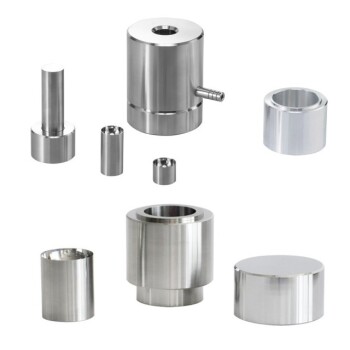
The selection of a precision compression mold is the single most critical factor in ensuring the geometric integrity of pressed electrolyte disks. By determining the sample's shape and stress uniformity, the mold directly influences the physical quality of the disk. Using high-hardness mold materials is essential to withstand extreme pressures without deforming, thereby guaranteeing that the resulting disks possess the flat surfaces and consistent thickness required for valid testing.
Precision molds eliminate geometric variability by resisting deformation during the pressing process. Because ionic conductivity is calculated using the sample's dimensions, the physical accuracy provided by the mold is a prerequisite for reliable electrochemical impedance data.
The Physical Impact on the Sample
Achieving Stress Uniformity
The mold is responsible for how pressure is distributed across the electrolyte material. A precision mold ensures that stress is applied uniformly, resulting in a homogeneous disk structure.
Maintaining Consistent Thickness
To calculate conductivity accurately, the sample thickness must be known and constant. High-hardness mold materials resist expanding or warping under load, ensuring the final disk thickness is uniform across its diameter.
Ensuring Surface Flatness
A precise mold yields a disk with perfectly flat surfaces. This flatness is crucial for establishing optimal contact with electrodes, preventing interfacial resistance that could skew test results.
Connecting Geometry to Data Accuracy
The Foundation of Conductivity Calculations
Electrochemical impedance spectroscopy (EIS) data must be normalized by the sample's geometry to determine ionic conductivity. If the mold yields a disk with irregular thickness, the mathematical formula used for this calculation becomes invalid.
Reducing Experimental Noise
Using precision molds standardizes the sample preparation process. This isolation of variables ensures that variations in test results reflect actual changes in material chemistry, rather than inconsistencies in the pressing tool.
Understanding the Trade-offs
Hardness vs. Durability
While high-hardness molds are necessary to prevent deformation, the materials used are often brittle. These molds require careful handling, as dropping or mishandling them can cause chips or cracks that ruin the surface finish.
Investment vs. Data Integrity
Precision molds manufactured to tight tolerances represent a higher initial cost compared to standard tooling. However, the cost of "saving money" on a mold is often paid for in wasted time and unreliable data that forces repeated experiments.
Making the Right Choice for Your Goal
- If your primary focus is accurate conductivity calculation: Prioritize molds made of high-hardness materials to ensure the geometric precision necessary for valid impedance analysis.
- If your primary focus is high-pressure densification: Select molds explicitly rated for extreme pressures to avoid tool deformation that will compromise sample flatness.
True experimental reliability begins not with the measurement, but with the precision of the sample preparation.
Summary Table:
| Key Feature | Impact on Electrolyte Disk | Benefit to Testing Result |
|---|---|---|
| High Hardness | Prevents mold deformation | Maintains consistent sample thickness |
| Stress Uniformity | Ensures homogeneous structure | Eliminates internal physical gradients |
| Surface Flatness | Guarantees optimal contact | Minimizes interfacial resistance in EIS |
| Tight Tolerances | Standardizes geometry | Increases repeatability of conductivity data |
Precision Sample Preparation Starts Here
Elevate the accuracy of your electrochemical impedance spectroscopy with KINTEK. As specialists in comprehensive laboratory pressing solutions, we provide the high-hardness, precision-engineered tooling essential for battery research. Whether you need manual, automatic, heated, or glovebox-compatible systems, our isostatic and compression presses ensure your electrolyte disks meet the strictest geometric standards.
Don't let inferior tooling compromise your data integrity. Contact KINTEK today to find the perfect mold and press solution for your laboratory's needs.
References
- Coby H. Scrudder, Yi Lin. Ionic conductivity measurements of solid state electrolytes with coin cells enabled by dry-pressed holey graphene current collectors. DOI: 10.3389/fenrg.2025.1684653
This article is also based on technical information from Kintek Solution Knowledge Base .
Related Products
- Lab XRF Boric Acid Powder Pellet Pressing Mold for Laboratory Use
- Lab Polygon Press Mold
- Lab Round Bidirectional Press Mold
- Lab Isostatic Pressing Molds for Isostatic Molding
- XRF KBR Steel Ring Lab Powder Pellet Pressing Mold for FTIR
People Also Ask
- Why are pellets used in XRF analysis, and what is their limitation? Boost Accuracy and Speed in Your Lab
- What are the primary factors to consider when deciding between a manual and an automatic XRF pellet press? Optimize Your Lab's Efficiency
- What should be included in a checklist for making XRF pellets? Ensure Accurate and Repeatable XRF Analysis
- What are the different pellet pressing options for XRF sample preparation? Choose the Best Method for Accurate Analysis
- What checklist of factors should be considered when choosing an XRF pellet press? Ensure Accurate Sample Preparation