
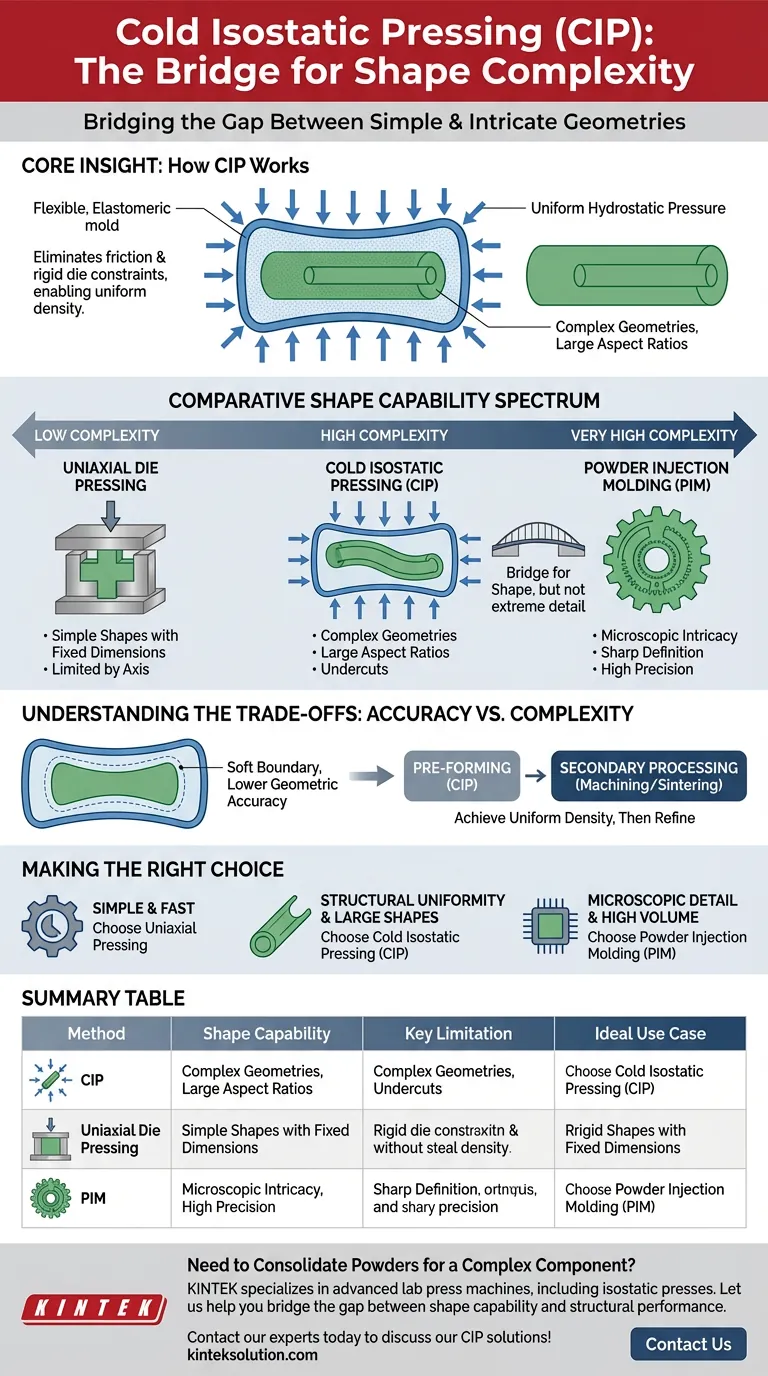
In the spectrum of powder consolidation methods, Cold Isostatic Pressing (CIP) acts as a functional bridge for shape complexity. It significantly outperforms standard uniaxial die pressing by enabling the creation of components with large aspect ratios and undercuts, yet it generally lacks the ability to reproduce the microscopic intricacy and sharp definition achievable with Powder Injection Molding (PIM).
Core Insight: CIP achieves its versatility by applying uniform hydrostatic pressure through a flexible mold, eliminating the friction and geometric constraints of rigid dies. While this allows for complex geometries like long tubes and hollow interiors, the flexibility of the mold inevitably sacrifices the high-tolerance geometric precision found in injection molding.
The Mechanics of Shape Flexibility
To understand why CIP performs better than some methods but worse than others, you must look at how force is applied to the powder.
The Advantage of Isostatic Pressure
Unlike uniaxial pressing, which applies force along a single axis, CIP applies pressure uniformly from all directions.
This utilizes a fluid medium to transmit hydraulic pressure equally against the mold surface.
Because there is no die-wall friction to overcome, the density remains consistent throughout the part, even in complex or elongated shapes.
The Role of Elastomeric Molds
CIP utilizes flexible molds made of rubber or similar elastomeric materials, rather than rigid metal dies.
This flexibility is the key to its shape capability.
It allows for the formation of geometries that would be impossible to eject from a rigid die, such as long tubes, solid electrolyte layers, and complex ferrites.
Comparative Capability Analysis
When selecting a manufacturing process, it is helpful to view CIP relative to its primary alternatives.
CIP vs. Uniaxial Die Pressing
Uniaxial pressing is strictly limited to simple shapes with fixed dimensions.
Because it presses from top to bottom, it cannot accommodate complex contours or parts with significant length-to-diameter ratios without suffering from density gradients.
CIP bypasses these limitations entirely, offering superior uniformity and the ability to form complex geometries that a rigid vertical press cannot achieve.
CIP vs. Powder Injection Molding (PIM)
While CIP is versatile, it is considered inferior to PIM regarding extreme intricacy.
PIM involves injecting a feedstock into a rigid cavity, allowing for the replication of tiny features, sharp corners, and highly complex external details.
CIP is better suited for larger, "near-net-shape" components, whereas PIM is the standard for small, high-precision intricate parts.
Understanding the Trade-offs: Accuracy vs. Complexity
While CIP allows for complex shapes, there is a critical compromise regarding geometric accuracy.
The Precision Challenge
The very feature that enables complexity—the flexible mold—is also a source of imprecision.
Because the mold creates a "soft" boundary, the resulting green part (the compacted powder before sintering) often has lower geometric accuracy compared to parts pressed in rigid dies.
Mitigation Strategies
To address this, CIP is often used as a pre-forming operation.
The process yields a part with high, uniform green density (60% to 80% of theoretical density).
This uniformly dense part can then be machined or sintered to achieve the final, precise dimensions, effectively combining the structural integrity of CIP with the precision of secondary processing.
Making the Right Choice for Your Manufacturing Goals
Selecting the correct method requires balancing your need for geometric complexity against your tolerance requirements and production volume.
- If your primary focus is simple geometry and high speed: Choose Uniaxial Pressing, as it is faster and sufficient for parts with fixed, simple dimensions.
- If your primary focus is structural uniformity in large or tubular shapes: Choose Cold Isostatic Pressing (CIP) to ensure consistent density in complex geometries that rigid dies cannot support.
- If your primary focus is microscopic detail and high-volume intricacy: Choose Powder Injection Molding (PIM), as it offers the highest flexibility for intricate features.
Ultimately, CIP is the superior choice when your component requires high material integrity and a shape that defies the constraints of a single-axis press, provided you can accommodate minor post-processing for final tolerances.
Summary Table:
| Method | Shape Complexity Capability | Key Limitation | Ideal Use Case |
|---|---|---|---|
| Cold Isostatic Pressing (CIP) | High - Complex geometries, large aspect ratios, undercuts | Lower geometric accuracy due to flexible molds | Large, near-net-shape parts requiring uniform density (e.g., tubes, solid electrolytes) |
| Uniaxial Die Pressing | Low - Simple shapes with fixed dimensions | Density gradients and geometric constraints | Simple, high-speed production of basic shapes |
| Powder Injection Molding (PIM) | Very High - Microscopic detail, sharp corners, high intricacy | Higher complexity and cost for tooling | Small, high-precision, intricate parts in high volumes |
Need to Consolidate Powders for a Complex Component?
Choosing the right pressing method is critical for achieving the desired shape complexity and material integrity in your lab. KINTEK specializes in advanced lab press machines, including isostatic presses designed for uniform density in complex geometries.
Let us help you bridge the gap between shape capability and structural performance. Our expertise ensures you select the ideal equipment for your specific powder consolidation needs, whether for R&D or production.
Contact our pressing experts today to discuss how our CIP solutions can enhance your manufacturing process!
Visual Guide
Related Products
- Automatic Lab Cold Isostatic Pressing CIP Machine
- Electric Split Lab Cold Isostatic Pressing CIP Machine
- Electric Lab Cold Isostatic Press CIP Machine
- Manual Cold Isostatic Pressing CIP Machine Pellet Press
- Lab Isostatic Pressing Molds for Isostatic Molding
People Also Ask
- What are the key features of automated laboratory Cold Isostatic Press (CIP) systems? Achieve Precise, High-Pressure Powder Consolidation
- Why is an Isostatic Press (CIP) Necessary After Uniaxial Pressing? Achieve Transparency in Nd:Y2O3 Ceramics
- How does a Cold Isostatic Press (CIP) increase Bi-2223/Ag current density? Boost Superconductivity with Uniform Pressure
- What is the primary function of a Cold Isostatic Press (CIP) in NASICON preparation? Achieve 96% Theoretical Density
- How does a Cold Isostatic Press (CIP) facilitate the preparation of CaO-doped silicon carbide (SiC) green bodies?










