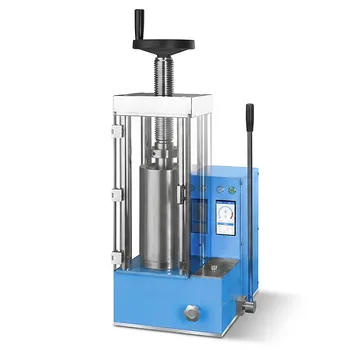
The wet bag process acts as a flexible, external batch method for Cold Isostatic Pressing (CIP). In this technique, you fill a flexible mold with powder and seal it airtight outside of the high-pressure vessel before directly submerging the entire assembly into a liquid pressure medium to compress it.
The wet bag process is defined by its versatility rather than its speed. While it requires longer cycle times than automated methods, it is the superior choice for prototyping, producing extremely large or complex parts, and running mixed batches of different shapes simultaneously.
The Mechanics of the Wet Bag Process
Step 1: External Filling and Sealing
Unlike other pressing methods where the mold is fixed inside the machine, the wet bag process begins on the workbench.
You fill a flexible forming mold (the "bag") with powder material. Once filled, this mold must be sealed airtight to prevent the hydraulic fluid from contaminating the powder.
Step 2: Direct Immersion
The sealed mold is physically moved into the high-pressure vessel.
It is completely submerged in the pressure fluid, which is often a soluble oil. Because the mold is not fixed to the vessel, you can load multiple bags of varying shapes and sizes into the chamber for a single cycle, provided they fit within the vessel's diameter.
Step 3: Isostatic Pressurization
Once the vessel is closed, pumps or intensifiers pressurize the liquid.
Because liquids are incompressible, this pressure is applied equally to every square inch of the mold's external surface. This compresses the powder inward from all directions, creating a solid mass with uniform density.
Why Engineers Choose Wet Bag CIP
Unmatched Geometric Flexibility
Because the pressure is applied via a fluid rather than a rigid die, the wet bag process can form complex shapes.
It easily handles parts with undercuts or high length-to-diameter ratios that would be impossible to eject from a rigid tool.
Capacity for Large-Scale Components
This method is the standard for producing massive parts.
Global facilities utilize wet bag presses with diameters ranging from 50mm up to 2000mm. If the pressure vessel is large enough to hold the bag, the part can be pressed.
Ideal for High-Mix, Low-Volume Production
The process does not require a fixed, permanent mold installation inside the cylinder.
This makes it highly suitable for trial production (prototyping) or small-quantity runs where you need to switch between different part designs frequently.
Understanding the Trade-offs
Slower Cycle Times
The wet bag method is inherently a batch process.
It is significantly slower than the "dry bag" alternative, with cycle times ranging from 5 to 30 minutes depending on the equipment and part size. It lacks the rapid, continuous throughput capabilities required for mass production of simple parts.
Higher Labor and Handling
Loading and unloading the molds involves more manual intervention.
The mold must be removed from the vessel, dried, and opened to extract the part after every single cycle. This contrasts with dry bag pressing, where the mold remains fixed inside the vessel for continuous operation.
Making the Right Choice for Your Goal
To determine if the wet bag process aligns with your manufacturing requirements, consider the following:
- If your primary focus is Mass Production: This process is likely too slow; consider dry bag pressing for high-volume, continuous runs of identical parts.
- If your primary focus is Prototyping or R&D: The wet bag process is ideal because it allows for easy changes to mold shapes without expensive machine retooling.
- If your primary focus is Part Complexity or Size: This is your best option for large-scale components or parts requiring uniform density with minimal distortion.
The wet bag process remains the gold standard for projects demanding high material integrity and geometric flexibility over raw production speed.
Summary Table:
| Feature | Wet Bag CIP Details |
|---|---|
| Best For | Large components, complex shapes, and R&D prototyping |
| Cycle Time | 5 to 30 minutes (Batch processing) |
| Pressure Media | Liquid (typically soluble oil) applied isostatically |
| Mold Type | External flexible bags (removed after each cycle) |
| Key Advantage | High geometric flexibility and uniform density |
Elevate Your Research with KINTEK Precision Pressing
Maximize your material integrity with KINTEK’s industry-leading laboratory pressing solutions. Whether you are conducting cutting-edge battery research or developing complex industrial ceramics, our comprehensive range of equipment—including manual, automatic, heated, and multifunctional models, alongside advanced cold and warm isostatic presses—is designed to meet your exact specifications.
Why choose KINTEK?
- Versatility: Solutions tailored for glovebox-compatible workflows.
- Precision: Uniform density for high-performance material prototyping.
- Expertise: Specialized support for high-mix, low-volume R&D needs.
Ready to optimize your lab’s efficiency? Contact KINTEK today to find the perfect pressing solution for your application.
Related Products
- Manual Cold Isostatic Pressing CIP Machine Pellet Press
- Electric Lab Cold Isostatic Press CIP Machine
- Electric Split Lab Cold Isostatic Pressing CIP Machine
- Automatic Lab Cold Isostatic Pressing CIP Machine
- Lab Isostatic Pressing Molds for Isostatic Molding
People Also Ask
- Why is Cold Isostatic Pressing (CIP) necessary for SBN ceramics? Achieve High-Density and Crack-Free Sintering
- What are the process advantages of using Cold Isostatic Pressing (CIP) for LSMO? Achieve Defect-Free Density
- Why is Cold Isostatic Pressing (CIP) applied after uniaxial pressing? Optimize Superconductor Precursor Density
- What types of equipment are available for cold isostatic pressing? Explore CIP Solutions for Labs and Production
- What are the technical advantages of cold isostatic pressing equipment compared to uniaxial compression equipment? Learn More!