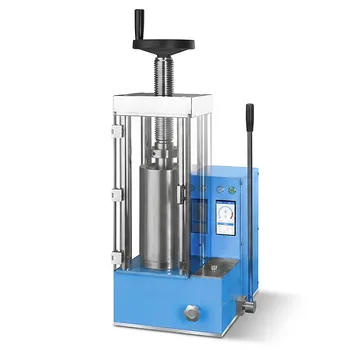
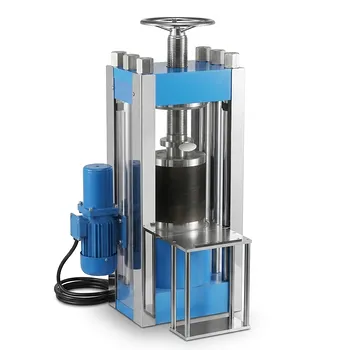
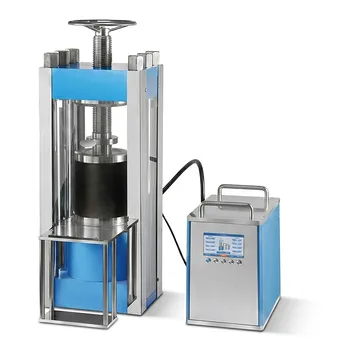
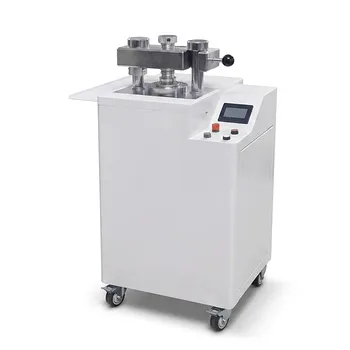
The fundamental difference lies in the directionality of force: isostatic pressing applies pressure equally from all directions simultaneously, whereas other techniques typically exert force along a single axis. Instead of using a mechanical ram to compress powder within a die, isostatic pressing utilizes a fluid medium—such as a liquid or high-pressure inert gas—to surround the part and compact it uniformly.
Core Takeaway Isostatic pressing eliminates the density gradients inherent in uniaxial compaction by utilizing isotropic (omnidirectional) pressure. This allows for the effective consolidation of complex shapes and the creation of a uniform microstructure that single-axis methods cannot achieve.
The Core Mechanism: Isotropic Pressure
Fluid-Based Compression
The defining characteristic of isostatic pressing is the use of fluid pressure rather than mechanical contact.
By submerging the powder compact in a fluid medium, the system ensures that the force applied is identical on every surface of the object.
Contrast with Uniaxial Force
Traditional powder processing techniques rely on forces applied along a single axis.
In these standard methods, pressure is exerted linearly, often leading to uneven force distribution throughout the material.
Implications for Material Quality
Eliminating Density Gradients
Because standard hot pressing is limited by uniaxial pressure, it often results in density gradients.
Isostatic pressing resolves this by applying isotropic pressure, ensuring the material is compacted evenly throughout its volume.
Pore Elimination and Microstructure
Techniques like Hot Isostatic Pressing (HIP) utilize high-pressure inert gas to facilitate densification.
This method is highly effective at eliminating internal pores, resulting in a significantly more uniform microstructure than standard pressing can provide.
Understanding the Trade-offs
The Limitations of Standard Pressing
While both standard hot pressing and HIP utilize plastic deformation and creep at high temperatures, the standard approach is constrained by its mechanics.
Standard pressing is generally less effective for handling complex shapes or achieving near-net shaping because the pressure is strictly directional.
The Advantage of Near-Net Shaping
The uniform application of pressure in isostatic processes allows for near-net shaping.
This means the final compacted part closely matches the desired dimensions, reducing the need for extensive post-processing that is often required with uniaxial methods.
Making the Right Choice for Your Goal
When deciding between isostatic pressing and standard compaction techniques, consider the geometric complexity and quality requirements of your final part.
- If your primary focus is complex geometries: Choose isostatic pressing, as isotropic pressure allows for near-net shaping of irregular parts that uniaxial rams cannot accommodate.
- If your primary focus is maximum density uniformity: Select isostatic pressing (specifically HIP) to effectively eliminate internal pores and avoid the density gradients common in standard hot pressing.
- If your primary focus is basic consolidation of simple shapes: Standard hot pressing may suffice, as it utilizes the same thermal mechanisms of deformation but without the omnidirectional pressure benefits.
Isostatic pressing is the superior solution when uniform density and structural integrity are non-negotiable.
Summary Table:
| Feature | Isostatic Pressing | Uniaxial (Standard) Pressing |
|---|---|---|
| Pressure Direction | Omnidirectional (Isotropic) | Single Axis (Linear) |
| Pressure Medium | Fluid (Liquid or Gas) | Mechanical Ram/Die |
| Density Distribution | Uniform throughout the part | Presence of density gradients |
| Shape Complexity | High (Ideal for complex/irregular) | Low (Best for simple shapes) |
| Microstructure | Highly uniform, eliminates pores | Less uniform, potential porosity |
| Post-Processing | Minimal (Near-net shaping) | Often required (extensive machining) |
Elevate Your Material Research with KINTEK Isostatic Solutions
Unlock superior material density and structural integrity with KINTEK’s precision engineering. As specialists in comprehensive laboratory pressing solutions, we provide the tools you need to move beyond the limitations of uniaxial compaction.
Whether you are focusing on advanced battery research or high-performance ceramics, our range includes:
- Manual & Automatic Models for flexible lab workflows.
- Heated & Multifunctional Presses for diverse thermal requirements.
- Cold (CIP) & Warm Isostatic Presses (WIP) designed for uniform consolidation and near-net shaping.
- Glovebox-Compatible Systems for sensitive material handling.
Ready to eliminate density gradients and achieve uniform microstructures? Contact our experts today to find the perfect pressing solution for your application!
Related Products
- Electric Isostatic Pressing Machine 40 Tons Automatic Laboratory Powder Compacting Press
- Warm Isostatic Press for Solid State Battery Research Warm Isostatic Press
- Split Warm Isostatic Lab Press 200 Ton Powder Compaction Chamber for Battery Research and Material Science
- Electric Lab Cold Isostatic Press CIP Machine
- Split Hot Isostatic Pressing Machine 150 Ton Laboratory Heated Isostatic Press
People Also Ask
- What are the key characteristics of the isostatic pressing process? Unlock Uniform Density and Complex Geometries
- Why is vacuum-sealed packaging necessary before isostatic pressing of CuPc thin films? Protect Integrity & Uniformity
- How is pressure applied to the material during isostatic pressing? Master Uniform Density and Complex Geometries
- How does pressure distribute during isostatic pressing of aluminum? Achieve Uniform Density for Your Lab Materials
- What are the applications of isostatic pressing in the automotive industry? Precision Manufacturing for High-Performance Parts