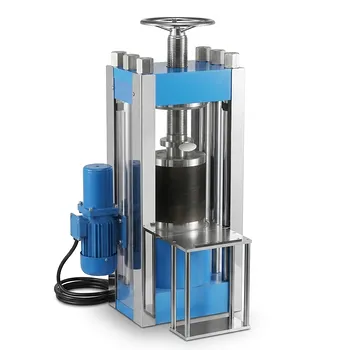
To utilize a cellulose wax binder in XRF sample preparation, you must mix it with your sample powder at a ratio of 20% to 30%. Once mixed, this combination is subjected to high pressure in a hydraulic press to form a solid, completely compacted pellet ready for analysis.
The definitive advantage of using a cellulose wax binder is its analytical transparency. It provides the necessary physical structure for the pellet while remaining undetected by XRF, ensuring that the resulting data reflects only the elemental composition of your sample.
The Mechanics of the Binder
Ensuring Structural Integrity
XRF analysis requires a sample to be presented as a flat, smooth, and solid disc. Many loose powders lack the natural cohesion to hold this shape. The cellulose wax acts as a stabilizing agent, gluing the particles together to prevent the pellet from crumbling during handling or analysis.
Analytical "Invisibility"
The primary technical benefit of this specific binder is its chemical inertness regarding X-ray fluorescence. Because the binder is not detected by XRF instrumentation, it introduces no background noise or interfering spectral lines. This ensures the integrity of the elemental reading remains compromised.
The Preparation Protocol
The Mixing Proportion
To achieve the correct balance of stability and signal strength, the binder should be added in a proportion of 20% to 30% relative to the total mixture. This ratio provides enough binding agent to coat the sample particles without overwhelming the sample matrix.
Hydraulic Compaction
Once the binder and sample are thoroughly mixed, the physical pellet is created using a hydraulic press. The mixture is placed between two pressure plates and "squeezed" at high pressure. This process ensures the material is completely compacted, creating a dense and uniform surface for the X-ray source.
Understanding the Trade-offs
Sample Dilution
While the binder is invisible to the detector, it does physically dilute the sample. By introducing 20-30% of non-sample material, you are effectively reducing the density of the analyte in the pellet. This is a necessary trade-off to achieve the physical durability required for the test.
Adhering to Ratios
Deviating from the recommended proportion carries risks. Using less than 20% binder may result in a fragile pellet that breaks under the stress of the hydraulic press. Conversely, using significantly more than 30% unneccesarily dilutes the sample, potentially affecting the detection limits for trace elements.
Making the Right Choice for Your Goal
To optimize your sample preparation, consider the following application guidelines:
- If your primary focus is Pellet Durability: Utilize a ratio closer to 30% binder to ensure maximum cohesion, especially for powders that are naturally resistant to compaction.
- If your primary focus is Data Accuracy: Trust the cellulose wax formulation, as its inability to be detected ensures your results focus solely on the elemental composition of the sample itself.
By balancing the mixing ratio with proper hydraulic compression, you create a sample that is mechanically robust and analytically pure.
Summary Table:
| Feature | Specification/Guideline |
|---|---|
| Recommended Ratio | 20% to 30% Binder |
| Primary Function | Structural stability and particle cohesion |
| Analytical Impact | Undetected by XRF (Chemical Inertness) |
| Equipment Required | Hydraulic Press |
| Key Benefit | High pellet durability without spectral interference |
Elevate Your XRF Accuracy with KINTEK Solutions
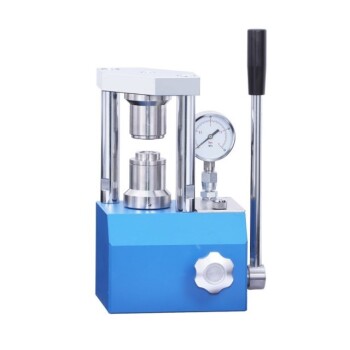
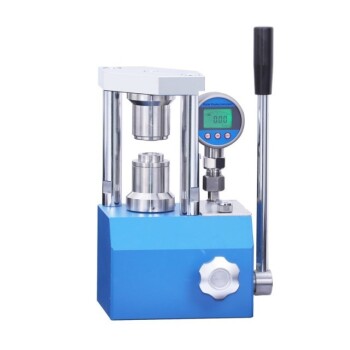
Don't let poor pellet integrity compromise your data. KINTEK specializes in comprehensive laboratory pressing solutions designed for precision research. Whether you need manual, automatic, heated, or glovebox-compatible models, our advanced hydraulic and isostatic presses ensure your XRF pellets are perfectly compacted every time.
Ready to optimize your sample preparation? Contact us today to find the ideal pressing solution for your battery research or material science laboratory. Our experts are here to help you achieve the perfect balance of durability and analytical transparency.
Related Products
- Manual Button Battery Sealing Machine for Battery Sealing
- Button Battery Sealing Machine for Button Batteries
- Lab Cylindrical Press Mold for Laboratory Use
- Warm Isostatic Press for Solid State Battery Research Warm Isostatic Press
- Lab Round Bidirectional Press Mold
People Also Ask
- Why is a laboratory hydraulic press or battery sealing machine essential? Ensure Coin Cell Data Integrity
- How do laboratory battery sealing machines ensure performance consistency? Master Your Lithium and LFP Battery Assembly
- Why is stable pressure control necessary when assembling SC-NCM83/PLM-3/Li batteries? Optimize Solid-State Interfaces
- How does the mechanical pressure provided by a laboratory crimper affect the performance of assembled 2032-type coin cells?
- What role does a laboratory press perform for CR2032 coin cell assembly? Ensure Precision in Battery Research