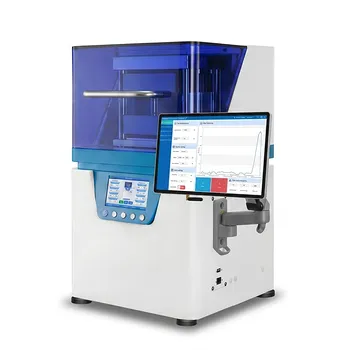
In warm isostatic pressing (WIP), a flexible material functions as a dynamic "envelope die" that surrounds the powdered workpiece. Often referred to as a jacket mold, this flexible barrier contains the powder while serving as the medium for pressure transmission. Because it is pliable rather than rigid, it allows the external pressure to be applied to the product simultaneously and evenly from all directions.
The flexible envelope die is the critical interface that ensures pressure is truly isostatic. By conforming to the changing shape of the powder during compression, it guarantees uniform density distribution throughout the final component.
The Mechanics of the Envelope Die
Functioning as a Jacket Mold
In this process, the flexible material acts as a jacket mold that encapsulates the powder. Unlike a rigid die that forces material into a shape, this jacket supports the powder while allowing for movement.
The mold holds the loose powder in the desired pre-form shape before pressure is applied. This flexibility is essential for accommodating the reduction in volume that occurs as the powder is compressed.
Ensuring Uniform Pressure Transmission
The primary role of the flexible envelope is to facilitate multi-directional force. When the system is pressurized, the flexible material does not resist the force; instead, it transmits it directly to the powder.
Because the material is not rigid, it ensures that the pressure is applied equally to every surface of the part. This prevents the pressure gradients often seen in rigid die compaction, where friction at the die walls can cause uneven densification.
Conforming to Material Shape
As the pressure increases, the powder compacts and the part shrinks. The flexible envelope die conforms to the powder’s shape in real-time.
This continuous contact ensures that there are no gaps between the mold and the material. Consequently, the final product achieves a highly consistent and uniform density distribution, regardless of the part's geometric complexity.
Operational Considerations and Trade-offs
Dimensional Control Challenges
While flexible dies excel at density uniformity, they offer less precision regarding external dimensions than rigid dies. Because the mold moves and compresses, the final surface finish and tolerances may vary.
Material Lifespan
The flexible material is subjected to repeated cycles of compression and thermal stress. Over time, the elasticity of the jacket mold may degrade, requiring monitoring to prevent rupture or deformation that could affect the workpiece.
Making the Right Choice for Your Goal
To determine if a flexible envelope die is the correct approach for your manufacturing needs, consider your specific priorities.
- If your primary focus is internal structural integrity: The flexible die is superior, as the uniform pressure distribution minimizes internal density gradients and voids.
- If your primary focus is complex geometry: This method allows for the consolidation of shapes that would be impossible to eject from a rigid die.
The effective use of a flexible envelope die transforms pressure into a tool for achieving exceptional material consistency.
Summary Table:
| Feature | Flexible Envelope Die (Jacket Mold) | Rigid Die Compaction |
|---|---|---|
| Pressure Transmission | Multi-directional & Isostatic | Unidirectional or Bi-directional |
| Density Distribution | Highly Uniform | Often Uneven (Wall Friction) |
| Shape Capability | Complex & Near-net Shapes | Simple Geometries Only |
| Dimensional Precision | Lower (due to compression) | Higher (fixed cavity) |
| Volume Change | Conforms to shrinkage | Rigid (no shrinkage during pressing) |
Optimize Your Material Research with KINTEK Pressing Solutions
Achieve unmatched material consistency and density uniformity with KINTEK’s advanced pressing technology. As specialists in comprehensive laboratory pressing solutions, we provide the tools you need for success in battery research and material science, including:
- Cold and Warm Isostatic Presses (CIP/WIP): Ideal for complex geometries and uniform densification.
- Versatile Lab Presses: Manual, automatic, heated, multifunctional, and glovebox-compatible models.
Ready to eliminate internal voids and master complex shapes? Contact KINTEK today to discover how our high-precision isostatic presses can elevate your laboratory’s efficiency and performance.
Related Products
- Warm Isostatic Press for Solid State Battery Research Warm Isostatic Press
- Split Warm Isostatic Lab Press 200 Ton Powder Compaction Chamber for Battery Research and Material Science
- Split Hot Isostatic Pressing Machine 150 Ton Laboratory Heated Isostatic Press
- Electric Isostatic Pressing Machine 40 Tons Automatic Laboratory Powder Compacting Press
- Lab Isostatic Pressing Molds for Isostatic Molding
People Also Ask
- Why must composite cathodes be sealed in vacuum lamination bags for WIP? Ensure Battery Stability and Density
- How do sacrificial volume materials (SVM) maintain microchannels in isostatic pressing? Ensure Structural Integrity
- What is the function of elastic molds in warm isostatic pressing? Achieve Uniform Density in Composite Particles
- What is the mechanism of a Warm Isostatic Press (WIP) on cheese? Master Cold Pasteurization for Superior Safety
- How does Warm Isostatic Pressing differ from traditional pressing methods? Unlock Uniform Density for Complex Parts