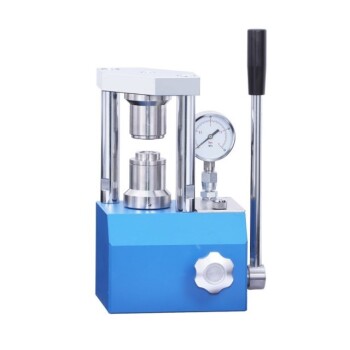
In the assembly of all-solid-state lithium metal batteries, a laboratory press machine functions as the critical mechanism for establishing physical continuity between rigid components. It applies precise, uniform mechanical pressure to the battery stack—comprising the solid electrolyte, cathode, and anode—to force these solid layers into intimate contact, a process that is unnecessary in traditional liquid-based batteries.
Core Takeaway Solid-state electrolytes lack the ability to naturally "wet" or flow into electrode surfaces like liquids do. A laboratory press is essential to mechanically force these materials together, eliminating microscopic voids and significantly reducing interfacial impedance to ensure the battery functions safely and efficiently.
Overcoming the Solid-Solid Interface Challenge
The Necessity of Mechanical Force
In liquid batteries, the electrolyte naturally fills pores and creates contact. In solid-state batteries, the interface is solid-to-solid, meaning inherent surface roughness creates voids.
A laboratory press applies controlled force to compress the anode, solid electrolyte, and cathode. This compression is required to achieve atomic-level physical contact between the layers.
Reducing Interfacial Impedance
The primary objective of using the press is to lower interfacial impedance (resistance).
Without sufficient pressure, the gaps between the electrolyte and electrodes act as barriers to electron and ion flow. The press eliminates these gaps, facilitating efficient charge transfer.
Critical Impacts on Electrochemical Performance
Ensuring Uniform Ion Flux
When pressure is applied uniformly across the active area, it ensures a consistent flux of lithium ions.
This prevents localized current concentration, which occurs when ions are forced through limited contact points. Uniform flux is vital for stable charging and discharging.
Suppressing Lithium Dendrites
One of the most significant risks in lithium metal batteries is the growth of dendrites—needle-like structures that can short-circuit the cell.
Dendrites often form in areas of poor contact or uneven current distribution. By creating a tight, void-free interface, the press helps suppress dendrite growth and prevents localized overheating.
Structural Integrity and Sealing
Beyond the chemical interface, the press ensures the mechanical integrity of the cell, whether it is a coin cell or a pouch cell.
It provides the force necessary to seal the casing and components tightly. This prevents the physical separation or peeling of interfaces during the repeated expansion and contraction of the battery's cycle life.
The Risks of Improper Pressure Control
The Consequence of Overpressure
While high pressure is needed, excessive force can be destructive.
Localized overpressure can fracture the brittle solid electrolyte material or damage the electrode structure. This physical damage compromises the cell immediately, rendering the test invalid.
The Failure of Insufficient Pressure
If the pressure is too low, the solid electrolyte will not make "conformal" contact with the electrodes.
This results in high resistance and "dead spots" where no reaction occurs. This leads to poor rate performance and drastically shortened cycle life.
Making the Right Choice for Your Goal
To maximize the utility of your laboratory press in solid-state battery development, focus on the specific needs of your prototype stage.
- If your primary focus is Electrochemical Performance: Prioritize a press with high precision and uniformity to minimize interfacial impedance and suppress dendrite formation.
- If your primary focus is Prototype Durability: Ensure the press can deliver repeatable, stable pressure to prevent layer delamination during long-term cycling tests.
The laboratory press is not just an assembly tool; it is an active variable in defining the internal resistance and safety profile of your solid-state battery.
Summary Table:
| Process Objective | Role of Laboratory Press | Impact on Performance |
|---|---|---|
| Interface Contact | Eliminates microscopic voids between solid layers | Reduces interfacial impedance & resistance |
| Ion Transfer | Ensures uniform mechanical force across active areas | Promotes consistent ion flux & stable cycling |
| Safety Control | Creates tight, void-free solid-to-solid contact | Suppresses lithium dendrite growth |
| Structural Integrity | Seals casings and prevents layer delamination | Increases cycle life and mechanical durability |
Elevate Your Battery Research with KINTEK Precision
At KINTEK, we understand that the future of energy depends on the perfect interface. We specialize in comprehensive laboratory pressing solutions tailored for battery research, including:
- Manual & Automatic Presses for rapid prototyping.
- Heated & Multifunctional Models for advanced material synthesis.
- Glovebox-Compatible Designs for air-sensitive lithium metal handling.
- Cold & Warm Isostatic Presses (CIP/WIP) for superior density and uniformity.
Don't let interfacial impedance hinder your innovation. Contact KINTEK today to find the ideal press for your solid-state assembly and ensure the structural integrity of your next-generation cells.
References
- Yunlong Deng, Kai Xi. LiX Zeolites Hybrid Polyethylene Oxide‐Based Polymer Electrolyte for Practical Lithium Metal Batteries. DOI: 10.1002/cnl2.70037
This article is also based on technical information from Kintek Solution Knowledge Base .
Related Products
- Warm Isostatic Press for Solid State Battery Research Warm Isostatic Press
- Button Battery Sealing Press Machine for Lab
- Laboratory Hydraulic Press Lab Pellet Press Button Battery Press
- Lab Infrared Press Mold for Laboratory Applications
- Carbide Lab Press Mold for Laboratory Sample Preparation
People Also Ask
- Why must composite cathodes be sealed in vacuum lamination bags for WIP? Ensure Battery Stability and Density
- How do sacrificial volume materials (SVM) maintain microchannels in isostatic pressing? Ensure Structural Integrity
- What is the function of elastic molds in warm isostatic pressing? Achieve Uniform Density in Composite Particles
- What is the process involved in warm isostatic pressing? Mastering Uniform Density with WIP Technology
- What is the mechanism of a Warm Isostatic Press (WIP) on cheese? Master Cold Pasteurization for Superior Safety