
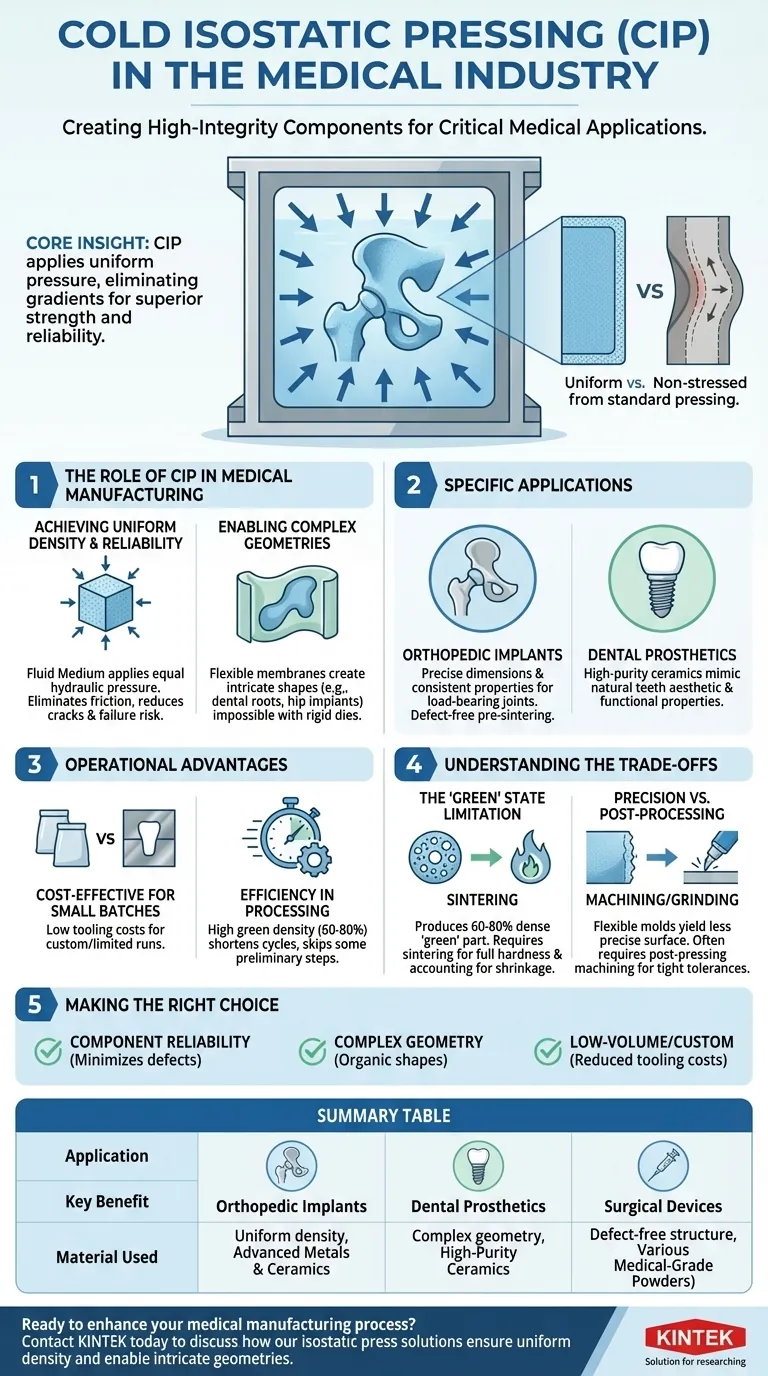
Cold Isostatic Pressing (CIP) is a critical manufacturing process utilized in the medical industry to create high-integrity components where failure is not an option. It is specifically applied to the production of orthopedic implants, dental prosthetics, and surgical devices by consolidating powdered materials—such as advanced ceramics and metals—into complex shapes with uniform density.
Core Insight: Unlike standard pressing methods that create internal stress gradients, CIP applies pressure uniformly from all directions. This creates a "green" part with consistent internal structure, ensuring that the final sintered medical device possesses the superior strength and reliability required for integration into the human body.
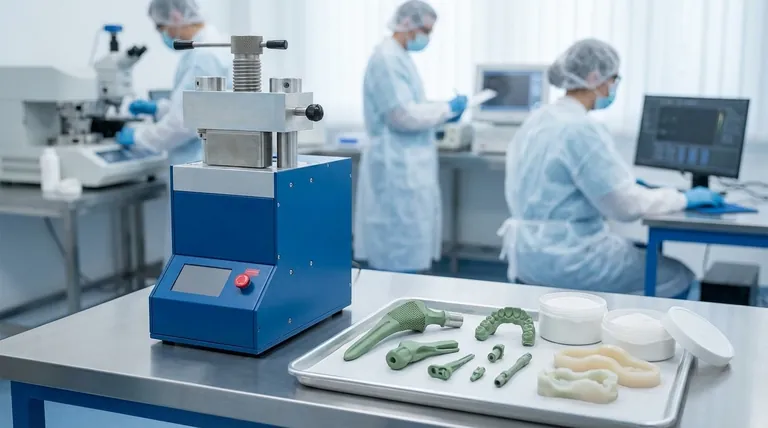
The Role of CIP in Medical Manufacturing
Achieving Uniform Density and Reliability
In medical applications, the structural integrity of a part is paramount. CIP immerses a powdered material in a high-pressure fluid medium, applying equal hydraulic pressure from every side.
This eliminates the friction and pressure gradients common in uniaxial pressing. The result is a component with uniform density throughout, which significantly reduces the risk of cracks, distortion, or material failure under stress.
Enabling Complex Geometries
Human anatomy is rarely linear or simple. Standard rigid dies struggle with the organic shapes required for medical devices.
CIP utilizes flexible membranes or hermetic containers to hold the powder. This flexibility allows manufacturers to produce intricate, complex shapes—such as the curvature of a hip implant or the fine details of a dental root—that would be impossible or prohibitively expensive with other methods.
Specific Applications
Orthopedic Implants
CIP is extensively used to manufacture orthopedic components, such as hip and knee replacements.
These parts require precise dimensions and consistent material properties to withstand the mechanical loads of the human body. CIP ensures the pre-sintered material is free of defects that could propagate fractures later.
Dental Prosthetics
The dental industry relies on CIP for creating implants and prosthetics.
Material quality is critical in this field to ensure biocompatibility and longevity. CIP allows for the processing of high-purity ceramics that mimic the aesthetic and functional properties of natural teeth.
Operational Advantages for Medical Production
Cost-Effective for Small Batches
Medical manufacturing often involves custom sizes or limited production runs rather than mass commoditization.
CIP is highly cost-effective for these scenarios because the "molds" are often simple flexible bags. This avoids the high capital investment required for complex, rigid steel dies used in other pressing technologies.
Efficiency in Processing
References indicate that CIP can shorten processing cycle times.
By achieving high green density (60% to 80% of theoretical density) immediately, CIP eliminates the need for certain preliminary steps, such as binder burnout or extensive drying, streamlining the path to the sintering furnace.
Understanding the Trade-offs
While CIP offers superior material properties, it is essential to understand its limitations within the manufacturing workflow.
The "Green" State Limitation
CIP does not produce a finished product. It creates a "green" part that is typically 60% to 80% dense.
This part must subsequently undergo sintering (heating) to achieve full hardness and final density. Manufacturers must account for shrinkage during sintering when designing the initial molds.
Precision vs. Post-Processing
While CIP is excellent for complex shapes, the flexible mold means the outer surface finish of the green part is not as precise as a die-pressed part.
Consequently, medical components produced via CIP often require machining or grinding after the pressing stage (or after sintering) to achieve the extremely tight tolerances required for surgical implementation.
Making the Right Choice for Your Goal
If you are evaluating CIP for a medical application, consider your specific production requirements:
- If your primary focus is component reliability: CIP is the superior choice for minimizing internal defects and ensuring uniform strength in critical load-bearing implants.
- If your primary focus is complex geometry: CIP allows you to form organic, non-symmetrical shapes that rigid tooling cannot accommodate.
- If your primary focus is low-volume or custom production: CIP offers a lower barrier to entry due to significantly reduced tooling costs compared to uniaxial pressing.
CIP serves as the foundational step in medical manufacturing, transforming raw powder into a reliable, defect-free structure ready for final finishing.
Summary Table:
| Application | Key Benefit | Material Used |
|---|---|---|
| Orthopedic Implants | Uniform density for load-bearing reliability | Advanced Metals & Ceramics |
| Dental Prosthetics | Complex geometry for biocompatible shapes | High-Purity Ceramics |
| Surgical Devices | Defect-free structure for critical applications | Various Medical-Grade Powders |
Ready to enhance your medical manufacturing process with reliable, complex components?
At KINTEK, we specialize in advanced lab press machines, including isostatic presses, designed to meet the stringent demands of the medical industry. Our equipment ensures uniform density and enables the production of intricate geometries for orthopedic and dental applications.
Contact us today via our [#ContactForm] to discuss how our solutions can bring superior strength and cost-efficiency to your medical device production.
Visual Guide
Related Products
- Electric Lab Cold Isostatic Press CIP Machine
- Automatic Lab Cold Isostatic Pressing CIP Machine
- Electric Split Lab Cold Isostatic Pressing CIP Machine
- Manual Cold Isostatic Pressing CIP Machine Pellet Press
- Lab Isostatic Pressing Molds for Isostatic Molding
People Also Ask
- What are the applications of electric lab cold isostatic presses in research settings? Advance Material R&D with High-Pressure CIPs
- What role do electric lab cold isostatic presses play in industrial contexts? Bridge R&D and Manufacturing with Precision
- How does electrical Cold Isostatic Pressing (CIP) contribute to cost savings? Unlock Efficiency and Reduce Expenses
- What are some research applications of electric lab CIPs? Unlock Uniform Powder Densification for Advanced Materials
- What are the characteristics of standard off-the-shelf electric lab CIP solutions? Achieve Immediate, Cost-Effective Processing









