
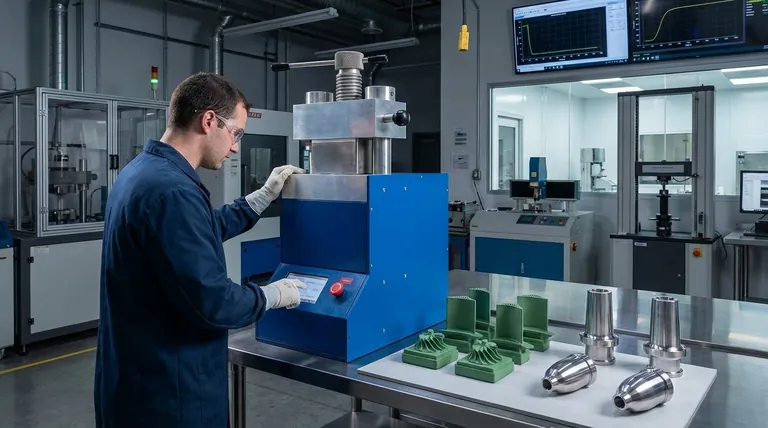
In the aerospace industry, Cold Isostatic Pressing (CIP) is primarily utilized to manufacture high-integrity preforms and components from powdered materials like advanced ceramics and composites. By submerging a sealed elastomer mold into a high-pressure fluid, manufacturers apply uniform force from all directions, creating parts with consistent density that can withstand the extreme temperatures and mechanical stresses inherent to flight.
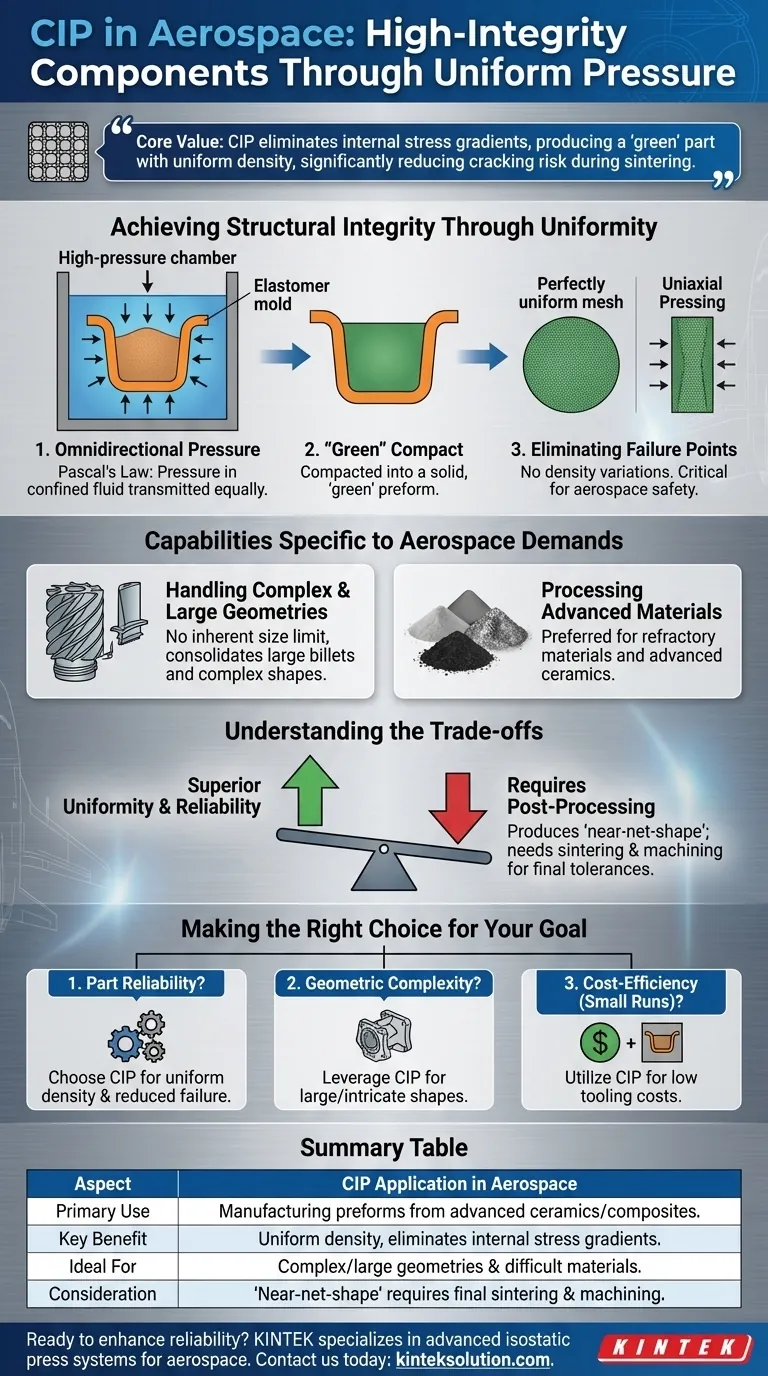
The core value of CIP in aerospace is its ability to eliminate the internal stress gradients common in other pressing methods. It produces a "green" part with uniform density, significantly reducing the risk of cracking or distortion during the final sintering phase.
Achieving Structural Integrity Through Uniformity
The Mechanics of Omnidirectional Pressure
CIP functions based on Pascal’s law, where pressure applied to a confined fluid is transmitted equally in all directions.
In this process, metal or ceramic powder is placed into a flexible elastomer mold and submerged in a liquid medium, typically water or oil.
High hydraulic pressure is then applied uniformly to the mold, compacting the powder into a solid, homogeneous mass known as a "green" compact.
Eliminating Failure Points
Unlike uniaxial pressing, which compresses material from a single direction, CIP ensures there are no variations in density within the part.
This uniformity is critical for aerospace safety, as density gradients can lead to structural weaknesses or unpredictable failure rates under load.
The process yields parts with 60% to 80% of their theoretical density, providing a stable foundation for the subsequent sintering (firing) process.
Capabilities Specific to Aerospace Demands
Handling Complex and Large Geometries
Aerospace applications often require components that are too large or too structurally complex for standard mechanical presses.
CIP has no inherent size limitation other than the dimensions of the pressure chamber, allowing for the consolidation of very large billets or preforms.
It effectively produces parts with large aspect ratios and intricate shapes without the friction effects that cause density variations in rigid die pressing.
Processing Advanced Materials
The industry relies on refractory materials, cemented carbides, and advanced ceramics to resist extreme environments.
CIP is the preferred method for compacting these difficult-to-handle powders into viable shapes.
By minimizing distortion and cracking during the forming stage, CIP ensures these expensive materials perform reliably in high-temperature and high-pressure aerospace applications.
Understanding the Trade-offs
The Necessity of Post-Processing
CIP is a pre-forming process; it does not produce a finished, flight-ready component immediately.
The resulting "green" parts require sintering (heating) to achieve full strength and final material properties.
Precision and Tolerances
While CIP provides excellent material uniformity, it is generally used for parts that do not require high precision in the as-pressed state.
Because the flexible mold compresses, the final dimensions can vary slightly.
Consequently, CIP components usually serve as "near-net-shape" preforms that require machining or grinding after sintering to achieve exact aerospace tolerances.
Making the Right Choice for Your Goal
While CIP offers superior material properties, it is essential to align the process with your specific manufacturing constraints.
- If your primary focus is part reliability: Choose CIP to ensure uniform density and minimize failure rates in safety-critical ceramic or composite components.
- If your primary focus is geometric complexity: Leverage CIP to produce large or intricate shapes that are impossible to form with uniaxial die pressing.
- If your primary focus is cost-efficiency for small runs: Utilize CIP for its low tooling costs, as the elastomer molds are significantly cheaper than rigid metal dies.
CIP bridges the gap between raw powdered material and the high-performance, defect-free structure required for modern aerospace engineering.
Summary Table:
| Aspect | CIP Application in Aerospace |
|---|---|
| Primary Use | Manufacturing preforms and components from advanced ceramics and composites. |
| Key Benefit | Uniform density, eliminating internal stress gradients and reducing failure risk. |
| Ideal For | Complex/large geometries and difficult-to-handle refractory materials. |
| Consideration | Produces 'near-net-shape' parts requiring final sintering and machining. |
Ready to enhance the reliability of your aerospace components?
KINTEK specializes in advanced lab press machines, including isostatic press systems, designed to meet the rigorous demands of aerospace manufacturing. Our technology ensures the uniform density and structural integrity critical for your safety-critical parts.
Contact us today to discuss how our isostatic press solutions can help you achieve superior material performance and reliability.
Visual Guide
Related Products
- Electric Lab Cold Isostatic Press CIP Machine
- Automatic Lab Cold Isostatic Pressing CIP Machine
- Electric Split Lab Cold Isostatic Pressing CIP Machine
- Manual Cold Isostatic Pressing CIP Machine Pellet Press
- Lab Isostatic Pressing Molds for Isostatic Molding
People Also Ask
- What are the applications of electric lab cold isostatic presses in research settings? Advance Material R&D with High-Pressure CIPs
- What role do electric lab cold isostatic presses play in industrial contexts? Bridge R&D and Manufacturing with Precision
- How does electrical Cold Isostatic Pressing (CIP) contribute to cost savings? Unlock Efficiency and Reduce Expenses
- What are some research applications of electric lab CIPs? Unlock Uniform Powder Densification for Advanced Materials
- What are the characteristics of standard off-the-shelf electric lab CIP solutions? Achieve Immediate, Cost-Effective Processing








