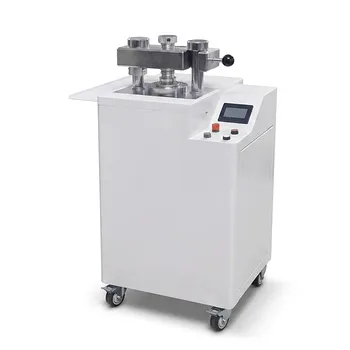
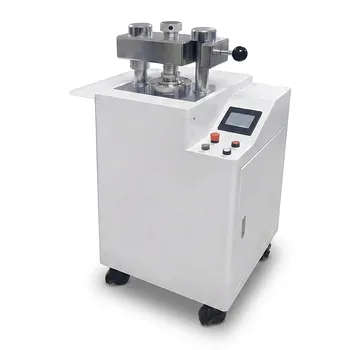
To calculate the required pressing force for a KBr pellet, you must multiply the surface area of the pellet's face by the target pressure (typically between 8,000 and 10,000 psi). Because the area changes based on the square of the diameter, simply changing the die size without recalculating the force can result in damaged tools or poor-quality pellets.
Core Takeaway The force required to form a pellet is not a fixed number; it scales drastically with the pellet's diameter. To maintain a consistent internal pressure of 10,000 psi, a 1/2-inch pellet requires approximately 1 ton of force, whereas a 1/4-inch pellet requires only 0.25 tons.
The Physics of Pellet Formation
Defining Target Pressure
The goal of pressing KBr is to fuse the powder into a transparent solid. This requires a specific internal pressure, often cited as 8,000 to 10,000 psi (pounds per square inch).
The Formula
To find the load you must set on your hydraulic press, use this relationship:
Force (Load) = Target Pressure × Pellet Surface Area
Why Diameter Matters
The surface area is calculated using the formula for a circle ($\pi \times r^2$). Small changes in diameter lead to large changes in area. Therefore, the force required drops significantly as the pellet gets smaller.
Calculating for Standard Diameters
The 1/2 Inch (12.7 mm) Standard
This is a common pellet size. A 1/2-inch diameter pellet has a surface area of approximately 0.196 square inches.
To achieve an internal pressure of 10,000 psi, you calculate: 10,000 psi × 0.196 sq in = 1,960 lbs
This is approximately 1 ton of total force.
The 1/4 Inch (6 mm) Micro-Pellet
If you switch to a smaller 1/4-inch die, the surface area drops to roughly 0.049 square inches (one-fourth of the 1/2-inch area).
To achieve that same 10,000 psi pressure: 10,000 psi × 0.049 sq in = 490 lbs
This is approximately 0.25 tons. If you were to accidentally apply the 1-ton load used for the larger pellet, you would subject this small pellet to 40,000 psi, potentially damaging the die.
Critical Factors Beyond Force
The Role of Vacuum
Force alone does not guarantee a transparent pellet. Before pressing, you must apply a vacuum (several mm Hg) to the die set. This removes air and moisture that would otherwise be trapped, causing cloudiness or fractures.
Dwell Time
Once the target force is reached, it is not instantaneous. The pressure should be maintained for several minutes. This allows the KBr crystals to flow and fuse completely.
Protocol Variations
While the calculation logic (Force = Pressure × Area) remains constant, specific laboratory protocols may differ on the "target pressure."
Some procedures call for total loads as high as 8 tons for standard pellets to ensure maximum density. However, you must always verify the maximum load rating of your specific die set before exceeding the calculated values found in the primary reference.
Making the Right Choice for Your Goal
To ensure your KBr pellets are clear and your equipment remains safe, apply these guidelines:
- If your primary focus is Equipment Safety: Always calculate the force based on the die's area; never apply a "standard" force (e.g., 8 tons) to a smaller diameter die (e.g., 1/4 inch).
- If your primary focus is Pellet Transparency: Ensure you apply a vacuum before pressing and maintain the calculated force for several minutes to allow the material to settle.
- If your primary focus is Consistency: Standardize your target pressure (psi); if you move from a large die to a small die, reduce the applied tonnage proportionally to keep the psi constant.
Calculate the force based on the specific area of your die to achieve the target pressure without crushing your tools.
Summary Table:
| Pellet Diameter | Surface Area (sq in) | Target Pressure (psi) | Required Force (Tons) |
|---|---|---|---|
| 1/2 Inch (12.7 mm) | ~0.196 | 10,000 | ~1.0 Ton |
| 1/4 Inch (6.0 mm) | ~0.049 | 10,000 | ~0.25 Tons |
| 1/8 Inch (3.0 mm) | ~0.012 | 10,000 | ~0.06 Tons |
Precision Pressing Solutions for Your Laboratory
At KINTEK, we specialize in comprehensive laboratory pressing solutions designed for precision and durability. Whether you are conducting battery research or spectroscopic analysis, our range of manual, automatic, heated, and multifunctional presses—including specialized cold and warm isostatic models—ensures you achieve perfect pellet density every time.
Why partner with KINTEK?
- Glovebox Compatibility: Optimized designs for sensitive research environments.
- Technical Expertise: We help you match the right tonnage and die set to your specific material needs.
- Comprehensive Range: From micro-pellets to large-scale industrial samples.
Don't risk damaging your equipment or compromising your data. Contact KINTEK today to find the ideal pressing solution for your lab!
Related Products
- Laboratory Hydraulic Press 2T Lab Pellet Press for KBR FTIR
- XRF KBR Plastic Ring Lab Powder Pellet Pressing Mold for FTIR
- Laboratory Hydraulic Pellet Press for XRF KBR FTIR Lab Press
- Automatic Laboratory Hydraulic Press for XRF and KBR Pellet Pressing
- Lab Infrared Press Mold for No Demolding
People Also Ask
- What is the role of a laboratory pressure machine and KBr in FTIR? Master Sample Preparation for Flame Retardants
- What is the role of a laboratory hydraulic press in high-loading NCM811 cathode prep for solid-state batteries?
- Why is a laboratory hydraulic press necessary for sample preparation? Precise Pelleting for Spiro Heterocyclic Analysis
- What role does a laboratory hydraulic press play in reaction pellets? Optimizing Lunar Soil and Metal Fuel Density
- What role does a laboratory hydraulic press play in molding polymer composites? Ensure Specimen Integrity & Precision